









Ladakh: Lock In the Gains, Keep the Democratic Process Moving
The debate over Ladakh has reached a point where the question is no longer simply what should be demanded, but how the gains already achieved should be secured while the remaining issues are negotiated.
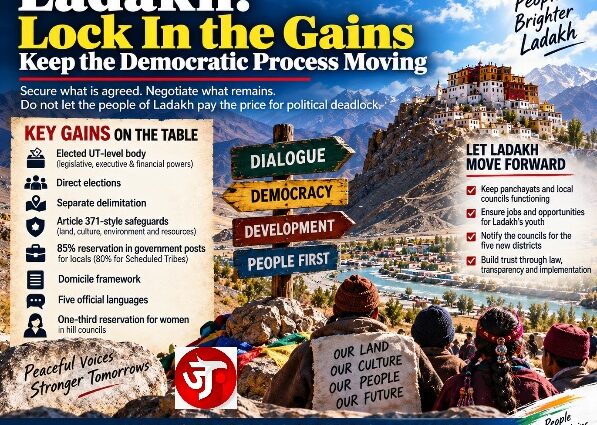
The Centre has indicated movement on several significant demands: an elected Union Territory-level body with legislative, executive and financial powers; direct elections; separate delimitation; constitutional safeguards on the lines of Article 371 for land, culture, environment and resources; reservations for locals in government employment; a domicile framework; recognition of five official languages; and greater representation for women in the hill councils.
These are not insignificant concessions. They represent the foundations of a more representative and protected political structure for Ladakh.
The sensible course, therefore, is to lock in what has already been agreed while continuing the negotiations over what remains unresolved.
The real question is the distribution of power
The most difficult issue now is institutional. Ladakh already has the Leh and Kargil Autonomous Hill Development Councils. If a new territorial legislature is created, there must be a precise division of authority between the two levels.
Who controls land? Forests? Local administration? Development? Recruitment? Natural resources?
These powers cannot simply be divided through political rhetoric. They must be clearly allocated in law.
A constitutional settlement becomes meaningful only when citizens know which elected institution is responsible for what. Otherwise, two democratic bodies can end up competing for the same authority, producing precisely the administrative paralysis that decentralisation is supposed to prevent.
The Sixth Schedule versus Article 371
The demand for Sixth Schedule protection has understandable appeal because it offers a familiar model of tribal autonomy.
But Ladakh’s institutional circumstances are different.
The Sixth Schedule primarily creates autonomous district councils. Ladakh already has hill councils. A model combining a directly elected territorial legislature with strong constitutional safeguards for land, culture, environment and resources would create a different structure.
Autonomous councils and a territorial legislature are not the same thing.
A specially created Article 371-type constitutional provision could potentially provide a more durable protection than ordinary legislation. The question should therefore be not which demand sounds more powerful, but which constitutional architecture best protects Ladakh while giving its people genuine democratic representation.
But protest cannot simply be dismissed as obstruction
There is also a legitimate warning against allowing unresolved negotiations to freeze everyday governance.
If recruitment is delayed, local elections are stalled, panchayat processes are disrupted and promised councils for areas such as Zanskar, Drass, Sham, Nubra and Changthang remain pending, the cost is ultimately borne by ordinary citizens.
Young people waiting for government employment do not experience constitutional negotiations as abstract federal theory. They experience them as another postponed opportunity.
Villages waiting for functioning local institutions do not benefit from political deadlock.
Yet there is an equally important counterpoint: the persistence of protest reflects a serious problem of trust.
Since Ladakh became a Union Territory without its own legislative assembly, many people have been concerned not merely about promises, but about the actual powers that will eventually be transferred and the extent to which those protections will be legally enforceable.
Therefore, telling people simply to stop protesting is not enough.
Trust has to be built through law, transparency and implementation.
No side should claim an exclusive mandate
The political argument also needs balance.
Representative organisations such as the Leh Apex Body and Kargil Democratic Alliance do not possess a constitutional veto over Ladakh’s future. Neither coalition was elected as a territorial legislature.
But the absence of a formal veto does not make their concerns irrelevant.
Equally, administrative authority cannot permanently substitute for democratic legitimacy.
The eventual settlement will have to command enough confidence among Ladakh’s people to survive beyond the negotiating room. That requires more than declaring that sufficient concessions have already been made.
The danger of an all-or-nothing approach
The greatest danger now is allowing the entire process to become hostage to the principle that nothing moves until everything is settled.
That approach gives unresolved questions disproportionate power.
A better model is sequential:
Secure the agreed gains.
Legislate the new institutions.
Define the division of powers.
Continue negotiating the unresolved demands.
Keep local democracy functioning throughout.
There is no contradiction between demanding stronger safeguards and allowing panchayats, recruitment and local governance to proceed. In fact, keeping democratic institutions functioning strengthens the very political system that Ladakh is seeking to protect.
The test is implementation
The next phase should therefore be judged by concrete outcomes rather than competing claims of victory.
Will the elected territorial body actually be created?
Will direct elections and delimitation be legally guaranteed?
Will Article 371-style safeguards become enforceable constitutional protection?
Will the division of powers between the territorial legislature and hill councils be made explicit?
Will recruitment and local-government processes continue?
And will the promised new district councils move from announcement to notification and implementation?
These are the questions that matter.
The choice facing Ladakh is not protest versus progress.
Nor is it Delhi versus Ladakh.
The real choice is between institutional progress with continuing negotiation and a prolonged political deadlock in which ordinary citizens become collateral damage.
Ladakh should not have to abandon its legitimate demands in order to move forward. But neither should every aspect of governance be frozen until the final clause of the settlement is resolved.
Lock in the gains. Protect what matters. Define the powers clearly. Keep democracy moving.
Because constitutional protection means little if governance itself remains permanently suspended.
JANPATH NEWS NETWORK (JNN)
Independent. Fearless. On the People’s Path.