








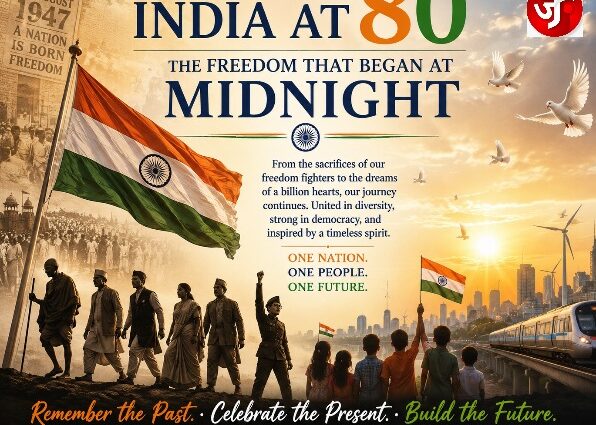
At the stroke of midnight on 15 August 1947, something happened that generations of Indians had waited to witness.
On August 15, 1947, an empire loosened its grip. A flag rose. A country became free. But freedom did not arrive alone. It came carrying refugees, grief, hunger, uncertainty and an enormous question: what would India do with the freedom it had fought so hard to obtain?
Eighty years later, that question has not disappeared: On the night of 14 August 1947, India was holding its breath. In Delhi, preparations were underway for the birth of a new nation. The British were preparing to leave, leaders gathered in the Constituent Assembly, and streets filled with anticipation.
But elsewhere, there was little room for celebration. Partition had created two new dominions, India and Pakistan, and one of the largest and most traumatic migrations in modern history was already underway. Families were abandoning homes they had occupied for generations. Trains carried terrified passengers across a newly created border. Some arrived filled with refugees. Some arrived carrying the dead. Punjab was burning. Bengal was bleeding. People who had lived beside one another for decades suddenly found themselves on the wrong side of a line drawn across a map.
This was the extraordinary contradiction of Indian independence: a nation was being born while millions were losing the places they called home. And still, at midnight, India chose to celebrate freedom. Not because the suffering had disappeared, but because after nearly two centuries of colonial domination, sovereignty had finally returned to the people.
To understand what that freedom meant, we have to remember what India had been freed from. British rule transformed India’s economy, politics and society in ways that profoundly served the imperial system. India’s resources and markets were integrated into an empire whose priorities were ultimately determined elsewhere. Traditional industries suffered, Indian producers faced competition and policies shaped by imperial interests, and wealth flowed through colonial structures.
When famine struck, the consequences could be catastrophic. The Bengal famine of 1943 remains one of the darkest chapters of late colonial India, with millions dying amid food shortages, wartime disruption, inflation, administrative failures and the unequal distribution of available supplies.
There was also the question of political power. Indians were subjects of an empire. They did not possess full sovereign control over their own government. Race mattered. Class mattered. Where you were born mattered. Who ruled you was decided elsewhere. And resistance was often met with imprisonment, censorship and violence. The massacre at Jallianwala Bagh in 1919 became a terrible symbol of what colonial power could mean when confronted by dissent.
But India did not respond with silence. It responded with resistance where farmers resisted, workers fought, students marched, women entered the struggle, revolutionaries took up arms, while lawyers abandoned careers. Ordinary people broke colonial laws.
Gandhi transformed non-violent resistance into a mass political weapon. Nehru, Patel, Ambedkar, Maulana Azad, Sarojini Naidu, Subhas Chandra Bose and countless others shaped different strands of the struggle. They did not always agree. Their visions of India were sometimes sharply different. But beneath the famous names stood millions of people whose stories never entered the textbooks, people who marched, protested, went to prison, lost livelihoods, endured violence and refused to accept that their country should forever belong to someone else.
Then came midnight. Inside the Constituent Assembly, Jawaharlal Nehru spoke of India’s “tryst with destiny.” The words have survived generations, but the deeper significance of that night was the transfer of sovereignty. For the first time, an independent India had to answer to its own people.
And almost immediately, the new country confronted a terrifying list of problems: poverty, illiteracy, food shortages, disease, displacement, communal violence, a weak industrial base, deep caste discrimination, enormous regional differences and hundreds of princely states requiring integration. India had inherited the enormous task of building a modern nation from extraordinarily difficult circumstances.
Yet it made a remarkable decision. It would not postpone democracy until it became rich. It would not wait until everyone was educated. It would not decide that poor people were not ready to vote. India chose universal adult franchise. One person, one vote. For a country emerging from colonial rule, with hundreds of millions of people and staggering levels of poverty and illiteracy, it was an extraordinary act of faith in its people.
The Constitution gave that faith a framework. Equality before the law, fundamental rights, universal suffrage, an independent judiciary, federal government and parliamentary democracy became the foundations of the new republic. Dr B. R. Ambedkar understood the danger clearly: political democracy could not survive indefinitely if social and economic inequality remained overwhelming. The Constitution therefore became more than a legal document. It became an argument about what India ought to become.
The India of 1947 was overwhelmingly poor. The India of 2026 is vastly different. Agricultural production was transformed. Industries expanded. Roads, railways, dams, ports and institutions multiplied. Literacy rose dramatically, life expectancy increased, universities and research institutions expanded, and a new middle class emerged. Indian businesses became global. Indian doctors, engineers, scientists, artists and entrepreneurs began working across the world.
And then came technology, altering the country’s imagination of itself. India developed nuclear capability, built satellites, launched missions to Mars and reached the Moon. Its digital infrastructure has transformed everyday life in ways earlier generations could scarcely have imagined. A small shopkeeper can receive a digital payment in seconds. A student can access information from a village that once required travelling to a distant city. A country once struggling to build basic industrial capacity now possesses sophisticated capabilities in space, pharmaceuticals, information technology, engineering and telecommunications.
India today is one of the world’s largest economies and an increasingly consequential power. Its voice carries further in international affairs. Its companies operate globally. Its scientists and engineers contribute to some of the world’s most ambitious technological projects. Its young population represents an enormous reservoir of energy, talent and possibility.
That journey deserves recognition. It was not inevitable. It was built by generations.
But this is where the story of Independence Day becomes uncomfortable, and perhaps more meaningful: A country can become richer without becoming equal. It can become more powerful without becoming more just. It can build extraordinary technology while some citizens still struggle for extraordinarily ordinary things.
A rocket can travel into space while a child sits in a classroom without a functioning toilet. A city can boast luxury towers while workers who build them live precariously. A digital economy can move billions of transactions in seconds while millions of families remain one medical emergency away from financial disaster. A young woman can become a scientist, pilot, entrepreneur or minister while another girl somewhere in the same country still fights for the right to attend school safely.
India has world-class hospitals, but there are also people who cannot afford basic healthcare. India has elite universities, but there are classrooms where children still lack teachers, infrastructure or adequate learning conditions. India produces extraordinary wealth, while many workers remain one missed wage packet away from crisis.
This does not mean India has failed. It means India has more work to do.
Independence cannot be measured only by economic growth, military strength, infrastructure, technological achievement or the number of satellites launched. Freedom must eventually reach the individual. It must mean that a child can go to school without fear, that a woman can walk home safely, that a worker can demand fair treatment, that a farmer can survive a bad harvest, that a citizen can disagree with the government without becoming an enemy of the state, that minorities can live without fear, that caste does not determine dignity and that poverty does not determine destiny.
Perhaps this is where patriotism itself needs to grow up. India does not have to hate itself to examine itself. Nor does it have to silence criticism to love itself.
The India of 1947 also inherited deep inequality, caste discrimination, communal wounds and enormous rural poverty. The India of 2026 still battles all of them. At midnight in 1947, an empire ended, freedom was born and grew wings to fly. At 80, the promise remains. India is free. But freedom, in its fullest meaning, is still being built.
JANPATH NEWS NETWORK (JNN)
Independent. Fearless. On the People’s Path.