








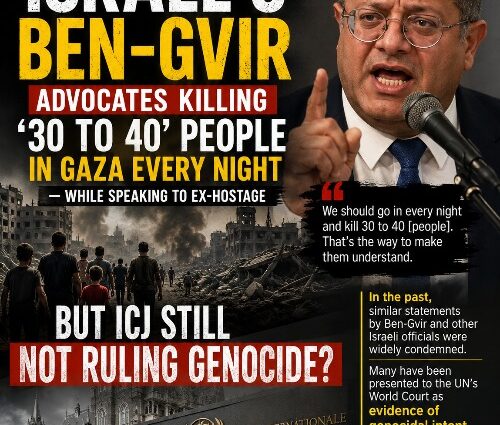
Extremist Israeli lawmaker, Ben-Gvir, in Prime Minister Benjamin Netanyahu’s coalition publicly advocated for killing “30 to 40” people in Gaza each night, comments that surfaced on Sunday (August 16, 2026) and were quickly shared by Palestinian media.
August 19, 2026: Extremist Minister of National Security Itamar Ben-Gvir made this radical statement while speaking to a former Gaza-held hostage, Rom Braslavski, on Braslavski’s podcast. The two were discussing Israel’s recovery from the Hamas attack of October 7, 2023, when Ben-Gvir criticized Israel’s recent drawdown of strikes in Gaza.
Israel has been vehemently denying any genocide, but statements like these and others uncover the diabolic intent. There was a time when images of dead Palestinian babies were dismissed as propaganda, with some claiming that the children were merely dolls covered in tomato sauce. Those who spoke out for Gaza were mocked, vilified and accused of being terrorist sympathisers. The time has come when the Gaza Geocide the world cannot ignore anymore because truth is shouting from the rooftops.
As journalists, doctors, humanitarian workers and internationally recognised figures entered or visited Gaza and the surrounding region, the scale of devastation became increasingly difficult to dismiss. UNICEF officials, WHO officials, humanitarian coordinators and other international figures described what they witnessed firsthand: destroyed homes and hospitals, displaced families, starving children, overwhelmed medical facilities and civilians living without adequate food, water or shelter. UNICEF spokesperson James Elder described Rafah as almost unrecognisable, while WHO Regional Director Hanan Balkhy said she had witnessed “the scale of devastation” firsthand, including lives and homes in ruins and a city whose health system was collapsing.
Figures such as Sigrid Kaag, the UN Senior Humanitarian and Reconstruction Coordinator for Gaza, returned from the territory describing conditions as “absolutely catastrophic”. Muhannad Hadi, the UN Humanitarian Coordinator, spoke after visiting hospitals and shelters of people lacking basic services, food and medical care. And in 2025, Cindy McCain, Executive Director of the World Food Programme, visited Gaza and reported witnessing immense destruction and desperation.
The cumulative effect was powerful. What had once been dismissed as “propaganda” became increasingly impossible to explain away when the evidence was being described by people who had actually walked through the ruins, entered the hospitals and spoken to families living through the catastrophe.
There was a shift in perception that did not happen overnight. It came through thousands of photographs, videos, testimonies from Palestinian journalists, accounts from doctors and aid workers, satellite imagery and repeated reports from international organisations.
Even people who disagreed about the legal definition of genocide could no longer easily deny the extraordinary scale of destruction and humanitarian suffering.
Also, Israel has killed hundreds of United Nations personnel in Gaza, and UN investigators have identified specific incidents in which Israeli forces appear to have deliberately targeted humanitarian workers. The scale of the deaths is unprecedented in the UN’s history. While Israel has disputed allegations that its forces deliberately target UN personnel and has accused some UNRWA employees of links to armed groups, UN bodies have repeatedly called for investigations and accountability over deaths involving Israeli fire. In one particularly disturbing March 2025 incident in Rafah, the UN Human Rights Office said an UNRWA employee appeared to have been summarily executed and concluded that the accompanying killing of clearly marked humanitarian and rescue personnel appeared to constitute deliberate targeting.
The tragedy is that it took this much suffering, this much evidence and this many witnesses for much of the world to begin confronting what Palestinians had been saying all along.
The answer from the UN Independent International Commission of Inquiry has been unequivocal. In 2025, the Commission concluded that Israel had committed genocide in Gaza, identifying four of the five acts listed under the Genocide Convention: killing members of the group, causing serious bodily or mental harm, deliberately creating conditions of life calculated to bring about the physical destruction of Palestinians in Gaza, and imposing measures intended to prevent births within the group.
Under the 1948 Genocide Convention, genocide requires certain prohibited acts to be committed with the specific intent to destroy, in whole or in substantial part, a national, ethnic, racial or religious group. That question of intent is crucial.
The UN Commission examined Israel’s conduct in Gaza alongside statements and policies by Israeli officials, arguing that the pattern of killings, d estruction and conditions imposed on Palestinians demonstrated the required genocidal intent.
Israel has categorically rejected the accusation. Its government argues that the war is directed against Hamas, not Palestinians as a people, and says its military operations are conducted in self-defence following the Hamas-led October 7, 2023 attacks, in which Israeli civilians and security personnel were killed and hostages were taken.
But, Israeli military operations have destroyed or severely damaged vast areas of Gaza, including residential neighbourhoods and essential civilian infrastructure. Hospitals and medical services have been repeatedly damaged, while restrictions on movement, supplies and humanitarian access have placed enormous pressure on an already devastated population.
UN humanitarian reporting continues to document Israeli military operations, displacement and restrictions affecting Palestinian civilians. OCHA’s August 2026 reporting also describes continuing humanitarian needs and serious restrictions on healthcare and essential services.
The consequences extend far beyond the immediate death toll. Families have been repeatedly displaced. Children have lost homes, schools and relatives. Medical treatment for serious illnesses has been disrupted. People with spinal, neurological and other life-changing injuries face major difficulties obtaining rehabilitation and assistive equipment.
The destruction of Gaza’s health system has become one of the most visible consequences of the war. The crisis is not confined to Gaza. Across the occupied West Bank, the UN has documented Israeli military operations, demolitions, movement restrictions and escalating settler violence. OCHA reported that more than 1,300 incidents involving Israeli settlers had been recorded during 2026, averaging more than six incidents a day, with hundreds of Palestinians injured.
That wider pattern matters because the Palestinian crisis is increasingly being viewed not simply as a war in Gaza, but as a broader system of occupation, displacement and violence affecting Palestinians across the occupied territory.
BUT THERE IS AN IMPORTANT LEGAL CAVEAT
The UN Commission’s genocide finding is extraordinarily significant, but it is not the same thing as a final judgment by the International Court of Justice.
The ICJ is separately considering South Africa’s case against Israel under the Genocide Convention. A final judgment has not yet been issued.
A UN Commission of Inquiry concluded that Israel had committed genocide in Gaza, while Israel rejects the allegation and the ICJ has not yet issued a final judgment on the genocide claim.
For Palestinians in Gaza, however, the legal debate offers little immediate relief. They continue to live amid destroyed homes, damaged hospitals, displacement and severe humanitarian needs.
The world is therefore confronting two questions simultaneously:
JANPATH NEWS NETWORK (JNN)
Independent. Fearless. On the People’s Path.