
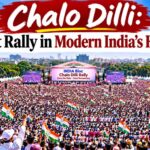
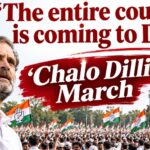



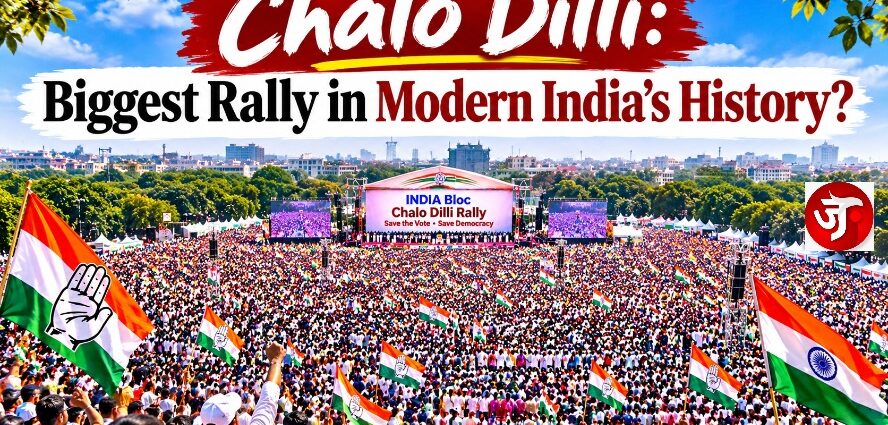
Chalo Dilli merged a confluence of crowds across India to become a day of protest, politics, and people power at Ramlila Maidan
November 1, 2026, New Delhi
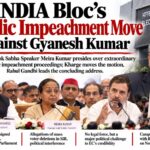
From ex-servicemen and lawyers to sadhus, saints, students, activists and political leaders, the INDIA bloc’s ‘Chalo Dilli’ mobilisation brought a wide range of participants to the streets of the national capital on Sunday. The central issue was the alleged manipulation of electoral rolls, the Special Intensive Revision (SIR), and demands for accountability from Chief Election Commissioner Gyanesh Kumar.
What unfolded at Ramlila Maidan was not just a gathering of opposition leaders. It was a day marked by unusual alliances, colourful demonstrations, sharp political speeches and competing claims over the meaning of democracy.
Asociated Press (AP): Reported that tens of thousands gathered at Ramlila Maidan on November 1, 2026. The Week reported thousands of participants and noted that INDIA bloc organisers had projected attendance of up to 10 lakh. Delhi Police estimated attendance at approximately 50,000. The venue’s effective capacity was estimated at 30,000–40,000 with seating and security arrangements. India Today reported that the BJP disputed the Congress’s 10-lakh turnout claim, citing aerial footage.
Reuters stated:
“Thousands protested in Delhi on Sunday to demand the resignation of India’s election chief over a revision of voter lists, the latest in more than a month of opposition demonstrations challenging Prime Minister Narendra Modi”
Chalo Dilli was a major opposition mobilisation that drew out the citizens, but the numbers are yet to be verified but aerial views show a sea of humanity as far as the eye can see!
Can we call it historic?
Yes, in the context of the breadth of political participation, the mobilisation across states, the presence of different social groups and the centrality of electoral rights to the protest.
The scale and security: Delhi Police deployed more than 4,000 personnel, over 200 CCTV cameras, drones and body-worn cameras. The ground was divided into 14 security zones.
The march: From Minto Road to Ramlila Maidan
The march began around noon from the Minto Road–Connaught Place junction, with Rahul Gandhi, Priyanka Gandhi Vadra, Mallikarjun Kharge, Sonia Gandhi, Akhilesh Yadav, Mamata Banerjee, Tejashwi Yadav, Farooq Abdullah, Supriya Shrinate and other INDIA bloc leaders taking part.
Leaders travelled in open vehicles as supporters gathered along the route. The march brought together several opposition parties under a common demand: accountability over alleged electoral irregularities and the protection of voting rights.
The unexpected faces of Chalo Dilli
Notable highlights
1. Ex-servicemen join the protest
One of the striking visuals was a contingent of ex-servicemen raising slogans as they arrived at Ramlila Maidan. Their presence added another dimension to the gathering, taking the protest beyond conventional party cadres. PTI photographs documented their participation.
2. Sadhus and saints march to Ramlila Maidan
In an unusual political sight, a large procession of Hindu sadhus and saints made its way towards the rally. Mahamandaleshwar Computer Baba was among those expressing support.
Computer Baba (Namdeo Das Tyagi) told IANS:
“When sadhus and saints themselves are unable to vote, when the votes of saints are stolen, and when temple offerings and donations are stolen, what is left?”
He said the saint community stood behind the demand to protect voting rights.
A strong quote from Congress president Mallikarjun Kharge at the Chalo Dilli rally:
“No matter how many attempts Narendra Modi makes, until Gyanesh Kumar resigns, we will not stay silent. We will keep fighting.”
Another sharp line from his speech:
“Modi jayega to hi loktantra bachega.”
(Only when Modi goes will democracy survive.)
The Tribune reported that the AISA national president was sharing the stage with senior INDIA bloc leaders, making her the first student leader to do so at the rally. She addressed the gathering, questioning the demand that ordinary citizens prove their citizenship and accusing the government of undermining voting rights.
3. Neha Bora delivers a sharp warning
She questioned the demand that ordinary citizens repeatedly prove their citizenship while their voting rights were allegedly being threatened.
Her pointed challenge was:
“Who are you to ask the people of India to prove their citizenship?”
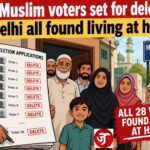
She alleged that electoral roll manipulation was affecting people across communities, including Muslims, Dalits, Adivasis, women and poor workers. She also criticised the Election Commission’s impartiality.
4. Mahua Moitra’s Kunne Lal moment
TMC MP Mahua Moitra shared a particularly striking account involving Kunne Lal, a Delhi resident whom she alleged had been declared dead in the electoral records despite being alive.
She wrote on X:
“CEC Gyanesh Kumar declared Kunne Lal is DEAD! Here he is next to me!”
Moitra alleged that no Booth Level Officer had visited his home before his name was marked for deletion. The case became a human face for the opposition’s allegations about voter-list errors.
Rahul Gandhi’s speech: “This is the voice of India’s people”
Rahul Gandhi delivered one of the rally’s most closely watched speeches, taking aim at the Election Commission, the BJP leadership and what he described as the concentration of India’s wealth in a handful of hands.
Some of his strongest statements:
- On democracy: “This is not the voice of a political party. This is the voice of Indian youth, farmers and people.”
- On the Constitution: “We will not allow the Constitution to be destroyed.”
- On alleged vote theft: “This is not regular chori. It is theft of the voice of every person.”
- On accountability: “After Gyanesh Kumar, we will come for you. Legal action will be taken.”
- On inequality: “We do not want a country that belongs to two or three people.”
He also spoke about farmers struggling for their rights, young people unable to find jobs and workers being denied their due, arguing that India’s opportunities and wealth should not be concentrated among a few powerful interests.
The political fireworks: Leaders deliver sharp messages
Sanjay Raut: The Shiv Sena (UBT) MP described the gathering as a move towards regime change. His remarks added to the combative atmosphere of the rally. India News
Shashi Tharoor: “This is not about the Congress, it is about the constitutional rights of the Indian people,” he said ahead of the march. He also called for a clean electoral register.
Yogendra Yadav: Describing the gathering as a coming together of different ideologies and organisations, he called it a confluence expressing people’s unity.
Salman Khurshid: “Our protest will not stop with just one rally. Our movement will continue. Just wait and see what happens next,” he said.
Mamata Banerjee: The West Bengal Chief Minister accused the BJP of targeting Bengal through SIR and declared that the fight for democracy would continue. She also extended support to the CJP and Gen Z movement.
Neha Bora: In another forceful intervention, the AISA president warned that history would judge the BJP and RSS harshly, saying they would find a place in the dustbin of history.
The CJP connection: Support, but no formal participation
An important distinction deserves attention. The Cockroach Janata Party (CJP), associated with Abhijeet Dipke, had expressed support for the underlying demand for electoral accountability. However, Dipke clarified that CJP would retain its independent identity and would not formally join the INDIA bloc’s November 1 rally. Its position should not be confused with participation as an alliance member.
The crowd question: Millions or thousands?
Drone footage and sweeping aerial visuals showed a densely packed Ramlila Maidan, creating an impression of an enormous gathering. Opposition leaders described the turnout in terms such as a “sea of humanity”.
However, the numbers need careful reporting. The INDIA bloc had projected up to 10 lakh attendees, while Delhi Police had planned for approximately 50,000. The venue’s effective capacity was estimated at 30,000–40,000 with seating and enclosures. No independently verified final attendance figure establishing millions was available in the reports reviewed as of yet.
The Delhi Police Special Commissioner for Law and Order, Devesh Srivastava, said:
“Everything is peaceful; people are coming.”
Meanwhile, the BJP organised a separate march in Hari Nagar against the 1984 anti-Sikh riots, turning November 1 into a day of competing political demonstrations in the capital.
The larger picture: What made Chalo Dilli noteworthy?
Three aspects stood out:
- A broader social presence: Ex-servicemen, religious figures, students, activists and opposition workers were among those participating.
- A common electoral concern: The rally brought the SIR controversy, alleged voter deletions and the independence of the Election Commission into the centre of public debate.
- A continuing movement: Opposition leaders indicated that November 1 would not be the final demonstration, with further political and legal action being discussed.
The central political message was captured in Rahul Gandhi’s words: the gathering, he argued, was not merely the voice of a political party but of India’s farmers, workers and young people.
JANPATH NEWS NETWORK (JNN)
Independent. Fearless. On the People’s Path.