









From the Strait of Hormuz to the ruins of Gaza, from a diplomatic shift in Kashmir to a deadly Kolkata fire, a volatile world enters another day of escalating crises
August 19, 2026: The world is being pulled in multiple directions at once.
In the Persian Gulf, the confrontation between Washington and Tehran is tightening its grip on the Strait of Hormuz. In Gaza, another strike has killed civilians along the coastline. Ukraine is facing a fresh political rupture in the middle of war. And in India, tragedy has struck in Kolkata while questions over the safety of schoolchildren are again being raised in Bihar.
The crises are geographically distant, but together they paint a grim picture of a world where diplomacy is struggling to keep pace with violence, political upheaval and human catastrophe.
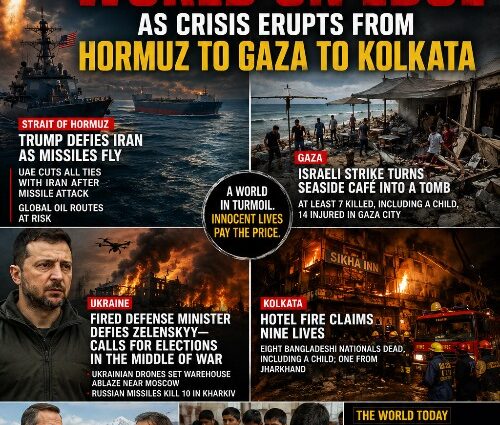
HORMUZ ON A KNIFE-EDGE: US-IRAN STANDOFF DEEPENS
The crisis around the Strait of Hormuz has entered another dangerous phase.
President Donald Trump has declared that there are no talks or conversations underway with Tehran, while tensions around the strategic waterway continue to escalate.
The United Arab Emirates reported detecting two ballistic missiles launched from Iran toward maritime traffic. The missiles fell into the sea, according to UAE authorities, while Tehran rejected the allegation as baseless. In response, Abu Dhabi announced the suspension of trade, commercial and financial dealings with Iran.
The development is significant far beyond the Gulf.
Hormuz is one of the world’s most critical energy chokepoints. Any sustained disruption threatens shipping, oil supplies and financial markets far beyond the region. Gulf markets reacted sharply on Wednesday, with UAE and Qatar stocks falling amid renewed security fears.
The message is unmistakable: the confrontation is no longer confined to military statements and diplomatic threats. It is beginning to reshape economic behaviour across the Gulf.
UKRAINE: FORMER DEFENCE MINISTER CHALLENGES ZELENSKYY
Ukraine’s wartime political front has also erupted.
Former Defence Minister Mykhailo Fedorov, recently dismissed from office, has called for presidential elections despite the continuing war with Russia.
His intervention represents a significant political challenge to President Volodymyr Zelenskyy’s wartime leadership and has reopened one of the most difficult questions facing Ukraine: how can democratic legitimacy be maintained while the country remains under attack?
Fedorov has argued that Russia should not determine when Ukrainians are allowed to choose their leaders. His call comes as Ukraine continues to endure Russian missile and drone attacks, while Kyiv maintains its own campaign of long-range strikes against targets inside Russia.
The dispute threatens to add a new layer of political uncertainty to a war that has already devastated Ukraine for years.
GAZA: SEASIDE CAFÉ BECOMES ANOTHER SCENE OF DEATH
In Gaza City, the coastline has once again become a scene of bloodshed.
An Israeli strike hit a café along the Gaza seafront, killing at least six people, including a child, and injuring more than a dozen others, according to reports. Israel said the strike targeted an imminent threat involving Hamas.
The incident comes amid continuing efforts to revive diplomacy and establish a pathway toward a ceasefire.
For civilians in Gaza, however, the distinction between diplomatic momentum and battlefield reality remains brutally clear.
Negotiations may take place in conference rooms. The consequences are being felt on beaches, in cafés, hospitals and crowded shelters.
KOLKATA HORROR: DEADLY HOTEL FIRE CLAIMS LIVES
In Kolkata, a night of terror unfolded as flames tore through the Sikha Inn on Mirza Ghalib Street, in the central New Market area.
According to the details reported, nine people died, including eight Bangladeshi nationals and one person from Jharkhand.
The fire trapped sleeping occupants as smoke rapidly spread through the building, turning a hotel into a death trap before emergency responders could bring the situation under control.
The deaths have also triggered concern in Bangladesh, where emergency arrangements have reportedly been put in place to assist the families of the victims.
A city known for its crowded streets and historic buildings has once again been reminded of the deadly consequences when fire safety fails.
SRINAGAR DIPLOMATIC SIGNAL: US ENVOY CALLS J&K AN “IMPORTANT PART OF INDIA”
Against this backdrop of global instability, a striking diplomatic moment unfolded in Srinagar.
US Ambassador to India Sergio Gor, visiting Jammu and Kashmir for the first time since taking office, met Chief Minister Omar Abdullah and publicly described Jammu and Kashmir as an “important part of India.”
Gor also said Washington would review its travel advisory for the Union Territory, signalling a possible reassessment of the American position as security conditions improve.
The visit carries significance beyond tourism and diplomacy. It comes at a time when Kashmir remains closely watched internationally, making the envoy’s public language particularly notable.
For New Delhi, the statement represents an important diplomatic affirmation. For Washington, the review of its travel guidance could signal growing confidence in the security environment.
BIHAR: SCHOOL MIDDAY MEAL TURNS INTO A NIGHTMARE
And in Bihar, a programme designed to feed children became the centre of another disturbing episode.
At Parsa Middle School in Nalanda district, according to the information provided, 34 children fell ill after detergent powder was reportedly used instead of salt in their midday meal.
The incident has triggered anger among parents and renewed questions about basic safety checks in school kitchens.
The meal (rice with potato-soybean vegetable) was supplied by an NGO (Ekta Shakti Foundation) through a centralised kitchen. School headmaster Shailendra Kumar Singh stated that detergent powder was served “by mistake” instead of salt.
A WORLD UNDER PRESSURE
From the narrow waters of Hormuz to the battered coastline of Gaza, from Ukraine’s political battlefield to Kashmir’s diplomatic theatre, and from the streets of Kolkata to a school kitchen in Bihar, the headlines of August 19 reveal a world under extraordinary pressure.
Missiles are falling. Governments are confronting political crises. Civilians are dying. Diplomats are recalibrating positions. Markets are reacting to threats thousands of kilometres away.
The danger is not simply that any one crisis will explode.
It is that several crises are escalating simultaneously.
And in a world already strained by war, economic uncertainty and fractured diplomacy, humanity has very little room left for another mistake.
JANPATH NEWS NETWORK (JNN)
Independent. Fearless. On the People’s Path.