








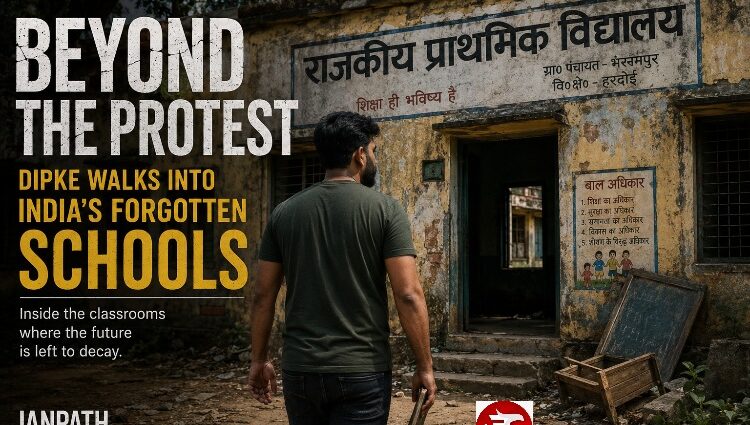
He is not a government inspector. He does not have the power to walk into a school, demand files or issue orders. But neither does that mean citizens must remain silent while public schools decay.
There is a question being thrown around after Abhijeet Dipke and the Cockroach Janta Party launched their “School Thik Karo” campaign:
“Who gave him the right to inspect government schools?”
It is a fair question. And it deserves a serious answer, rather than the usual political shouting match in which everyone suddenly becomes a constitutional expert after watching a 40-second video.
The answer is this:
Dipke is not a government-authorised school inspector. He has no statutory power to compel entry, seize records, suspend teachers, issue official findings or order a government department to act.
But that is not the same thing as saying a citizen has no right to question the condition of a government institution.
In fact, India’s own education framework recognises something much more important: the community has a legitimate role in monitoring public education.
Under Section 21 of the Right of Children to Free and Compulsory Education Act, government and government-aided schools are required to have School Management Committees, with responsibilities that include monitoring the working of the school and the utilisation of grants. The government itself has described community participation as an important part of school governance.
The National Commission for Protection of Child Rights has itself worked with the idea of community monitoring and social audits, involving citizens and civil-society groups in checking whether children’s educational entitlements are actually being delivered. NCPCR’s records describe social audits as a mechanism through which rights-holders themselves can monitor implementation and provide feedback to authorities.
The Centre for Policy Research, in work developed around school social audits, similarly describes social audits as a way of putting people at the centre of evaluating programmes intended for them.
So perhaps the better question is not: “Who gave Dipke the right?”
Perhaps it is: “Why are we uncomfortable when citizens look closely at institutions that exist for them?”
THE SCHOOL DOES NOT BELONG TO THE GOVERNMENT
A government school may be administered by a government department, its teachers may be government employees, its buildings may be maintained through public funds, its classrooms may be filled with children from poor families, but the school ultimately exists for the public.
The money that sustains the public system does not fall from the sky.
People contribute through income taxes, GST and countless other taxes and charges embedded in everyday economic life. The poorest citizen may not file an income-tax return, but he or she still participates in the tax system every time taxable goods and services are purchased.
A person buying biscuits contributes, as does a family buying clothes, worker buying a phone, etc. The point is that public institutions are sustained by public resources.
And when public money becomes public infrastructure, the public has a legitimate interest in knowing what happened to it.
THE POOR CANNOT ALWAYS FIGHT THE STATE THEMSELVES
There is another dimension to this debate that is perhaps even more important. The people who depend most heavily on government schools are often the people with the least power to demand accountability. What happens to parents who cannot navigate bureaucratic procedures, write formal complaints or understand which department is responsible? What happens when a village has no influential person willing to knock on the doors of officials?
That is where an external public voice can matter. Not because the outsider is automatically right or because Dipke is automatically right, but because sometimes somebody has to walk through the door and ask the question that the weakest people in the room are afraid to ask.
BUT THERE IS A LINE
This is where the argument must remain intellectually honest. A citizen’s right to demand accountability does not create a licence to trespass. Dipke cannot simply declare himself a government inspector and acquire powers that Parliament has not given him.
A citizen-led social audit is not the same thing as an official inspection by an education department, statutory authority or designated audit team. There are also legitimate concerns surrounding children.
Schools are not ordinary public spaces. They are places where minors are present. Their privacy and safety must be protected. Photography, filming, interviews and publication involving children must therefore be handled responsibly and in accordance with applicable law and school rules.
And if an administration requires permission for outsiders to enter school premises, that restriction cannot simply be ignored.
Indeed, Rajasthan’s education authorities have recently moved to restrict outsider entry and photography/videography in government schools following controversy surrounding the CJP campaign. That distinction matters.
The right to demand accountability is not the right to behave as though one is above the law. Dipke should not be above the rules. Neither should the government be above scrutiny.
THE GOVERNMENT SHOULD WELCOME THE CAMERA
There is something profoundly revealing about the anxiety that sometimes surrounds photographs of broken toilets, missing benches, damaged buildings or classrooms without basic facilities. If everything is functioning properly, scrutiny should be reassuring.
The answer to an uncomfortable photograph should not automatically be:
“Who gave you permission to look?”
The better answer is:
“Thank you for pointing it out. Here is what we are doing about it.” That is what accountable government looks like.
THIS SHOULD NOT BE ABOUT DIPKE
There is a danger in making the entire debate about Abhijeet Dipke. He is a political activist. His organisation is political and satirical. While people will support him, there are others who will distrust him, some will accuse him of publicity-seeking, while another group will accuse the government of trying to suppress scrutiny.
All of those political arguments can continue indefinitely, because apparently humanity has decided that arguing about the messenger is more entertaining than fixing the leaking roof.
But the children inside those classrooms do not care about the political theatre. They care whether they have water, toilets, sit safely, and whether their school is functioning.
The child is the real stakeholder.
And that is precisely why community participation in school governance exists in the first place. The Ministry of Education’s 2026 School Management Committee guidelines explicitly describe community participation as part of strengthening school governance and creating community ownership of schools.
A DEMOCRACY THAT CANNOT BE QUESTIONED BECOMES A BUREAUCRACY
Democracy is not merely the act of voting every few years. It is also what happens afterward. The strongest governments should not fear citizens who look closely. They should fear becoming governments that no longer care whether citizens look at all.
India’s own framework recognises community participation, School Management Committees and social-audit mechanisms as tools for monitoring educational entitlements.
And perhaps that leaves us with a question far more uncomfortable than “Who gave Dipke the right?”
Who gave any government the right to expect silence from the people whose money sustains it?
Because the poor child sitting on a broken floor does not need another argument about political ideology. He needs a floor. The girl walking to a filthy toilet does not need another press conference. She needs a functioning toilet.
And if the people responsible for delivering those basics are failing, then someone must have the courage to look, document, question and demand answers.
Not as a king, inspector, someone above the law, but as a citizen. And in a democracy, that may be one of the most important rights we have.
JANPATH NEWS NETWORK (JNN)
Independent. Fearless. On the People’s Path.