









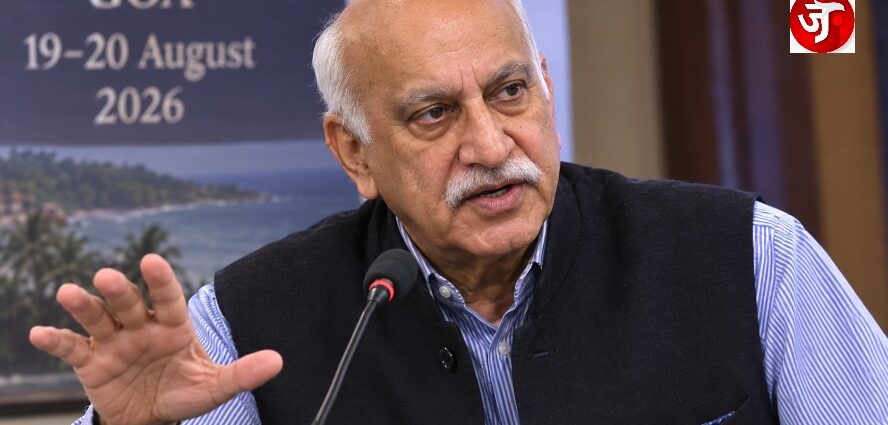
August 20th: In the quiet coastal town of Mapusa, Goa, former Union minister of state for external affairs and seasoned author MJ Akbar paused to consider a diplomatic moment that felt both affirming and incomplete.
Speaking to reporters and ANI, he described US Ambassador Sergio Gor’s characterisation of Jammu and Kashmir as an “important part of India” as “most welcome” and “perhaps long overdue.” Yet even as he offered that measured welcome, he threw out his most cynical and revealing phrase when he said, “I hope this is not another exercise in giving India President Trump’s crumbs while the main meal is being served elsewhere.”
Akbar suspects that the Kashmir comment may be a low-cost gesture designed to keep India satisfied while the United States pursues more consequential arrangements with other players (Pakistan, Saudi Arabia, Türkiye, or the broader West Asian security architecture). He is warning Indian audiences not to over-interpret a single sentence.
For India, which has long held Jammu and Kashmir to be an integral part of the nation, the language landed as a quiet validation. Pakistan, however, reacted sharply, summoning the US chargé d’affaires, lodging a formal protest, and branding the remarks “factually incorrect” and “irresponsible,” a departure from what it regards as Washington’s established stance grounded in UN resolutions.
MK Akbar’s critique of the US habit of “cross-ties” urges Washington to stop viewing India and Pakistan as an inseparable package, which has historically distorted American perceptions of the subcontinent. The Kashmir statement, if sustained, could help break that pattern, but only if it is deliberate and durable.
By highlighting poverty and persecution in Pakistan-occupied Kashmir and calling it a colony, Akbar is both scoring a political point against Pakistan and suggesting that even Pakistan’s “most dependable ally” (the United States) can no longer ignore the reality on the ground. This is classic Akbar: using moral language to reinforce a strategic argument.
The conversation then turned, almost inevitably, to the Mecca Pact signed on 7 August 2026 in Al-Safa Palace by Saudi Crown Prince Mohammed bin Salman, Turkish President Recep Tayyip Erdoğan and Pakistani Prime Minister Shehbaz Sharif. Building on an earlier bilateral understanding between Riyadh and Islamabad, the agreement carries a collective-defence clause: an armed attack on one is to be treated as an attack on all.
Here the cynicism deepens. He interprets the name change as a deliberate symbolic delinking of India from the Indian Ocean and West Asian security architecture. The fact that the US ambassador in Delhi could not adequately explain it only strengthens his suspicion that the move carries real strategic meaning, even if the area of responsibility remains unchanged on paper. Symbolism, for Akbar, is never empty.
The Mecca Pact questioned: This is the sharpest part of the critique. Trump’s description of the Saudi-Pakistan-Türkiye agreement as a “big, bold and important first step” is treated as an invitation to ask the uncomfortable follow-ups: What is the second step? The third? Is this evolving into an “Islamic NATO”? Every military alliance, he notes, needs a defined enemy: So who is the common adversary of these three countries? By asserting that America has “sponsored or endorsed” the pact, he places responsibility on Washington to explain its implications for India. The underlying worry is clear: a collective-defence arrangement that includes Pakistan could constrain or complicate India’s strategic space.
The main message Akbar wants to convey is to not mistake tactical diplomatic language for strategic realignment. While positive words on Kashmir are welcome, they must be tested against the broader pattern of American behaviour – the Indo-Pacific name change, the enthusiastic welcome of a trilateral defence pact involving Pakistan, and the historical US tendency to manage India and Pakistan as linked files.
India should demand consistency, transparency, and clarity rather than celebrate isolated statements. The United States, in his view, still needs to demonstrate that it is not offering India symbolic reassurance while pursuing more consequential arrangements elsewhere in the region.
In short, Akbar is performing the classic role of a seasoned strategic realist: acknowledging a favourable development, then immediately interrogating its limits and possible contradictions. The cynicism is deliberate. It is meant to keep Indian policymakers and the public alert rather than complacent..
JANPATH NEWS NETWORK (JNN)
Independent. Fearless. On the People’s Path.