










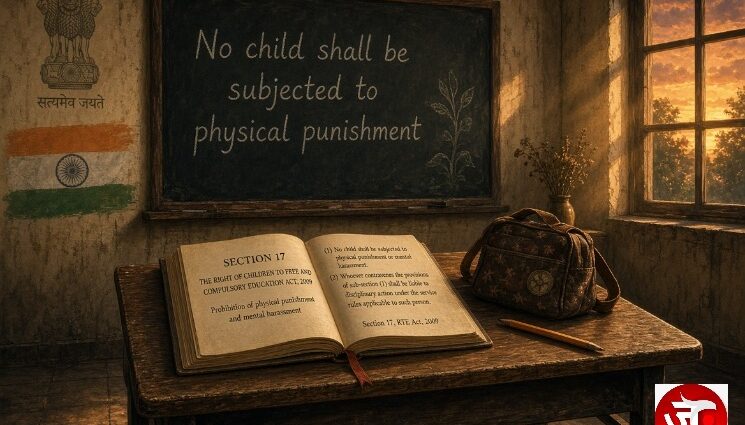
Seventeen years earlier, India had declared Section 17 of the Right of Children to Free and Compulsory Education (RTE) Act, 2009 is unambiguous: (1) No child shall be subjected to physical punishment or mental harassment.
On a Thursday morning in August 2026, six-year-old Pranay Teja left home healthy and eager for school at Little Garden School in Visakhapatnam’s One Town area in Andhra Pradesh. By noon, he was dead. CCTV footage, according to his family, captured a teacher striking him, reportedly with a slap or stick, for incomplete homework. The boy collapsed into her lap.
He was rushed to hospital and declared dead. His father insisted the child had been playing happily the night before, with no fever or illness. Relatives protested outside King George Hospital, demanding justice. Police opened an investigation; a three-member committee was formed; the Andhra Pradesh School Education Department called the incident “extremely unfortunate and painful.” The post-mortem would decide the exact cause. But the allegation was clear: another child had died after being hit in a classroom.
Seventeen years earlier, India had already declared such acts illegal. Section 17 of the Right of Children to Free and Compulsory Education (RTE) Act, 2009 is unambiguous:
“(1) No child shall be subjected to physical punishment or mental harassment.
(2) Whoever contravenes the provisions of sub-section (1) shall be liable to disciplinary action under the service rules applicable to such person.”
It is the statutory heart of India’s ban on corporal punishment in schools for children aged 6 to 14. National Commission for Protection of Child Rights guidelines expand “physical punishment” to include slapping, hitting with any implement, forcing uncomfortable positions, or any act causing pain or discomfort, however light.
Complementary protections exist under the Juvenile Justice Act against cruelty to children, and the Constitution’s Article 21 (right to life and dignity) and Article 21A (right to education) provide the moral and legal foundation.
Why Section 17 was made is a story of accumulated horror, judicial courage, and delayed recognition that “spare the rod” was destroying childhoods.
For decades, corporal punishment was routine and culturally defended in Indian classrooms. A 2007 government study found two out of every three children had experienced it. Teachers, parents, and institutions often treated the cane, the slap, the “murga” position, or public humiliation as discipline.
Then the cases mounted.
In 2000, the Delhi High Court, in Parents Forum for Meaningful Education vs Union of India, struck down rules permitting corporal punishment in Delhi schools. The court directed that children must learn “in an environment of freedom and dignity, free from fear.” It invoked constitutional rights and rejected the old English-derived idea that a teacher stood fully in loco parentis with a licence to strike.
In 2009, eleven-year-old Shanno Khan, a girl from a Delhi slum, died after teachers forced her to stand for hours in the sun for failing to recite the alphabet. That same year, the RTE Act was passed, embedding the explicit ban in national law.
A year later, in Kolkata, thirteen-year-old Rouvanjit Rawla of La Martiniere for Boys died by suicide days after being caned by the principal. Arrests followed; the nation watched.
These were not isolated tragedies. They were the visible tip of a practice that surveys and child-rights groups had documented for years. India’s ratification of the UN Convention on the Rights of the Child in 1992, growing advocacy, and the larger push for universal elementary education finally forced the legal line: physical punishment has no place in schools.
Section 17 was meant to end the era of fear.
Guidelines followed. Sensitisation programmes were promised. Disciplinary action became the prescribed response. On paper, the law was clear and absolute, no “mild” exception, no traditional defence.
Yet children keep dying or suffering under the same hands the law forbids.
Pranay Teja’s death in August 2026 is only the latest public reminder. Videos of teachers beating students still surface. “Murga” punishments, forced sit-ups that end in collapse, beatings with sticks or pipes continue to be reported across states. Enforcement remains uneven.
Many schools treat the ban as aspirational rather than absolute. Awareness among teachers is incomplete. Parental and societal attitudes sometimes still legitimise “a little discipline.”
Religious or minority institutions fall into grey zones. Complaints systems exist, but action is often slow or diluted. Courts occasionally show residual sympathy for “corrective” intent, even as the statute admits none.
The law was born from dead and broken children. It was written so that no teacher’s hand would again become an instrument of fatal authority. Section 17 exists because India finally recognised that dignity is not optional in a classroom. And still, another child dies with a slap.
The gap between the statute and the schoolroom is not a mystery of legal drafting. It is a failure of will, training, accountability, and cultural change. Until every slap is treated as the offence the law already names it to be, until every school treats Section 17 as non-negotiable rather than negotiable, children will continue to pay the price the legislation was meant to abolish.
Pranay Teja’s name now joins the list that forced the ban into existence. The question is how many more names the country is willing to add before the law finally becomes lived reality.
A law perfectly written. Imperfectly lived.
JANPATH NEWS NETWORK (JNN)
Independent. Fearless. On the People’s Path.