







Ankara wants sovereignty over its weapons, independence from Western restrictions and a decisive voice on Gaza. But the real measure of power is not what Turkey can say. It is what Turkey can change.
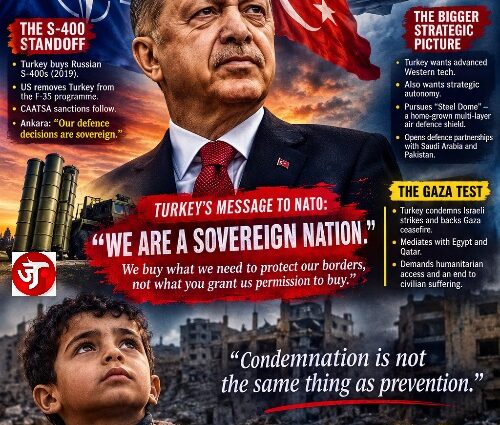
AUGUST 21, 2026: A dramatic video circulating on social media portrays NATO allies threatening Turkey with “strict economic penalties” over its defence choices and presents President Recep Tayyip Erdoğan responding that Turkey is a sovereign nation and will decide what weapons it needs to protect itself.
The video has generated attention, but its specific dialogue and quoted language have not been independently verified as a new official NATO-Erdoğan exchange. That distinction matters, because the underlying confrontation is real, and it is far more consequential than one viral video.
At the heart of it lies a seven-year-old dispute over a Russian missile system that transformed Turkey’s relationship with Washington and exposed one of NATO’s deepest contradictions: How sovereign can a country be in choosing its weapons when its security is also tied to an alliance?
Turkey purchased Russia’s S-400 air-defence system in 2019 despite strong objections from the United States and other NATO allies. Washington argued that the system was incompatible with NATO architecture and posed serious security and intelligence risks, particularly because of the possibility that its advanced radar could compromise sensitive information concerning NATO aircraft and technologies.
The consequences were severe. Turkey was removed from the F-35 programme and the United States imposed sanctions under the Countering America’s Adversaries Through Sanctions Act.
Seven years later, the dispute has not disappeared. It has become something much larger. The S-400 now represents Ankara’s determination to make its own defence decisions, even when those decisions collide with the preferences of its most important military allies.
For Turkey, the argument has always been straightforward: it needed an advanced air-defence system and believed Western alternatives did not provide the combination of delivery terms, cost, technology transfer and industrial cooperation it wanted. For Washington and other NATO capitals, the argument is equally straightforward: alliance membership requires a degree of technological trust and military interoperability.
That is where the S-400 became more than a missile system. It became a test of NATO itself.
The irony is difficult to miss. Turkey wants the strategic independence symbolised by the S-400 while simultaneously seeking access to the most advanced Western combat aircraft represented by the F-35.
Ankara has explored ways of resolving the deadlock, including the possibility of transferring its S-400 systems to a third country. Recent reports have pointed to discussions involving a Gulf destination, although no completed transfer has been confirmed.
The United States has also signalled greater openness toward repairing the relationship. But the S-400 remains the central obstacle, and legal and political restrictions in Washington have not simply vanished.
Turkey therefore finds itself caught between two ambitions: strategic autonomy and strategic integration. It wants both.
And perhaps that is precisely the point.
Ankara is not simply waiting for Washington to decide its future. Turkey is investing heavily in its domestic defence industry and developing the integrated Steel Dome air and missile-defence architecture, designed to combine sensors, radar, electronic warfare and multiple layers of air defence.
The message is unmistakable: if dependence creates vulnerability, build your own alternatives.
Earlier this month, Turkey, Saudi Arabia and Pakistan signed the Mecca Joint Defence Agreement, establishing a mutual-defence principle under which an attack on one would be treated as an attack on all.
Turkish Foreign Minister Hakan Fidan described the principle as comparable in some respects to NATO’s Article 5, although the agreement’s practical military commitments remain less defined than NATO’s collective-defence structure.
This does not mean Turkey is leaving NATO. Quite the opposite. Turkey remains one of NATO’s most strategically important members, with enormous military and geographical significance stretching from the Black Sea to the Middle East and the Caucasus.
But Ankara increasingly appears determined to ensure that NATO is one pillar of Turkish security, not the only pillar. Washington. Moscow. Europe. The Gulf. Pakistan. And an increasingly powerful Turkish defence industry, and this is not an alliance exit. It is strategic hedging.
And then there is Gaza.
This is where Turkey’s military ambitions collide with a much larger moral and geopolitical question.
President Erdoğan has become one of the most outspoken international leaders on Gaza. But Turkey’s role is not limited to speeches. Ankara is part of the mediation framework involving Egypt and Qatar, and the three countries have continued attempting to preserve negotiations and push for humanitarian access.
On August 20, Turkey, Egypt and Qatar jointly condemned recent Israeli attacks in Gaza and warned that continued violations were undermining efforts to end the conflict.
Earlier in August, the mediators also condemned attacks affecting healthcare facilities and civilian infrastructure and called for unhindered humanitarian assistance and medical supplies.
Turkey has therefore sought to use diplomacy, regional influence and international pressure to shape what happens in Gaza.
But here lies the uncomfortable question:
Condemnation is not the same thing as prevention.
Turkey can condemn an Israeli strike. It can negotiate. It can mediate. It can mobilise international opinion. It can pressure.
But when another strike occurs, the question becomes considerably harder:
What concrete leverage does Ankara possess to stop it?
That is the real test of Turkish power.
Erdoğan’s confrontation with Israel over Gaza stretches back years. In January 2009, during the Gaza war, then-Prime Minister Erdoğan famously confronted Israeli President Shimon Peres at the World Economic Forum in Davos.
Erdoğan accused Israel of killing civilians and told Peres: “When it comes to killing, you know very well how to kill.” He then walked off the stage after objecting to the moderator’s attempt to cut short his response. That moment became a defining symbol of Erdoğan’s relationship with Israel.
The rhetoric has only intensified since.
In August 2025, Erdoğan expressed hope that Palestinians would one day be able to pray in gratitude in Gaza, saying that, as in Syria, Turkey would witness the end of suffering there.
And on June 10, 2026, Erdoğan warned that Israeli attacks on Syria and Lebanon had reached a point where they threatened Turkey itself.
He declared that “Turkey’s security does not begin in Hatay.” He said it extended to Aleppo, Damascus and Beirut, and warned that Ankara would not permit what he described as the “Greater Israel” vision to advance.
Those statements demonstrate that Ankara increasingly views developments in Gaza, Syria and Lebanon not as distant regional events but as matters directly connected to Turkish security.
But Turkey’s position is complicated. Ankara wants to remain a major NATO power. It wants Western defence technology. It wants freedom from Western restrictions. It maintains a difficult but strategically important relationship with Russia. It is expanding defence partnerships with Saudi Arabia and Pakistan. It wants greater influence in Syria. And it wants to be recognised as one of the principal diplomatic actors capable of influencing the future of Gaza.
But strategic independence raises an uncomfortable question: What does independence mean when civilians are dying?
How much national autonomy can an alliance accommodate before collective security begins to fracture?
And how much influence can Turkey claim in Gaza if its diplomatic pressure cannot materially change what happens on the ground?
That is why the S-400 dispute matters. It is not ultimately about one missile system. It is about who gets to define security.
For Washington, security means protecting NATO technology and maintaining interoperability. For NATO, security means members operating within a trusted collective architecture. For Ankara, security increasingly means having the sovereign capacity to defend Turkey without becoming dependent upon another country’s permission.
And in Gaza, security must ultimately mean the protection of human beings.
The S-400 was acquired in the name of Turkish security. The F-35 is being pursued in the name of Turkish security. The Steel Dome is being built in the name of Turkish security. New defence partnerships are being forged in the name of regional security.
And in Gaza, Turkey says it is working for peace, humanitarian access and civilian protection. The world is now watching to see whether Ankara can convert its growing military capability, diplomatic reach and regional influence into something more substantial than political rhetoric.
JANPATH NEWS NETWORK (JNN)
Independent. Fearless. On the People’s Path.