






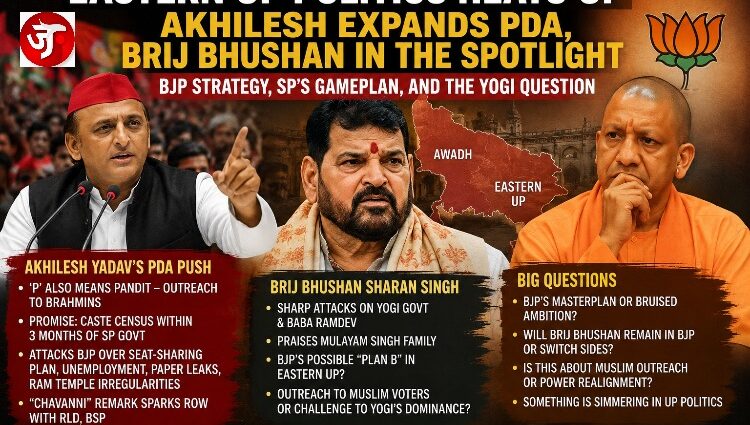
Akhilesh Yadav is no longer merely trying to defeat the BJP in Uttar Pradesh; he is attempting to build a social coalition broad enough to make the SP the natural pole of anti-BJP politics in 2027
AUGUST 22, 2026: With the 2027 Uttar Pradesh Assembly election increasingly becoming a battle of social coalitions, Samajwadi Party chief Akhilesh Yadav is attempting to redraw the party’s traditional electoral map, taking his PDA formula beyond its familiar Pichhde, Dalit and Alpsankhyak base.
The most striking shift is the party’s renewed outreach to Brahmins. Akhilesh has declared that the “P” in PDA can also stand for Pandit, signalling an effort to move the SP beyond its long-standing image as a Muslim-Yadav, or MY, party. The move is aimed at attracting Brahmin and other upper-caste voters while retaining the backward-class, Dalit and minority coalition that forms the core of his political strategy.
The strategy is not merely rhetorical. The SP has intensified Brahmin outreach, while Akhilesh has sought to position the party as a broader social coalition rather than a party representing a handful of caste groups. The political calculation is obvious: with the BJP seeking to retain its wide-ranging caste alliance and the BSP struggling to retain its earlier dominance among Dalits, the SP sees space to expand its own social base.
At the centre of Akhilesh’s campaign is the demand for a caste census. He has promised that if the Centre does not conduct one, an SP government in Uttar Pradesh would undertake the exercise within three months of taking office. He has framed the census as a question of representation, arguing that government benefits, political power and opportunities should reflect the actual population share of different communities.
Akhilesh has also been signalling greater attention to communities such as the Lodhis, indicating that the SP wants to deepen its appeal among non-Yadav backward castes rather than rely primarily on its traditional Yadav support.
His attack on the BJP is equally aggressive. Akhilesh has claimed that the BJP could distribute 162 of Uttar Pradesh’s 403 Assembly seats among NDA allies, including a reported 73 for the RLD, 39 for the SBSP, 31 for the Nishad Party and 19 for Apna Dal. He argues that such an arrangement would come at the expense of proportional representation for the PDA communities. The BJP has rejected the charge and accused him of focusing on its alliance arithmetic while failing to resolve issues within his own opposition alliance.
The SP chief has simultaneously sharpened attacks on the Yogi Adityanath government over unemployment, education, alleged paper leaks, protests and police action, as well as what he describes as false cases and encounters. He has also revived allegations surrounding irregularities in the handling of Ram Temple donations. These remain political allegations, not established findings.
Then came the “chavanni” controversy, adding another layer to the increasingly combative election rhetoric. Akhilesh’s remark was interpreted as a jibe at RLD chief Jayant Chaudhary, whose party had previously been an ally of the SP. Jayant responded sharply, while BSP Chief Mayawati demanded an apology to the Jat community.
But while Akhilesh is attempting to expand the SP’s social coalition, another intriguing political undercurrent is developing in eastern Uttar Pradesh and the Awadh region, where the name of Gonda’s controversial and influential politician Brij Bhushan Sharan Singh has once again begun attracting attention. His recent political statements have generated considerable discussion, particularly because of their seemingly contradictory directions. At times, he has launched sharp attacks on the Yogi Adityanath government and figures such as Baba Ramdev; at other moments, he has been seen speaking appreciatively of the Mulayam Singh Yadav family and the Samajwadi Party’s political legacy.
The question is whether these statements are simply the familiar political manoeuvring of a powerful regional leader or signals of something larger. Could the BJP eventually consider Brij Bhushan as a counterweight to Yogi Adityanath in eastern UP and Awadh? Could he, at some point, distance himself from the BJP and move closer to the Samajwadi Party? Or is his increasingly independent political voice intended to influence the region’s caste and minority arithmetic without any immediate change of political camp?
There is another, more consequential question. Could Brij Bhushan’s political positioning be part of a larger BJP strategy to reshape its hold over eastern UP and Awadh, including its outreach to Muslim voters, or could it eventually become part of a contest over Yogi Adityanath’s political dominance?
For now, Brij Bhushan Sharan Singh appears less like a declared successor or rebel and more like a powerful political variable, with his rising influence hinting that something may be simmering in Uttar Pradesh’s corridors of power, though no evidence yet proves whose recipe is being cooked.
What is undeniable, however, is that Brij Bhushan’s statements are attracting attention at a politically sensitive moment. In Uttar Pradesh, where caste equations, regional influence and personal political networks can matter as much as party labels, even apparently off-the-cuff remarks can carry electoral significance.
For now, the political signals are difficult to read with certainty. But something is clearly moving beneath the surface in Uttar Pradesh. The question is whether it is merely political positioning or the beginning of a larger realignment.
For Akhilesh, the larger game is bigger than one quarrel or one acronym. The SP is attempting to build a coalition that combines backward classes, Dalits and minorities with sections of Brahmins, while adding issues such as jobs, education, representation and youth anger to its electoral narrative.
That makes the 2027 Uttar Pradesh contest less about the old MY versus BJP binary and increasingly about who can assemble the broadest social coalition.
Akhilesh Yadav is betting that PDA can become bigger than its original definition.
The bigger question now is whether Uttar Pradesh’s political chessboard is beginning to move in other unexpected directions as well.
And in UP politics, where one never seems to have enough acronyms, alliances or political surprises, there may be considerably more cooking before the election arrives.
Akhilesh Yadav is no longer merely trying to defeat the BJP in Uttar Pradesh; he is attempting to build a social coalition broad enough to make the SP the natural pole of anti-BJP politics in 2027, and if his expanded PDA successfully brings non-Yadav OBCs, Dalits, minorities and even a meaningful slice of Brahmins into one tent, the political map of Uttar Pradesh could change dramatically.”
JANPATH NEWS NETWORK (JNN)
Independent. Fearless. On the People’s Path.
#AkhileshYadav #SamajwadiParty #BrijBhushanSharanSingh #UttarPradesh #UPElections2027 #UPPolitics #PDA #PDAFormula #CasteCensus #BJP #YogiAdityanath #JayantChaudhary #RLD #BSP #Mayawati #EasternUP #Awadh #OBCPolitics #DalitPolitics #MuslimVoters #BrahminOutreach #PoliticalRealignment #UPPoliticalBattle #IndianPolitics #JanpathNewsNetwork