








RESERVATION POLITICS: IS THE BJP REALLY PLANNING TO END QUOTAS, OR IS THE FEAR ITSELF THE STRATEGY?
Akhilesh Yadav, national president of the Samajwadi Party, who served as the 20th Chief Minister of Uttar Pradesh from 2012 to 2017. has accused the BJP of using the language of “reservation reform” to disguise a larger attempt to weaken reservation. But there is a more uncomfortable question beneath the political noise: is the BJP actually preparing to dismantle reservations, or is the controversy itself becoming a remarkably effective instrument for dividing India’s youth along caste lines?
The politics of reservation has entered another combustible phase.
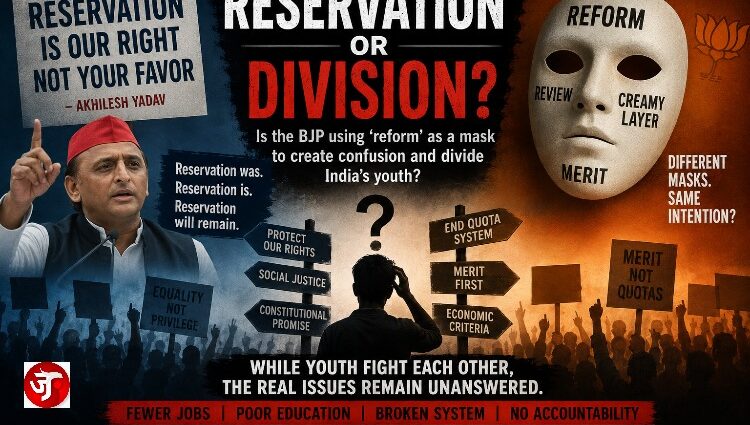
Akhilesh Yadav’s latest warning is blunt: the talk of “reform,” “review” and the “creamy layer” is, in his view, merely a new vocabulary for an old objective, weakening the constitutional protections of historically disadvantaged communities. His answer is equally blunt: “Reservation was. Reservation is. Reservation will remain.”
He wrote on X: “The conspiracy to end reservations under the guise of ‘reservation reform’ is yet another deep plot against PDA society. Reservation is the right of PDA, not the subject of anyone’s whim. The BJP and their allies, from time to time, oppose reservations by using vague terms like ‘review’ or ‘reform,’ or by talking about ‘creamy layer’ or advising ‘to give up reservations’—these are nothing but different masks for the ongoing attempts to trample the reservation rights granted to centuries-oppressed and deprived people. Reservation was there, reservation is there, reservation will remain!”
His political instinct is obvious. The Samajwadi Party’s PDA formulation, built around Pichhda, Dalit, Alpsankhyak, depends heavily on the belief that caste-based social justice remains under threat. With Uttar Pradesh heading toward another intensely caste-conscious electoral contest, reservation is not merely a policy question. It is political oxygen.
But there is another side to this story that deserves scrutiny.
Is BJP actually abolishing reservation?
At present, there is a crucial distinction between political rhetoric about changing reservation and an actual government programme to abolish it.
There is no publicly established national BJP-government policy, as of August 2026, announcing the wholesale abolition of SC, ST and OBC reservations. In fact, the current record is more complicated.
The Centre recently told the Supreme Court that the “creamy layer” principle should not automatically be extended to SC and ST reservations, arguing that their disadvantage is rooted in historical discrimination and cannot simply be reduced to income. The government also maintained that changing the SC/ST framework requires legislative action and empirical examination.
For OBCs, meanwhile, the creamy-layer principle is already part of the reservation framework, and the Supreme Court reiterated in March 2026 that income cannot be treated as the sole criterion for determining who falls within that category. That matters.
Because if the political claim is that the BJP has already decided to abolish reservation, the evidence does not currently establish that. But that does not make the controversy meaningless. It makes it more politically interesting.
The real battlefield may be perception: Reservation is one of those subjects where a whisper can travel faster than legislation. One side says: They are coming for your quota, while the other says: The quota system is unfair and must be reformed. The government may say: We are discussing efficiency, targeting and social justice. Meanwhile, millions of young Indians hear something much simpler: “Your future is under threat.”
And that is where politics becomes extremely powerful. India has a generation of young people fighting for a shrinking pool of government jobs, competitive-exam seats and educational opportunities. NEET, JEE, UPSC, SSC and other examinations have turned competition into a national psychological pressure cooker.
When opportunities are scarce, it becomes remarkably easy to convince one group that another group is responsible for its failure.
The unemployed general-category aspirant can be told that reservation is the reason he or she did not get a seat.
The reserved-category aspirant can be told that the dominant social groups are preparing to take away constitutional safeguards. Both can become angry, frightened, and politically mobilised.
That may be the most important point in this entire controversy.
The “Reservation Hatao” movement is revealing.
The developments at Jantar Mantar on August 22 show how quickly this issue can become a street-level political battle. Protesters demanding major changes to the reservation system argued that benefits should be based on economic disadvantage rather than caste, while more than 50 people were detained during the demonstration.
This creates an extraordinary political triangle. One constituency says: “Reservation is discrimination.” Another says: “Removing reservation is discrimination.” And political parties can position themselves as the defenders of one side against the other.
The result is not necessarily policy. Sometimes it is simply polarisation.
And this is where BJP’s critics have a legitimate question: If the government genuinely wants to reform reservation, where is the detailed blueprint?
If the government has no intention of weakening reservation, it has little reason to leave such enormous interpretive space around the issue. If it does intend major changes, then the public deserves to know exactly what those changes are.
Akhilesh’s argument also deserves scrutiny: He is is right about one fundamental historical fact: reservation was not conceived as charity. It emerged from the recognition that formal equality cannot automatically produce substantive equality when social exclusion has operated for generations.
The real question confronting India’s youth, “Why are there so few good jobs and so few quality educational opportunities?”, gets replaced by another question: “Who is taking my seat?” That is a remarkably convenient transformation, where the shortage of jobs becomes a caste dispute.
The failure to expand quality public education becomes a caste dispute.
The danger is not merely losing reservation. It is losing the ability to have a rational conversation about it.
Akhilesh Yadav is attempting to consolidate PDA voters by presenting himself as the political firewall against any perceived assault on reservation.
The anti-reservation movement is attempting to consolidate another constituency by presenting reservation itself as the obstacle to merit and equality.
Between these two political narratives stands a generation of young Indians already exhausted by unemployment, examination uncertainty and fierce competition.
They are being offered an increasingly familiar bargain:
Be angry at each other instead of asking who controls the system that distributes opportunity.
That is the real danger. Reservation deserves debate. Its history deserves respect. Its beneficiaries deserve protection. Its implementation deserves scrutiny. Its shortcomings deserve reform where evidence demands it.
But the country should be extremely suspicious of anyone who wants to turn the question into a permanent war between young Indians.
Because the ultimate political victory may not belong to the side that abolishes reservation.
It may belong to the side that successfully convinces millions of Indians that their fellow citizens are the reason they have no future. And that is a much more sophisticated form of politics than simply changing a quota.
Reservation was. Reservation is. Whether reservation will remain exactly as it is, however, should not be decided by slogans from either side. It should be decided openly, constitutionally, transparently and on evidence.
Otherwise, India will keep fighting over the seats while barely asking the more uncomfortable question:
Why did we create so few seats in the first place?
JANPATH NEWS NETWORK (JNN)
Independent. Fearless. On the People’s Path.