







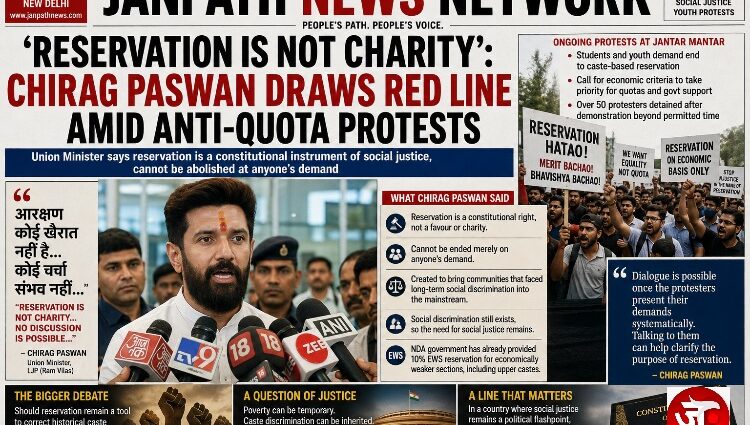
Union Minister Chirag Paswan says reservation is a constitutional instrument of social justice, cannot be abolished at anyone’s demand.
August 23, 2026
A political line has been drawn sharply across India’s increasingly heated reservation debate.
Union Minister and Lok Janshakti Party (Ram Vilas) leader Chirag Paswan has rejected demands for the abolition of reservation, declaring that the system is “not charity” but a constitutional right and cannot simply be ended because a section of protesters demands it.
Paswan delivered a blunt message amid the ongoing “Reservation Hatao Andolan” at Delhi’s Jantar Mantar.
“आरक्षण कोई खैरात नहीं है… कोई चर्चा संभव नहीं…”
“Reservation is not charity. It cannot be ended merely because someone demands it.”
Paswan’s intervention comes as protesters have challenged caste-based reservation and argued that economic disadvantage, rather than caste, should become the principal basis for government support and affirmative action. Hundreds gathered during the recent protests, with demonstrators carrying placards demanding a fundamental overhaul of the reservation system. More than 50 protesters were detained after some remained at Jantar Mantar beyond the permitted period.
But Paswan’s argument goes beyond the immediate protest. He placed reservation within the larger constitutional and historical framework of India’s struggle with caste discrimination.
According to Paswan, reservation was created to help communities that had endured generations of social discrimination, particularly Scheduled Castes and Scheduled Tribes, enter the mainstream and gain access to opportunities that had historically been denied to them. The central question, he argued, is whether that discrimination has actually disappeared.
His answer was unequivocal: it has not.
As long as caste-based discrimination continues to exist, he argued, the question of social justice cannot simply be declared closed.
Paswan, however, did not completely shut the door on dialogue. He said the government could engage with the protesters if they presented their demands systematically. He argued that a structured discussion could help clarify both the purpose of reservation and the reasons why the system continues to exist.
That distinction is politically significant. The message is essentially this: Debate the system. Question its implementation. Demand reform. But do not assume that constitutional affirmative action can simply be switched off because a movement has demanded it. It also exposes the complexity within the government’s own position.
The NDA government has already introduced 10% reservation for Economically Weaker Sections, including economically disadvantaged people outside the traditionally reserved categories. Paswan’s argument therefore implicitly points toward a distinction between addressing economic deprivation and addressing historical social exclusion.
The two are not necessarily interchangeable: Poverty can be temporary, caste discrimination can be inherited, and economic recovery does not automatically erase social stigma.
The Jantar Mantar protests have opened a debate that India has never fully escaped: Should reservation remain primarily a mechanism for correcting historical caste exclusion, or should economic deprivation become the dominant criterion?
The protesters say the present system compromises merit and argue that benefits should reach the economically poor irrespective of caste. Their supporters have demanded greater transparency, review and reform.
But defenders of reservation point to the persistence of caste discrimination and argue that treating caste and poverty as identical forms of disadvantage misunderstands why affirmative action was created in the first place.
That is where the political battle becomes much larger than a protest slogan.
For the BJP-led NDA, reservation is an especially sensitive issue because any perception that the government intends to weaken affirmative action can trigger enormous political consequences among Scheduled Caste, Scheduled Tribe and OBC communities.
Paswan’s statement therefore carries significance beyond his own party. As a prominent Dalit political leader and Union minister, his rejection of abolition provides an important counterpoint to the increasingly vocal anti-reservation campaign.
And there is another political message embedded within it: The government cannot afford to allow the reservation debate to become a contest between “merit” and “quota” alone.
That framing reduces a centuries-old social question to an examination score. The real argument is about what constitutes fairness in a society where historical exclusion has shaped access to education, employment, land, representation and social mobility.
Chirag Paswan’s intervention has therefore arrived at a critical moment. The anti-reservation movement is demanding answers from the political establishment. Paswan, in turn, has demanded that the protesters confront the constitutional and social foundations of the system they want dismantled.
His message is blunt: Reservation is not a favour handed out by politicians. It is a constitutional instrument created to address entrenched inequality.
For now, Paswan has drawn his line. “Reservation is not charity.”
And in a country where politics has repeatedly treated social justice as an electoral bargaining chip, that may be one of the more consequential statements to emerge from the current confrontation.He elaborated that reservation:
- Cannot be ended merely on anyone’s demand.
- Is not charity given to anyone.
- Is a constitutional right.
This was Chirag Paswan’s response to the ongoing anti-reservation (“Reservation Hatao”) protests at Delhi’s Jantar Mantar. Protesters (mostly students) are demanding an end to caste-based reservation and want economic criteria to take priority for government support/quotas.
Paswan said the reservation system was created to bring communities that faced long-term social discrimination (especially Scheduled Castes and Scheduled Tribes) into the mainstream.
He noted that social discrimination still exists in society, so the need for social justice remains relevant. He also pointed out that the NDA government has already provided 10% EWS reservation for economically weaker sections (including from upper castes).
He added that dialogue is possible once the protesters present their demands systematically, and that talking to them could help clarify the purpose of reservation.The video in the post is the media interaction clip capturing these remarks. This statement quickly became a widely shared soundbite on the issue.
JANPATH NEWS NETWORK (JNN)
Independent. Fearless. On the People’s Path.