










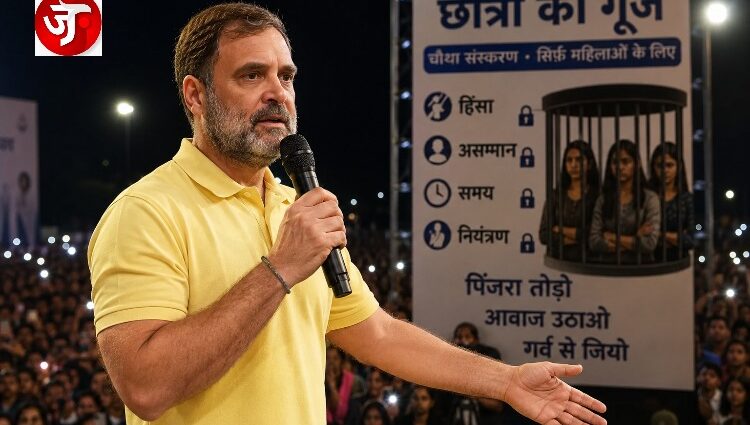
In a packed ground under the lights of SSPMS College, thousands of young women rose as one, phones held high, voices cracking with emotion.
Leader of the Opposition Rahul Gandhi stood before them in a yellow shirt and delivered a line that landed like thunder: “You belong to nobody but yourself.” The crowd gasped. Then it roared. “You have a relationship with your father, you have a relationship with your brother, you have a relationship with your husband, you have a relationship with your son… but you do not belong to them. You belong to yourself.”
In that moment, a quiet movement that has been building across campuses found its clearest, most powerful expression yet.
This was the fourth edition of Chhatron Ki Goonj – Students’ Echo – and the first deliberately reserved for women. What began as a platform for students to speak about paper leaks, rising fees and unemployment had evolved into something deeper: a direct challenge to the invisible cage that still shapes the lives of India’s 70 crore women.
Gandhi did not mince words.
He said, “The biggest strength of this country, he insisted, is that women should stand for themselves, believe in themselves, and refuse every definition that reduces them to someone else’s property.”
He laid bare the four methods of control that society still uses: Violence. Disrespect. Time. Control. All of it, he said, is “oppression disguised as concern.” The familiar refrain, “We are very concerned about you, that is why we need to control you”, was stripped of its polite mask and held up to the light.
On stage, a graphic of three women locked inside a cage appeared. Locks labelled Violence, Disrespect, Time and Control. The message was unmistakable: the cage is real, and it is time to break it.Gandhi called India’s women its greatest asset – “unique journeys, unique imagination, unique dreams.” He told them they need no permission for their ambitions. Safety should never cost a career. Education is not a favour. And patriarchy, he declared, must be smashed. “Be loud. Be proud. Fight for your space.”
The atmosphere was electric. Young women who had travelled from hostels and colleges across Maharashtra listened with intensity rarely seen in political gatherings. Many had faced pressure in the days before the event; reports of ABVP activists allegedly confining girls who expressed support for Chhatron Ki Goonj only sharpened the edge of the evening. Congress workers rushed to the hostels. The girls still came.
This is not the loud politics of slogans and street clashes. It is quieter, more dangerous to the status quo. A movement that does not ask women to choose between family and freedom, but insists the two are not the same. Relationships are precious, Gandhi said. Ownership is not. By the time the lights dimmed, the phrase had already begun travelling far beyond Pune. The wave flowed to social media, where youth responded with a kind of stunned recognition. . “THE GASP – GASPED JUST NOW,” one user wrote, capturing the collective intake of breath that swept the ground.
Gandhi repeatedly frames India’s 70 crore women as the country’s single greatest asset, unique journeys, imaginations, and dreams that no one else can replicate. He rejects the reduction of women to only three roles (daughter, wife, mother) and directly repudiates the Manusmriti passage that says a woman “must never be independent.” The central line that has travelled farthest is simple and powerful: “You belong to nobody but yourself. You have a relationship with your father, brother, husband, son… but you do not belong to them.”
He pairs this with a call to “break the cage,” “be loud, be proud,” and “smash the patriarchy.” Student after student is given the microphone to describe stereotypes in the workplace, family pressure after a father’s death, harassment, and the quiet daily restrictions on movement and ambition.
Unknown to many, at the COEP Technological University girls’ hostel in Shivajinagar, a clash broke out between ABVP and NSUI/Youth Congress activists the night before. Congress leaders and NSUI workers alleged that ABVP members entered or pressured the hostel, confined or locked female students in their rooms, and intimidated them for having expressed support for Chhatron Ki Goonj, shared related content, or spoken to the media about campus issues such as scholarships and fees.
Girls reportedly locked themselves in out of fear; Youth Congress members said they rushed to the site to protect them. Senior Congress figures described the episode as an attempt to silence young women and a reflection of a controlling mindset. ABVP countered that NSUI workers had been pressuring girls to register and record videos for the event, and that their own members were assaulted when they went to inquire. Police registered an FIR against dozens of NSUI/Youth Congress workers based on an ABVP complaint, while cross-complaints and mutual allegations of violence circulated.
One female student later released videos distancing herself from the political crossfire. Whatever the full truth of the competing claims, the episode illustrated in real time the very “control” Gandhi named the next evening, attempts by organised groups of young men to decide whether female students could speak, support, or simply leave their hostel to attend a public event.
The contrast sharpened the positive message: the call for women to belong only to themselves was delivered against a backdrop of men trying to restrict that very freedom of movement and expression.
The hostel confrontation the night before supplied the real-world stakes that made the words land with greater force. Senior figures including Vijay Wadettiwar, Praniti Shinde, Pawan Khera, and Maharashtra Congress leaders described the actions as “hooliganism,” “atrocities against women,” and an attempt to stifle freedom of expression. They claimed girls reached out for help, some locked themselves in rooms out of fear, and Youth Congress/NSUI members rushed to the site to protect them. CCTV concerns and forced apology videos were also raised.
Congress MP Praniti Shinde framed it as reflecting a broader “mindset… against women,” while others linked it directly to fear of the upcoming rally.
The hostel confrontation illustrated, in microcosm, the very dynamics under discussion: competing male-dominated student organisations treating women’s participation, speech, and physical presence as territory to be managed, pressured, or restricted, the point reinstated: Young women constantly find their choices exploited, their safety compromised, and their desires crushed, and this is what Chhatron Ki Goonj seeks to correct.
JANPATH NEWS NETWORK (JNN)
Independent. Fearless. On the People’s Path.