










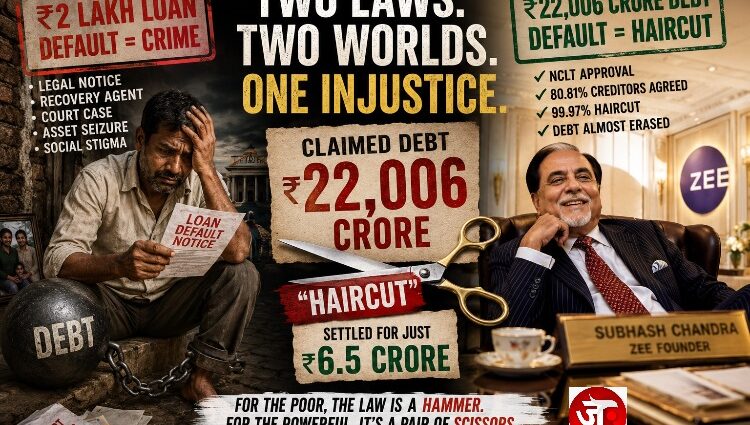
A ₹2 lakh loan can become a nightmare for an ordinary borrower.
A ₹2 lakh loan can become a nightmare for an ordinary borrower. A missed instalment can bring recovery notices, mounting penalties, damaged credit, court proceedings and, beyond the paperwork, the humiliation of being branded a defaulter.
But when the numbers run into ₹22,006 crore, the language changes. It becomes a “haircut.”
That contrast has triggered a fierce debate after the National Company Law Tribunal (NCLT) approved a repayment plan in the personal insolvency proceedings involving Zee Group founder Subhash Chandra. Against admitted creditor claims of approximately ₹22,006.57 crore, the approved plan provides for about ₹6.25 crore to creditors, with another ₹25 lakh allocated towards insolvency-process costs. In effect, creditors recover only around 0.03%, implying a staggering 99.97% haircut.
The arithmetic is almost surreal.
₹22,006 crore claimed.
₹6.5 crore paid.
99.97% written down.
And that is precisely why the case has become a political and public flashpoint.
The criticism is not simply about one businessman or one tribunal order. It is about the perception of two different Indias: one in which an ordinary citizen struggling with a relatively small loan can face the full machinery of financial recovery, and another in which enormous corporate-linked liabilities can be dramatically reduced through the formal insolvency system.
The comparison has been sharpened on social media, where Kumar R Talukdar described the system as a kind of “salon exclusively open for the rich”, arguing that debts belonging to the powerful are “trimmed” while ordinary borrowers are left to face the consequences in full.
The metaphor is deliberately brutal.
For the poor, debt becomes a burden, but for the powerful, debt can become a negotiation. But the legal reality is more complicated than the political outrage suggests.
The ₹22,006.57 crore figure represents admitted claims in Chandra’s personal insolvency proceedings, largely arising from personal guarantees he had given for borrowings by Essel Group-linked companies. It is therefore inaccurate to describe the entire ₹22,006 crore as money personally borrowed and spent by Chandra.
The NCLT also did not simply impose the settlement on creditors without a process. The repayment plan received support from creditors holding 80.81% of the voting share, although several lenders objected to the exceptionally low recovery.
Among the objectors was LIC Housing Finance. Its admitted claim was reported at around ₹1,322.39 crore, while the proposed recovery was only about ₹38.09 lakh, roughly 0.028% of the claim.
And now the battle may not be over.
HDFC Bank and LIC Housing Finance are preparing to challenge the NCLT decision, with LIC Housing Finance considering an approach to the National Company Law Appellate Tribunal (NCLAT).
That makes the controversy considerably bigger than a viral social-media post. The fundamental question is staring the insolvency system in the face:
When does a legal resolution become an economic surrender?
The Insolvency and Bankruptcy Code was designed to resolve distressed assets and maximise recovery, not to guarantee that every rupee lent will return. A “haircut” is therefore not automatically evidence of wrongdoing. Sometimes creditors accept a steep reduction because recovering even a fraction may be better than receiving nothing after years of litigation.
But 99.97% is not an ordinary haircut.
It is a number so extraordinary that it inevitably invites scrutiny of how such claims accumulated, why recovery prospects were assessed so low, what assets were available, how creditors voted, and whether the process genuinely maximised recovery. And this is where the anger of the ordinary borrower becomes understandable.
Because somewhere beneath the legal terminology is a brutally simple question:
If a ₹2 lakh borrower cannot escape the consequences of default, why should a ₹22,006 crore claim be capable of disappearing almost entirely under the respectable language of “resolution”? The law may have an answer, but the public is demanding a convincing one, because when the financially vulnerable encounter the system, it often feels like a hammer.
When the enormously indebted encounter it, the system can sometimes look remarkably like a pair of scissors.
And suddenly, ₹22,000 crore becomes just another haircut!
JANPATH NEWS NETWORK (JNN)
Independent. Fearless. On the People’s Path.