










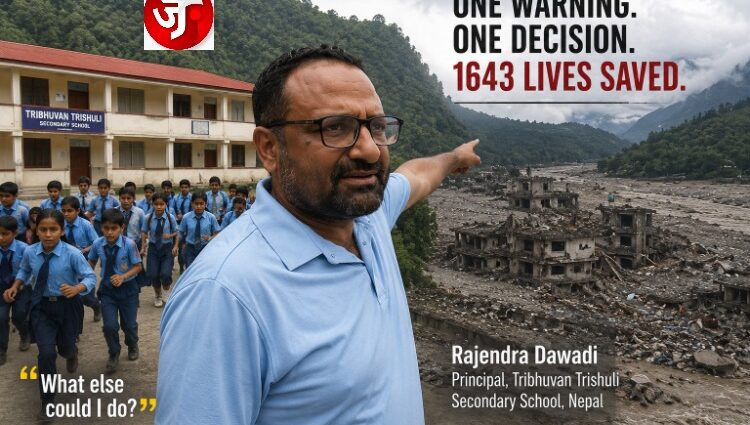
On an ordinary Wednesday morning in Nepal’s Trishuli Valley, a school principal was given just minutes to make a decision that would change the fate of 1,643 children.
At around 9:20 a.m. on August 26, Rajendra Dawadi, principal of Tribhuvan Trishuli Secondary School, received a desperate warning from a friend upstream: the river had swept away a village and a devastating flood was racing towards them.
Dawadi, a 47-year-old English teacher, immediately rang the school bell and ordered the evacuation. He alerted teachers, sent the children towards higher ground and called school-bus drivers, telling them to turn back. One bus was approaching the bridge when the order came. It turned around just before the bridge was destroyed.
Moments later, the three-storey school building was swallowed by the raging torrent of water, mud and debris.
All 1,643 students survived. They sheltered on higher ground beneath a bodhi tree, while the valley around them was transformed into devastation. Tragically, two school staff members were lost after returning towards the school or river.
Dawadi himself lost his home.
Yet amid unimaginable destruction, his response was remarkably simple: “What else could I do?”
Sometimes heroism is not about grand gestures. Sometimes it is simply recognising danger, acting without hesitation, and refusing to waste a single precious minute.
JANPATH NEWS NETWORK (JNN)
Independent. Fearless. On the People’s Path.