










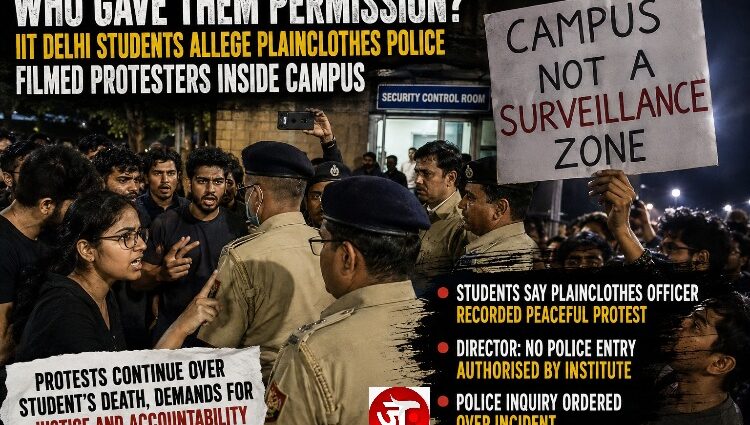
August 31, 2026: What began as a student demand for answers over the death of a 31-year-old MSc Physics student at IIT Delhi has now opened another deeply troubling question: how far can police enter and monitor a university campus without the knowledge or consent of the institute?
Students protesting the death of Rishikesh Kumar, who allegedly died by suicide on August 22 after falling from the sixth floor of the Lecture Hall Complex, have accused a plainclothes Delhi Police personnel of entering the IIT Delhi campus and secretly recording their demonstration on a mobile phone.
According to students, the man was confronted during the protest on August 26. He identified himself as a Delhi Police officer, but students say he could not explain who had authorised his entry or why he was filming them. He was subsequently taken to campus security.
For students, the incident was not merely about one officer with a phone. It was about surveillance, privacy and the autonomy of an educational institution.
The controversy became sharper after IIT Delhi Director Rangan Banerjee reportedly said he had not authorised Delhi Police to enter the campus and had not permitted campus security to record the protesters. He described the filming incident as “not done”. A police source subsequently said an inquiry had been ordered to determine who entered the campus and filmed the protest.
Students have also alleged excessive police presence and continuous audio-visual monitoring by campus security. They fear that recordings made during a protest could later be used against participants.
And that fear comes against the backdrop of an already bitter confrontation.
Students have demanded an independent investigation into Kumar’s death, accountability for alleged institutional lapses, resignations of senior officials and ₹1 crore compensation for his family. Delhi Police has registered an FIR for alleged abetment of suicide against unknown persons. IIT Delhi has since reconstituted its external inquiry committee under retired Delhi High Court judge Justice Mukta Gupta, following student objections to the original panel.
The administration, meanwhile, has accused protesters of taking their agitation into residential areas late on August 27 and using “unsavoury, humiliating and threatening” language, warning that disciplinary action could follow. Students have disputed that account, saying they remained on main roads and avoided sensitive areas.
The students have since temporarily paused their agitation while the inquiry proceeds, but the larger questions remain.
Who authorised police entry? Who authorised the filming? Where is the footage? Who will have access to it? And can students protesting over the death of a fellow student reasonably expect their peaceful demonstration to be recorded by police without explanation?
These are not trivial questions. A university is supposed to be a place where young people can question authority without wondering whether someone in the crowd is quietly documenting them for a file somewhere.
In the middle of a national debate about student mental health, institutional accountability and academic freedom, the IIT Delhi controversy has become a test of something even more fundamental: whether a campus remains a space for dissent, or becomes another place where surveillance quietly follows protest.
JANPATH NEWS NETWORK (JNN)
Independent. Fearless. On the People’s Path.