










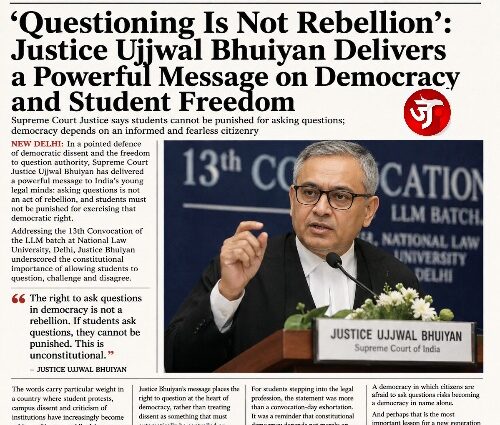
In a pointed defence of democratic dissent and the freedom to question authority, Supreme Court Justice Ujjwal Bhuiyan has delivered a powerful message to India’s young legal minds: asking questions is not an act of rebellion, and students must not be punished for exercising that democratic right.
Addressing the 13th Convocation of the LLM batch at National Law University, Delhi, Justice Bhuiyan underscored the constitutional importance of allowing students to question, challenge and disagree.
“The right to ask questions in democracy is not a rebellion. If students ask questions, they cannot be punished. This is unconstitutional.”
The words carry particular weight in a country where student protests, campus dissent and criticism of institutions have increasingly become subjects of intense public debate.
Justice Bhuiyan’s message places the right to question at the heart of democracy, rather than treating dissent as something that must automatically be controlled or silenced.
For students stepping into the legal profession, the statement was more than a convocation-day exhortation. It was a reminder that constitutional democracy depends not merely on obedience, but on the courage to ask difficult questions.
A democracy in which citizens are afraid to ask questions risks becoming a democracy in name alone.
And perhaps that is the most important lesson for a new generation of lawyers: the Constitution does not require citizens to remain silent. It gives them the space to speak, question and demand accountability.
Justice Bhuiyan’s message was unmistakable: questioning power is not rebellion. It is part of democracy.
JANPATH NEWS NETWORK (JNN)
Independent. Fearless. On the People’s Path.