







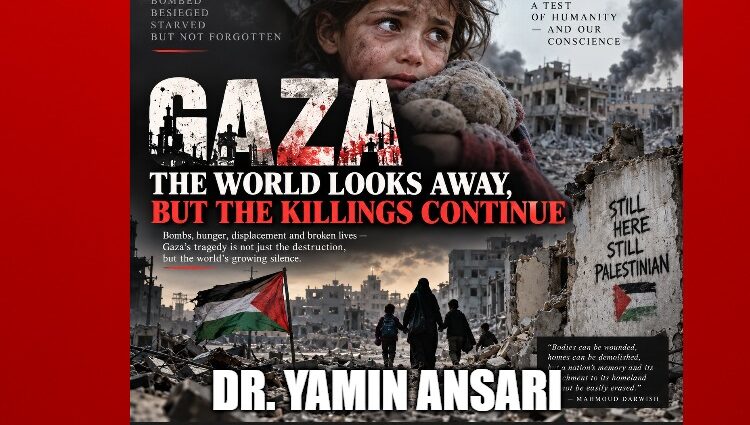
Israeli military operations against the Palestinian people continue with devastating intensity, yet the international community appears to have turned its eyes away from Gaza.
Dr. Yamin Ansari
Sometimes it is not the writing that tires you. It is the feeling that comes with writing the same terrible sentence in different ways, day after day, month after month. You open your phone or computer and another picture from Gaza appears. Another child. Another mother. Another building reduced to dust. Another family searching through rubble for someone who may never answer.
You look at those pictures and, for a moment, words simply fail.
Since 7 October 2023, Gaza has been living through a catastrophe that seems to have no end. What began as another terrible chapter in a long and painful history has become, for millions of Palestinians, a daily struggle simply to remain alive. Bombs fall where families once slept. Homes that held memories for generations have been reduced to rubble. Hunger and thirst have become part of childhood, and displacement has become a way of life.
Behind every statistic is a human being. More than 60,000 Palestinians have been killed since October 2023, according to Gaza health authorities, with children and women making up a devastating proportion of those killed. Tens of thousands more have been injured, many carrying wounds that will remain with them for the rest of their lives. The vast majority of Gaza’s population has been displaced, some repeatedly, moving from one place of insecurity to another with little more than what they can carry.
But numbers, however horrifying, cannot tell the whole story. They cannot tell us about a mother searching through the ruins for her child, a father standing helplessly outside a destroyed hospital, or a child who has learned the sound of an approaching airstrike before learning what it means to feel safe.
This is what makes Gaza so difficult to write about. Every number represents a name, a face, a family, a dream interrupted. And yet, perhaps the most painful part is that the world is beginning to hear these numbers without hearing the people behind them.
Homes have vanished, taking with them photographs, childhood memories, wedding clothes, schoolbooks and the small possessions that quietly make a house a home. Hospitals, places where the wounded once ran for safety, have been damaged or destroyed. Entire neighbourhoods have been flattened into landscapes of concrete, dust and twisted metal. Roads, schools, water systems and other infrastructure that generations spent decades building have been shattered in months.
But Gaza is not only a story of buildings destroyed. It is a story of lives interrupted. A child who should be worrying about school is learning how to recognize the sound of bombs. A mother is wondering where she will find water for her children. A father searches through rubble for something, anything, that can prove the life his family once lived was real.
And then there is the world outside Gaza.
Markets open. Restaurants fill with people. Governments sit around polished tables and hold meetings. Leaders deliver carefully prepared speeches. Conferences discuss peace, security and the future. Television channels devote a few minutes to Gaza before moving on to another headline, another crisis, another story.
For those trapped beneath the smoke and rubble, however, there is no “next story.” The bombs do not move on; the hunger does not move on; and the grief does not move on.
And perhaps this is the most unbearable part of Gaza’s tragedy: not only that so much destruction has been allowed to continue, but that the rest of the world is slowly learning to live with the images of that destruction.
When suffering becomes familiar, silence becomes easier, and when silence becomes normal, human lives can begin to look like statistics instead of people.
That may be the darkest tragedy of all.
There was a time when every image from Palestine shook the world. Today, the shock seems to last for a few hours, sometimes a few minutes, before something else takes its place. The headlines have moved on. Social media, once filled with outrage, has become quieter. Many of the voices that spoke passionately about human rights now seem strangely absent.
What happened to those voices?
Those hands that could have done something are also tied. The international community seems to have turned its eyes away from Gaza. The voices of the champions of human rights have also vanished somewhere. Today, in conferences, speeches and writings, mention of the world’s most oppressed nation is heard only rarely. Media headlines have changed, the noise on social media has died down, and conscience seems to have gone to sleep.
After mediation by the United States, Qatar, Turkey and Egypt, Israel signed a peace agreement on 10 October 2025 – that is, a promise was made to stop the genocide of Palestinians. But was it implemented? Since the ceasefire agreement, the Israeli army has martyred more than 1,200 Palestinians in Gaza.
Overall, the number of civilians in Gaza who have drunk the cup of martyrdom has now reached 73,000. Among the martyrs are the elderly, women and children. Even after pounding Gaza brick by brick and destroying the entire civilian infrastructure, Israel has not allowed the people of Gaza a single day of peaceful breath. Gaza has neither electricity nor water, neither food nor schools, neither hospitals nor safe shelters, neither economic activity nor social gatherings. Everything has been destroyed, and whatever remains is also on the brink of ruin.
The matter does not end here; new ambitions are now coming to the surface. It is regrettable that the United States, which claims the Gaza peace agreement, also appears to stand with Israel in this condemnable mission, and so does the international community. Only a few countries in the world remain sincere towards Palestine; otherwise, even the things that used to be said are no longer being said.
From 7 October 2023 until now, the United Nations has not been able to go beyond condemnatory resolutions. Circumstances give the impression that the international community has handed Gaza and the Palestinians over to the Zionist state, and it does whatever it wants with no one to stop or restrain it.If we examine the present situation, one tragic aspect of the Gaza tragedy also emerges: there is a world of difference between ceasefire announcements and the ground reality.
On the surface, the international community , especially the countries of the region , talk of peace, ceasefire, mediation and agreements, but no change comes in the lives of Gaza and the rest of the Palestinian civilians. Because if civilians continue to be killed despite a ceasefire, basic facilities are not restored, obstacles in the path of humanitarian aid remain, and fear and insecurity do not end, then the question arises: what kind of ceasefire is this, and what kind of peace agreement?
Regarding Gaza’s future, Israeli plans for the alleged forced or so-called “voluntary migration” of the Palestinian population have signalled another grave crisis. Certain far-right elements in Israeli politics have continued to support plans to transfer Palestinians out of Gaza.
This idea revives for Palestinians the bitter memory of the 1948 Nakba, when large numbers of Palestinians were expelled from their homes and ancestral areas. Occupied Israel’s minister and leader of the extremist Jewish Power party, Itamar Ben-Gvir, has presented a plan for the so-called “voluntary migration” or ethnic cleansing of 1.86 million Palestinians from besieged Gaza. Ben-Gvir presented this plan during his election campaign and named it “Disengagement 710.”
The plan includes establishing a special ministry for its implementation and providing funds for “integration packages” in countries that would give refuge to Palestinians.
The extremist Ben-Gvir claims that some countries are ready to accept Palestinians, while according to Israeli media there is currently no country that has agreed to take large numbers of Palestinians from Gaza.
According to the report, the plan’s target is to remove 250,000 in the first year, 1.11 million in three years, and approximately 1.86 million Palestinians in seven years.Although under international law the forced expulsion of any civilian population is an extremely serious matter, any attempt to remove Palestinians from their land cannot be dismissed merely as a political plan.
Signals from the Israeli leadership about further occupation of territory and transfer of the Palestinian population regarding Gaza have increased concerns. If an attempt is made to permanently divide destroyed Gaza, maintain occupation of its areas, and move the population out, it will no longer remain merely a wartime strategy; it could become an attempt to change the political map of the region.
In such a situation, the silence of the international community becomes even more meaningful. If the application of international law is different for powerful countries and different for weak nations, then the “rule of law” remains merely a slogan.Although first Iran and now China have informed the countries of the region that they should understand their power and not turn away from Palestine.
During his visit to Egypt, Chinese President Xi Jinping, giving special importance to the Palestinian issue, said that it is “the core of the Middle East issue” and should not be ignored or marginalized at any time. China’s support for Middle Eastern countries deciding their own affairs and future and forming a new regional security architecture is noteworthy.
In any case, Gaza is not merely a piece of land; it is also a test of humanity’s conscience. Every bomb that falls there does not merely bring down a building; it also wounds the claim that we live in a civilized world. If we remain silent today, if we do not raise our voice for this most oppressed nation today, history will place us too in the same rank where the spectators stood. Gaza does not need our sympathy; it needs our voice, and a voice only has meaning when it is raised in time.
The silent screams rising from Gaza’s rubble seem to echo Mahmoud Darwish’s haunting words: “We have on this earth what makes life worth living.” Bodies can be wounded, homes can be demolished and streets can be reduced to ruins, but a people’s memory, identity and attachment to their homeland cannot be so easily erased. Perhaps Gaza’s deepest tragedy, therefore, is not only the destruction that continues day after day, but the terrifying fact that the world is slowly becoming accustomed to witnessing it.
Dr. Yamin Ansari
(The writer is Resident Editor of Inquilab.)