










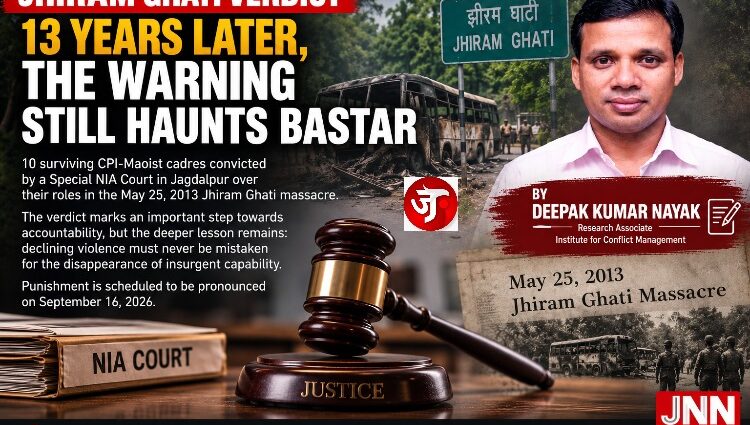
10 Maoists convicted in landmark case, but Jhiram Ghati remains more than a courtroom verdict: it is a stark lesson in the danger of mistaking declining violence for a defeated insurgency
September 10, 2026: Thirteen years after the devastating Jhiram Ghati massacre shook Chhattisgarh, a Special NIA Court in Jagdalpur has delivered a significant measure of justice, convicting 10 surviving CPI-Maoist cadres, including three women, for their roles in the May 25, 2013 attack. The court is scheduled to pronounce the quantum of punishment on September 16, 2026.
But the verdict is not simply the closing chapter of a brutal attack. Jhiram Ghati stands as a warning about the catastrophic consequences of believing that a decline in violence necessarily means an insurgency has been defeated.
On May 25, 2013, Maoist cadres ambushed the Congress Party’s Parivartan Yatra in the Darbha Valley of Bastar. Among those killed were Chhattisgarh Congress chief Nand Kumar Patel, his son Dinesh Patel, former Opposition Leader Mahendra Karma, and former Union Minister Vidya Charan Shukla, who later succumbed to his injuries. Security personnel and Congress workers were also among the victims. NIA records cited in the source put the death toll at 27, including 10 police personnel, with 38 injured.
The warning that came before the massacre
The most disturbing dimension of Jhiram Ghati is that the possibility of a Maoist regrouping had already been identified.
A March 2013 assessment described the Maoists as being in a phase of “tactical retreat”, rebuilding organisational strength, strengthening recruitment, developing alternative communications, intensifying propaganda and expanding mobilisation. The assessment explicitly warned against interpreting declining violence as the destruction of Maoist capability.
Barely two months later, Jhiram Ghati demonstrated the price of ignoring that distinction.
The attack showed that the insurgency retained the ability to exploit difficult terrain, strike a large political convoy, deploy an improvised explosive device and sustain an assault against armed security personnel.
Accountability, but not the end of the questions
The prosecution examined 101 witnesses and relied on forensic and documentary evidence. Eleven accused originally faced trial, but one died during proceedings, while several other accused named during the investigation remain absconding. The defence has indicated that the verdict will be challenged in a higher court.
The conviction is therefore an important step, but it should not automatically be treated as a complete reconstruction of the attack.
Political controversy has continued over whether the wider planning and command structure behind the massacre was fully established. Allegations of a larger conspiracy remain political claims unless established through evidence, but the unresolved debate highlights an important distinction: convicting those who participated in an attack is not necessarily the same as reconstructing the entire architecture of the operation.
Bastar today is different. the lesson is not.
The Maoist movement today is considerably weaker. Sustained security operations, expanded security infrastructure, leadership losses and large-scale surrenders have sharply reduced its operational footprint.
Several prominent figures connected to the wider Jhiram investigation have since surrendered or been killed, reflecting the dramatic erosion of the insurgency’s former organisational strength.
Yet that very decline carries its own danger.
When attacks become rare and casualty figures fall, governments can begin treating improving statistics as proof of irreversible victory. Jhiram Ghati offers a brutal reminder that insurgent capability can survive beneath apparently improving numbers.
The cost of complacency
The massacre also exposed the enormous security risks surrounding political activity in an insurgency-affected region.
Political mobilisation in such areas cannot be treated as routine campaigning. Intelligence, route sanitisation, convoy discipline, communications, contingency planning and adequate protective cover are essential, not optional additions to political activity.
The September 5 verdict therefore carries a message extending far beyond the courtroom.
Justice matters. Accountability matters. But the deeper lesson of Jhiram Ghati is about memory, preparedness and the deadly cost of self-deception.
jhiram Ghati must not become a footnote
The Maoist insurgency may be far weaker today than it was in 2013. But history has already demonstrated how quickly a seemingly diminished threat can exploit complacency.
The conviction of 10 accused is an important step towards accountability. The greater responsibility is to remember why Jhiram happened, understand what the warning signs were, and ensure that declining violence is never again mistaken for the complete disappearance of insurgent capability.
Author: Deepak Kumar Nayak, Research Associate, Institute for Conflict Management