


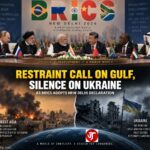
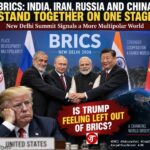


The 45-page New Delhi Declaration adopted by BRICS is, on the surface, a document of diplomacy. Beneath it lies something more revealing:
September 13, 2026: The extraordinary difficulty of finding a common voice in a world where the conflicts are multiplying faster than the consensus needed to address them.
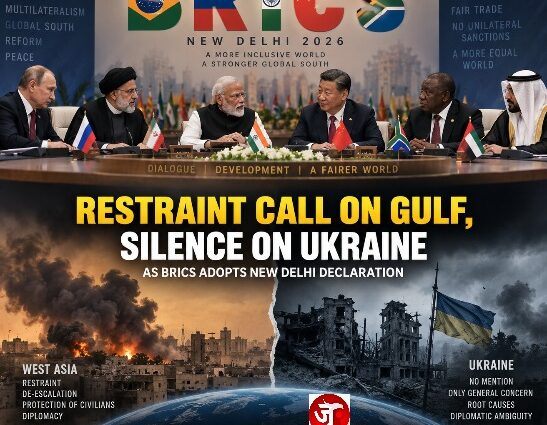
BRICS managed to do what had seemed increasingly difficult. Iran, Saudi Arabia and the UAE, themselves divided by the unfolding Gulf crisis, found enough common ground to allow the grouping to speak collectively. The answer was restraint. No country was named. No accusation was made. The language became deliberately broad: de-escalation, protection of civilians, sovereignty, dialogue and diplomacy.
Perhaps that is the price of keeping a diverse coalition together.
But then comes Ukraine.
The Russia-Ukraine war disappears into the larger vocabulary of “ongoing conflicts” and a “polarised and fragmented” international order. There is no explicit reference to Russia or Ukraine. The phrase “root causes” quietly enters the declaration, echoing Moscow’s long-standing argument about how the conflict began.
It is not exactly silence. It is diplomatic ambiguity. And ambiguity can sometimes be more revealing than a declaration..
Sudhakar Dalela, Secretary, Economic Relations, Ministry of External Affairs and India’s BRICS Sherpa, offered little detail on how the grouping managed to bridge its differences, saying the New Delhi Declaration represented a “common denominator” that allowed every member to maintain its individual position.
Asked who had been involved in forging the consensus, Dalela said: “Obviously, these are the result of conversations at various levels: the sherpa level which I steer, the foreign ministers and the leaders.”
He stressed that the consensus was the outcome of sustained engagement throughout India’s BRICS presidency.
“Throughout the year, we have been engaged with our BRICS members at various levels and only because of that engagement — I would like to underline the word ‘engagement’ — at various levels, that has enabled us to forge consensus on this particular matter.”
The carefully worded declaration avoids naming any country involved in the Gulf conflict, instead expressing concern while “recalling our respective national positions”. It calls on all sides to exercise maximum restraint and avoid actions that could further escalate tensions.
The declaration states: “Furthermore, we urge to ensure the protection of civilians and civilian infrastructure in accordance with the purposes and principles of the Charter of the United Nations in their entirety and interconnectedness, including respect for the sovereignty and territorial integrity of the States,” it says.
It also places dialogue and diplomacy at the centre of the search for a regional settlement: “We encourage increasing efforts, through dialogue and diplomacy, towards a long-term understanding that will contribute to lasting peace, security and stability in the region. We stress the need to work together to maintain smooth flow of global trade, supply chains and energy, in accordance with applicable international law.”
Yet one conspicuous absence remains: Ukraine.
Asked why the declaration did not specifically mention the Russia-Ukraine war, Dalela pointed instead to its broader language on conflicts, polarisation and distrust in the international system.
The declaration says: “We call on the international community to respond to these challenges and associated security threats through politico-diplomatic measures to lower conflict potential and stress the need to engage in conflict prevention efforts, including through addressing their root causes,” the declaration says.
The wording reveals the delicate balancing act behind the consensus: acknowledge global conflicts, advocate diplomacy and prevention, but leave individual members sufficient space to retain their own positions.
India has consistently advocated dialogue and diplomacy rather than choosing the language of confrontation. The New Delhi Declaration reflects that instinct. Yet the contrast is striking. BRICS can call for restraint in West Asia, while Ukraine is absorbed into a generalized discussion about global conflict. The grouping’s diversity has produced consensus, but consensus has also demanded careful avoidance of the questions on which its members fundamentally disagree.
The strongest collective language comes perhaps on unilateral sanctions. BRICS condemns unilateral coercive measures and secondary sanctions, arguing that they hurt ordinary people and undermine international law. That position carries particular weight when two members, Russia and Iran, are among those most affected.
Then comes Narendra Modi’s larger challenge to the existing global order.
His image of a world where the Global South stands at the front row of crises but the back row of decision-making is difficult to ignore. BRICS, in many ways, exists because that imbalance is no longer acceptable to much of the developing world.
“Countries that drive global economic growth should also have an appropriate role in shaping global economic governance,” he said.
A Congress statement later said: “Although Prime Minister Narendra Modi has reiterated a position that the Indian National Congress has long articulated, that India must be a voice for the Global South, the Congress firmly believes that declarations of solidarity must be complemented by consistent and consequential action.
“This includes taking special measures to address concerns of perceived endorsement of attacks on BRICS member Iran, the BJP Government’s limited diplomatic role during the ongoing war in West Asia (including its unwillingness to forge consensus between BRICS members), and its inadequate support for BRICS founding member South Africa when it faced diplomatic pressures.”
The irony is equally difficult to ignore.
A grouping demanding a greater voice in global governance must itself learn how to speak collectively about the world’s hardest conflicts. New Delhi succeeded in producing a declaration. Whether it succeeded in producing a truly shared political position is another matter.
Perhaps that is the deeper story of BRICS today.
It is no longer simply an alliance of emerging economies. It is a gathering of countries with competing strategic interests, different friendships, different wars at their doorstep and very different ideas about what the future international order should look like.
So the New Delhi Declaration says plenty.
And what it carefully avoids saying may say even more.
JANPATH NEWS NETWORK (JNN)
Independent. Fearless. On the People’s Path.