







From Manmohan Singh facing fierce press questioning to a woman journalist allegedly facing threats after questioning Yogi Adityanath, India’s democratic culture faces an uncomfortable test
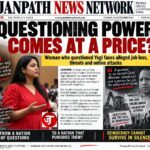
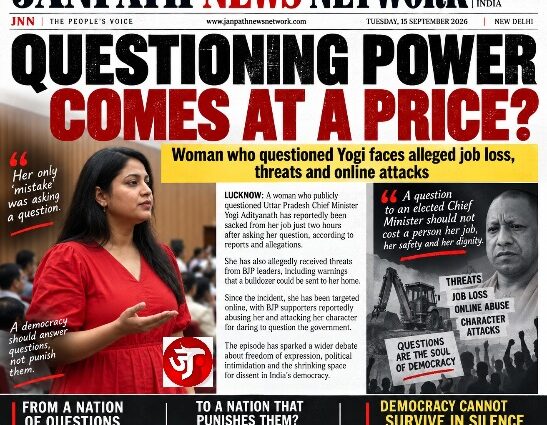
September 15, 2026: A woman journalist who publicly questioned Uttar Pradesh Chief Minister Yogi Adityanath has reportedly found herself at the centre of a growing controversy. According to reports and allegations circulating following the incident, the woman was reportedly dismissed from her job just two hours after questioning the Chief Minister. She has also allegedly faced threats from BJP leaders, including claims that a bulldozer could be sent to her home.
The controversy has now moved into the digital sphere, where supporters of the ruling party have reportedly targeted the woman with abusive comments and personal attacks, including attacks on her character.
What Happened?
Yogi Adityanath held a press briefing at the BJP state headquarters in Lucknow regarding the month-long Seva Sankalp Abhiyan. At the conclusion of the address, the Chief Minister prepared to leave the venue without taking questions from the media. Divya Srivastava raised her voice and pointedly asked why the media was invited if they were not allowed to ask questions. She reportedly sought to raise questions regarding public interest matters, including post-rain waterlogging and infrastructure issues, while other overlapping press queries at the event touched upon the state’s encounter and bulldozer policies. Video footage showed the journalist stating, “Mukhyamantri Ji, this is a press conference, please take questions,” as the Chief Minister smiled slightly, gestured, and walked away without answering
When did asking a question become an act of courage?
The political debate has inevitably turned to comparison with the Congress-led UPA years, when Prime Minister Manmohan Singh routinely faced searching questions from journalists on corruption, 2G, coal allocations, governance failures and his own leadership.
At a major press conference in January 2014, reporters openly questioned Singh about some of the biggest controversies engulfing his government, including whether he had failed to prevent corruption and whether his leadership had been weakened. He answered, his government was criticised, and the questions did not stop.
There was a time when a government could be battered on television night after night, its ministers grilled, its Prime Minister challenged and its scandals dissected before millions of viewers, without the government itself becoming the only institution expected to be protected from uncomfortable questions.
The Congress-led United Progressive Alliance (UPA) experienced precisely that. During UPA-II, television news channels relentlessly pursued the 2G spectrum controversy, the Commonwealth Games scandal, coal allocations, the Adarsh housing controversy, corruption allegations and accusations of policy paralysis. These stories dominated prime-time television and became subjects of furious nightly debates.
The government complained. Prime Minister Manmohan Singh himself complained, but the cameras kept rolling, and and the journalists kept asking.
In February 2011, as his government faced enormous pressure over the 2G controversy and other scandals, Manmohan Singh sat down with television editors. The questions were direct. Why had A. Raja remained Telecom Minister? What responsibility did the Prime Minister bear? Why had the government failed to act earlier? Was coalition politics preventing decisive governance?
The Prime Minister answered; the answers were challenged, and the television coverage continued.
Singh later complained that sections of the media had effectively become “the accuser, the prosecutor and the judge.” But even that complaint is revealing. He was arguing with the media. He was not arguing that the media should stop asking questions.
The 2G controversy became one of the defining political stories of the UPA era. For months, television channels dissected the allegations, the CAG report, the role of A. Raja, the Prime Minister’s Office and the government’s handling of the controversy. The issue repeatedly returned to prime time. The government was forced to defend itself before the public every evening.
And eventually, the political damage became enormous. Then came the Anna Hazare movement in 2011. The anti-corruption agitation became a national television phenomenon. Hazare’s hunger strike, the crowds at Ramlila Maidan, the Lokpal debate and the confrontation between protesters and the government dominated television coverage.
The media did not merely report the movement. Critics accused sections of the media of becoming too closely aligned with it. Yet the larger point remains: the government had to face an extraordinary wave of public criticism broadcast into millions of homes every night.
Congress minister Jairam Ramesh became known for publicly expressing differences with aspects of UPA policy. He criticised government approaches to the environment, industry and implementation of major programmes. His remarks sometimes irritated colleagues and led to reprimands. But he remained a minister: The government could disagree with him, party could discipline him, yet disagreement itself did not automatically make him an enemy of the state.
Perhaps the strongest evidence comes from Singh’s own words. In a meeting with editors in 2010, he acknowledged that differences of opinion had existed within Congress since the days of Jawaharlal Nehru.
He referred to the famous “Young Turks” who had challenged the party establishment during Indira Gandhi’s time and said differences could be expressed within party forums and even within government. In Parliament, Singh also described debate, argument, constructive criticism, multiple viewpoints and tolerance of dissent as essential elements of democracy. This was not merely a journalist describing democracy from outside, it was the Prime Minister defending the principle from inside government.
The UPA ultimately lost power in 2014.
There were many reasons: Corruption controversies damaged its credibility. Economic concerns and inflation contributed to public dissatisfaction. The Anna Hazare movement changed the political atmosphere. The Congress organisation weakened. Narendra Modi and the BJP mounted a formidable national campaign.
Television criticism alone did not bring down the UPA yet television played a huge role in amplifying and relentlessly debating the controversies that damaged the government’s public standing.
Now consider the question being asked today
Against that history comes the controversy surrounding the Divya Srivastava who questioned Uttar Pradesh Chief Minister Yogi Adityanath.
She has reportedly faced allegations of losing her job following the incident, threats and a torrent of online abuse. Claims have also circulated that BJP-linked individuals threatened her with bulldozer action.
Why should asking an elected Chief Minister a difficult question become grounds for hostility toward the person asking it?
Democracy does not mean that governments must like criticism. It means they must tolerate it. The question is this:
CAN INDIA STILL QUESTION POWER WITHOUT FEARING THE CONSEQUENCES? The purpose of asking questions is simply to ask for accountability and propel change. When a citizen stands before an elected leader with a microphone, democracy should view her or him as a loyal citizen, chalking change and reform. Questioning actually makes a system function better, and citizens more secure.
JANPATH NEWS NETWORK (JNN)
Independent. Fearless. On the People’s Path.