









In India, liberty is a constitutional promise. But in two very different criminal cases unfolding in the capital, the passage of time has become impossible to ignore.
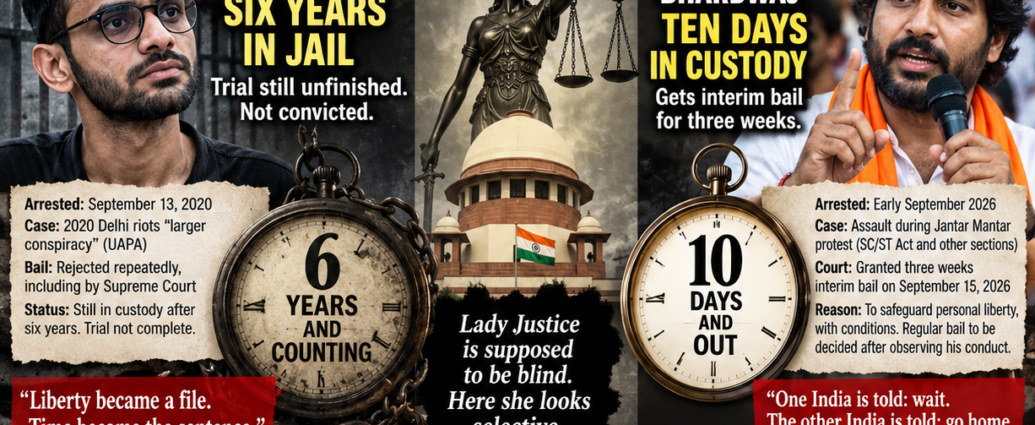
Umar Khalid has spent six years in custody without a substantive trial. Swatantra Bhardwaj spent a little over ten days in custody before a Delhi court granted him three weeks of interim bail.
The two cases are legally different, and treating them as identical would be inaccurate. Khalid is facing charges under the stringent Unlawful Activities (Prevention) Act in the alleged larger conspiracy connected with the February 2020 Delhi riots. Bhardwaj is facing an assault case arising from a protest at Jantar Mantar, with additional allegations under the SC/ST Act and a separate POCSO case. Yet the radically different timelines raise a question that goes beyond either accused: how does a constitutional promise of personal liberty operate when the criminal process itself moves at dramatically different speeds?
Six years behind bars, trial still unfinished
Umar Khalid was arrested on September 13, 2020, in connection with the Delhi Police case alleging a larger conspiracy behind the Northeast Delhi riots.
As of September 13, 2026, he had spent six years in custody without the allegations against him being tested through a completed trial. Proceedings on framing of charges have continued, while fresh bail proceedings have also remained before the courts.
The Supreme Court rejected Khalid’s bail plea in January 2026. In its ruling, the Court said that, at the bail stage, the prosecution material disclosed reasonable grounds for believing that the accusations against him were prima facie true. It described the prosecution case as attributing to him a central role in the alleged conspiracy. Crucially, the Court also stated that those observations were confined to bail and were not a determination of guilt.
Khalid remains an accused, not a convicted person.
The Delhi High Court subsequently granted him three days of interim bail in June to visit his mother before surgery, subject to strict conditions.
The legal question therefore remains alive: how long can pre-trial incarceration continue before the delay itself becomes a constitutional concern?
The courts have not ignored that question. The Supreme Court considered prolonged custody alongside the nature of the allegations, the prosecution material, Khalid’s alleged role and the stage and complexity of the proceedings when rejecting bail. The case remains pending.
Then came a very different clock
Swatantra Bhardwaj’s case began with a June 23 protest at Jantar Mantar involving the Cockroach Janta Party.
Bhardwaj was accused of assaulting the father of a student activist. After remarks he made in a podcast about the incident circulated widely, public pressure intensified. He was detained in Uttar Pradesh in early September and subsequently placed in judicial custody. Additional allegations under the SC/ST Act were brought into the case, while a separate POCSO FIR was also registered.
On September 15, a Patiala House court granted Bhardwaj three weeks of interim bail.
The court did not acquit him. Nor did it determine that the allegations were false.
The judge expressly said that the regular bail application would be considered after observing his conduct during the interim period. The court also imposed restrictions, including conditions concerning the case and his public conduct.
The court itself cautioned that bail is not a trophy and expressed concern about public displays surrounding the case. It also noted that Bhardwaj had been in custody for a little over ten days.
Bhardwaj has denied wrongdoing and has argued that his arrest was politically motivated, while his lawyers have contended that the complainant initiated the physical confrontation. Those claims remain part of the ongoing proceedings.
Two cases. Two legal frameworks. One uncomfortable question
There is an obvious danger in turning the comparison into a simplistic “same crime, opposite justice” argument.
They are not the same crime.
Khalid’s case concerns an alleged conspiracy under UAPA connected to mass communal violence, and the Supreme Court has found that the statutory restrictions on bail currently apply to him based on the prosecution material. Bhardwaj’s case concerns an alleged assault during a protest and involves a different set of offences and evidentiary circumstances.
The courts are therefore dealing with fundamentally different legal frameworks.
But that does not make the question of time irrelevant.
A person who has spent six years in prison awaiting trial has lost six years of ordinary life without a finding of guilt. A person who receives interim bail after around ten days has experienced a radically different form of pre-trial restraint.
That contrast deserves scrutiny precisely because bail is not supposed to be a reward for being politically popular, nor custody a punishment before conviction.
The Constitution does not have two stopwatches
Article 21 promises that no person shall be deprived of life or personal liberty except according to procedure established by law.
That protection does not disappear because an allegation is serious. At the same time, the seriousness of the allegations and the special bail provisions of laws such as UAPA are legally relevant. The Supreme Court has explicitly weighed those considerations in Khalid’s case.
The harder question is what happens when the process itself becomes years long.
Justice delayed is an old phrase. In cases of prolonged pre-trial detention, it becomes something more concrete: lost birthdays, lost family time, lost work, lost ordinary life.
And when another accused person receives temporary liberty after a comparatively short period, the contrast becomes impossible for the public to miss.
The issue is not whether Bhardwaj should have been granted bail. That is a judicial question governed by the facts and law of his case.
Nor is it whether Khalid should be convicted or released. That too belongs to the courts.
The larger democratic question is simpler:
Can a republic ask people to trust the justice system when the clock of liberty appears to move at radically different speeds?
One accused waits years for the evidence against him to be tested.
Another walks out temporarily while the court watches his conduct.
Two cases. Two legal frameworks. Two very different clocks.
One India. One Constitution. And a question that refuses to go away: when liberty is at stake, should justice ever become a matter of how fast the clock happens to run?
JANPATH NEWS NETWORK (JNN)
Independent. Fearless. On the People’s Path.