




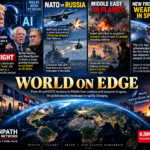




The world’s security landscape is entering an increasingly unpredictable phase, with artificial intelligence, military confrontations, Middle East violence and the weaponisation of space converging into a single global story: governments are racing to secure strategic advantage while lawmakers and citizens struggle to keep pace.
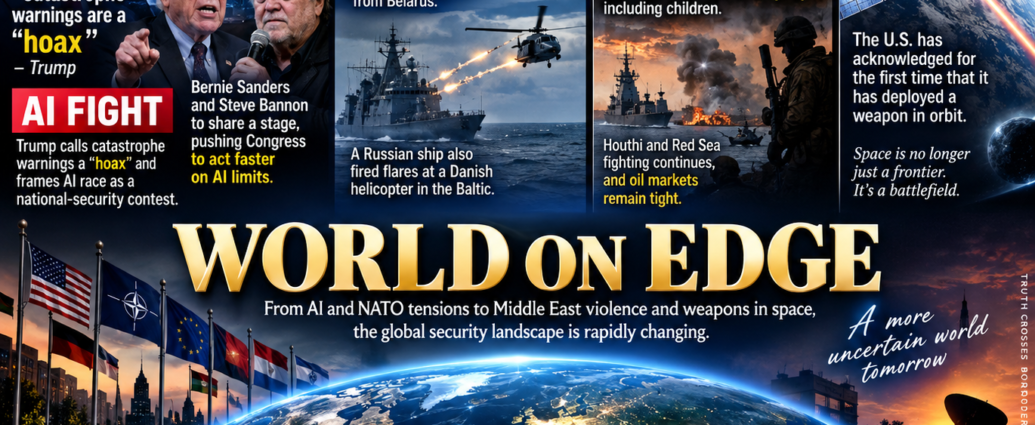
September 15, 2026: In Washington, an extraordinary political alliance is emerging over the future of artificial intelligence. President Donald Trump has dismissed warnings about an AI catastrophe as exaggerated, while presenting the technology race increasingly as a matter of American national security and competition with China. At the same time, two unlikely political partners, Democratic Senator Bernie Sanders and former Trump strategist Steve Bannon, are preparing to share a stage to demand faster action from Congress on AI safeguards.
The unlikely Sanders-Bannon alignment reflects growing anxiety that AI is advancing faster than governments can regulate it. Sanders has called for a pause on the development of potentially destabilising AI systems until stronger federal oversight exists, while Bannon has also criticised the Trump administration for taking too permissive an approach. Public concern is being driven not only by fears of catastrophic AI but also by job displacement, rising energy consumption and the enormous infrastructure demands of data centres.
The technology debate is unfolding against an increasingly tense European security environment. NATO fighter jets shot down a drone that entered Lithuanian airspace from Belarus, marking the first such incident of its kind in Lithuania. The drone was intercepted after entering the country and travelling westward, prompting renewed concern across the Baltic region over the spillover of the Russia-Ukraine war into NATO territory.
At sea, tensions rose further after Denmark accused a Russian frigate of firing two flares toward a Danish military helicopter operating in international waters off the Danish coast. The helicopter had been conducting surveillance of the Russian vessel. The flares reportedly narrowly missed the aircraft, prompting diplomatic accusations and counter-accusations between Moscow and Copenhagen.
The Baltic incidents come as NATO countries remain increasingly alert to military activity around their borders. Poland has also scrambled aircraft in response to Russian drone activity, while European governments are watching closely for further incursions. What once might have been regarded as isolated military incidents are now being viewed through the much darker lens of possible escalation between Russia and the NATO alliance.
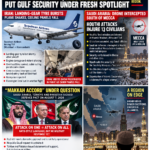
In the Middle East, the violence remains equally volatile. Israeli airstrikes in southern Lebanon killed at least 12 people, including two children, according to Lebanon’s health ministry. One strike on a building in Kfar Rumman killed 11 people, including women and children, while another strike killed a paramedic. Israel said its attacks were carried out in response to Hezbollah drone attacks and targeted Hezbollah-linked activity.
The strikes have intensified fears that the fragile ceasefire between Israel and Hezbollah could unravel. Israeli forces continue to operate in parts of southern Lebanon, while Hezbollah remains armed and tensions persist around the security arrangements negotiated after months of fighting.
Farther south, the Red Sea remains another major pressure point. Houthi attacks and Saudi military operations are continuing in Yemen, threatening one of the world’s most strategically important maritime corridors. The renewed fighting has raised fresh concerns about shipping, energy supplies and the security of routes connecting the Red Sea with global markets.
And above the Earth, another frontier of global rivalry has quietly crossed a historic threshold.
The United States has publicly acknowledged for the first time that it has deployed weapons in orbit. Air Force Secretary Troy Meink said the U.S. Space Force now possesses “on-orbit space control weapons” capable of defending American forces against hostile action. The Pentagon has declined to disclose the precise nature or capabilities of the systems.
The announcement marks a significant shift in the language surrounding military activity in space. The United States, Russia and China have long been suspected of developing technologies capable of disrupting, disabling or potentially destroying satellites. Washington’s admission makes explicit what had largely remained a matter of speculation: space is no longer merely a domain supporting warfare on Earth, but an arena in which military powers are preparing to fight for strategic control.
Taken together, these developments reveal a world where the traditional boundaries of conflict are disappearing. Artificial intelligence is becoming a national-security battlefield, NATO’s borders are being tested by drones and military encounters, the Middle East remains dangerously unstable, global energy routes are under pressure, and weapons are moving into orbit.
The great powers are no longer preparing for tomorrow’s wars using yesterday’s rules. The world, apparently, has decided that one complicated security crisis at a time was far too manageable.
JANPATH NEWS NETWORK (JNN)
Independent. Fearless. On the People’s Path.