





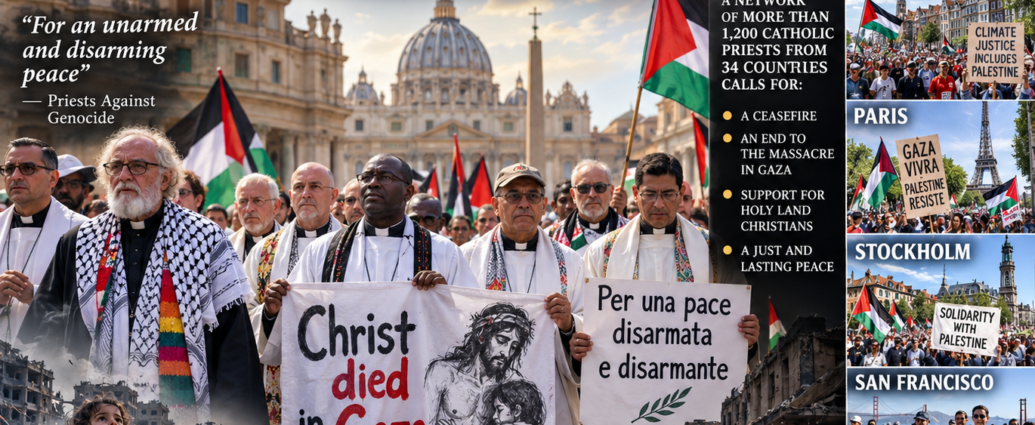
A network of Catholic priests from 34 countries has brought the suffering of Gaza into the heart of Rome, turning prayer, procession and public witness into a powerful call for an end to the war and the humanitarian catastrophe in the Gaza Strip.
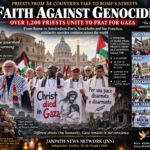
Gaza remains a global cause as solidarity marches fill streets across the world. In Rome, a representation of many countries joined hands, calling itself Priests Against Genocide, the network says it represents more than 1,200 Catholic priests across 34 countries. Its Rome action brought more than 100 priests into the streets, carrying Palestinian flags, wearing keffiyehs and displaying messages calling for peace and an end to the killing.
Their presence in Rome forms part of a much wider international movement. From Amsterdam and Paris to Stockholm and San Francisco, demonstrations, vigils, fundraising events and solidarity marches have continued to keep Gaza in the public eye.
Why Is This Crucial?
People are beginning to see Gaza not merely as “the Israeli-Palestinian conflict”, but as a test of what the world means when it says: human rights, civilian protection, international law, dignity and the sanctity of human life. That is why the Rome priests matter. They are essentially saying that this is no longer somebody else’s distant war, but a question of conscience.
The suffering of Gaza should not become normal.
From prayer to procession
The Rome gathering began with prayer at Sant’Andrea al Quirinale, before participants processed toward the Italian parliament and later gathered at another church.
Among the messages carried by the priests were “For an unarmed and disarming peace” and “Christ died in Gaza.”
The symbolism was unmistakable. Priests walked through the streets of Rome, not simply as religious figures but as witnesses demanding that the suffering of civilians in Gaza not become another statistic in a war that has consumed the attention of the world.
The network was founded in Italy in September 2025. Its first major public action took place on September 22 that year, coinciding with international debate over Palestine.
Among its prominent figures are Comboni missionary Fr. Alex Zanotelli and Xaverian superior general Fr. Fernando García Rodríguez. Supporters have included bishops and Cardinal Cristóbal López Romero of Rabat.
The network has called for a ceasefire, an end to what it describes as genocide and war crimes in Gaza, support for Christians in the Holy Land and what it calls a “disarmed and disarming” peace.
A movement that refuses to disappear
The Rome priests are part of a broader international picture.
In Amsterdam, tens of thousands joined a major climate march on September 12, with Palestine and Gaza among the issues highlighted by demonstrators.
In Paris, hundreds of pro-Palestinian protesters marched with Palestinian flags and demanded stronger political and economic pressure.
In Stockholm, demonstrators gathered at Odenplan before marching through the city in solidarity with Palestinians.
And in San Francisco, the Bay Area Gaza 5K transformed solidarity into humanitarian fundraising, with proceeds intended to support mental-health services for Palestine refugee children.
Different cities, different forms of protest, but a common thread runs through them: Gaza remains visible.
More than 1,200 voices
The distinction is important. The 1,200-plus figure refers to priests associated with or signing the network’s appeal, while roughly 100 priests participated in the Rome event itself.
The scale of the network nevertheless gives the Rome procession a significance beyond the streets where it took place.
For the priests involved, faith is being expressed not only through the sanctuary but through public solidarity with civilians caught in war.
Their message also reaches beyond Catholicism. The Palestinian flags, keffiyehs, prayers and calls for peace place the action within a much larger international campaign involving religious communities, humanitarian organisations, activists and ordinary citizens.
Gaza remains in the world’s conscience
The legal description of Israel’s conduct in Gaza remains fiercely contested. The priests use the term genocide, while Israel and its supporters reject that characterization and point to the October 7, 2023 Hamas attack and the group’s operations in civilian areas.
But whatever one’s position on the legal and political dispute, the Rome event itself represents a documented act of religious protest and solidarity.
And the demonstrations around the world suggest that the issue has not disappeared simply because other crises have occupied the headlines.
Priests pray in Rome. Crowds march in European capitals. Runners dedicate kilometres to Gaza. Communities raise money. Vigils continue after sunset.
Thousands of kilometres from Gaza, people continue to insist that distance cannot become an excuse for indifference.
From Rome to Amsterdam, Paris, Stockholm and San Francisco, the message continues to travel: Gaza remains not only a political question, but a human one.
JANPATH NEWS NETWORK (JNN)
Independent. Fearless. On the People’s Path.