


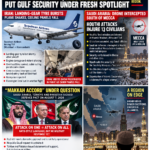






September 16: A dramatic aircraft incident in Iran, a Houthi drone interception near Mecca and growing questions over the newly signed Saudi-Türkiye-Pakistan defence pact have put the region’s security environment under renewed scrutiny.
The incidents are unrelated, but their timing has produced a striking picture of a Middle East where aviation safety, missile and drone warfare and new military alliances are increasingly colliding. Humanity, having apparently decided that one regional crisis at a time would be too simple, continues to multitask.
Plane “overturned in the air” claim debunked
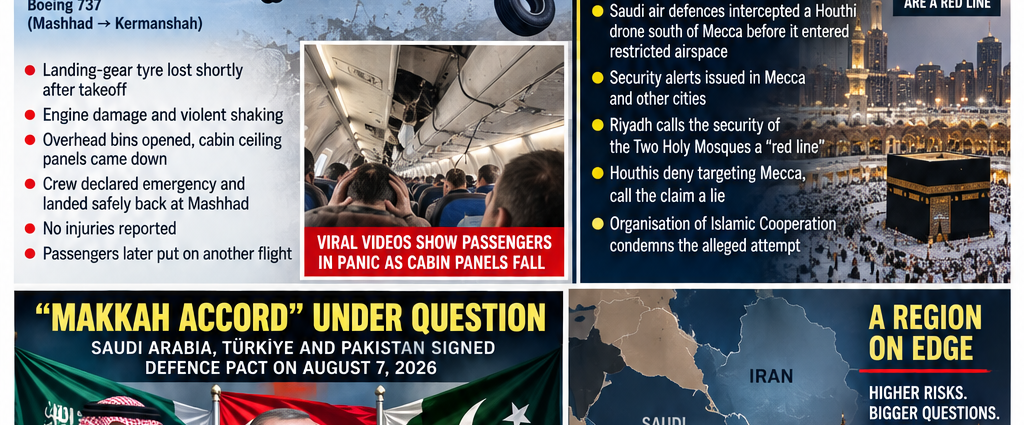
A viral description claiming that a “ship’s tyre burst” and that the aircraft “overturned in the air” refers to a Sepehran Airlines Boeing 737, not a ship. The aircraft was flying from Mashhad to Kermanshah on September 15 when a landing-gear tyre reportedly failed shortly after takeoff. The incident caused engine trouble and severe vibrations, while parts of the cabin interior, including ceiling panels, came loose and fell into the passenger compartment.
Videos recorded inside the aircraft showed passengers gripping seats and reacting as the cabin shook violently. Overhead compartments were affected and sections of the ceiling dropped down, exposing parts of the aircraft’s internal structure.
The crew declared an emergency and returned the aircraft safely to Mashhad. No injuries were reported, and passengers were subsequently transferred to another flight to Kermanshah. The runway was temporarily closed for inspection, while Iran’s aviation authorities began examining the incident.
The episode also comes after another Sepehran Airlines Boeing 737-500 was involved in a runway incident in Tehran in August, also without reported injuries.
Houthi attacks bring Mecca into the security picture
Far more consequential geopolitically was the escalation between Saudi Arabia and Yemen’s Iran-aligned Houthi movement.
Saudi authorities said Houthi missiles and drones targeted areas around Khamis Mushait, Abha and Taif, with 13 civilians reported injured. Saudi authorities subsequently issued security alerts covering several cities, including Mecca, Jeddah and Taif.
The most sensitive development came when Saudi air defences intercepted and destroyed a Houthi drone south of Mecca before it entered the city’s restricted airspace. Saudi coalition spokesman Turki al-Malki described the security of Mecca, Islam’s holiest city, as a “red line” and warned of further action.
The Houthis, however, denied that they had targeted Mecca or an Islamic holy site, disputing the Saudi characterization of the incident.
Saudi Arabia also activated emergency warnings in Mecca and other cities as authorities responded to the widening threat. The alerts were brief, but their appearance over Mecca carried significance because of the city’s religious importance.
The Organisation of Islamic Cooperation and other Muslim bodies have condemned threats to Saudi territory and the holy sites.
The Makkah defence pact faces its first serious test
The drone incident has also revived questions about the Makkah Joint Defence Agreement, signed by Saudi Arabia, Türkiye and Pakistan on August 7, 2026. The agreement contains a major collective-defence commitment: an armed attack against any one of the three countries is to be regarded as an attack against all three. It also calls for deeper defence cooperation and collective deterrence.
That language has inevitably invited comparisons with NATO’s Article 5, although the Makkah agreement has its own institutional structure and implementation arrangements.
The crucial question now is not what the agreement says on paper, but how and when it would actually operate during a crisis.
Pakistan’s Foreign Office said on September 10 that the three countries were still working to consolidate the organisation and establish the mechanisms required for its functioning. The Foreign Office described the pact as an “umbrella agreement” and said it was premature to discuss its operationalisation in terms of military action.
Pakistan’s position followed comments from Defence Minister Khawaja Asif that continued attacks spilling into Saudi Arabia could potentially activate the agreement.
The distinction is important. The pact exists, but its full military machinery is still being developed. Pakistan has separately said that its troops already present in Saudi Arabia are there for training and logistical purposes, rather than as part of an announced joint operation against the Houthis.
A new alliance under pressure
The Mecca drone alert therefore represents an early test of the political meaning of the new trilateral arrangement.
Saudi Arabia has so far relied on its own air-defence systems to intercept the reported threat. Pakistan and Türkiye have expressed support for Saudi sovereignty and security, while Pakistan has publicly emphasized that the alliance’s institutional mechanisms are still being established.
The result is an emerging distinction between collective political commitment and immediate collective military action.
For Saudi Arabia, the stakes are unusually high. The kingdom is facing attacks on its territory while attempting to protect critical infrastructure and the country’s most important religious sites. For Pakistan and Türkiye, the crisis provides an early real-world test of an alliance that was only formally created weeks ago.
Meanwhile, the wider regional security picture continues to deteriorate, with drone warfare increasingly capable of reaching cities, energy infrastructure and strategically sensitive locations.
The Iranian aircraft incident had a very different cause, but its frightening cabin footage has also become part of the day’s global news cycle. One aircraft survived a mechanical emergency and returned safely to the runway. In the skies over Saudi Arabia, however, the concern is of an altogether different kind: drones, missiles and the question of how far a new defence alliance is prepared to go when one of its members comes under attack
JANPATH NEWS NETWORK (JNN)
Independent. Fearless. On the People’s Path.