





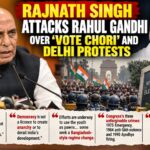
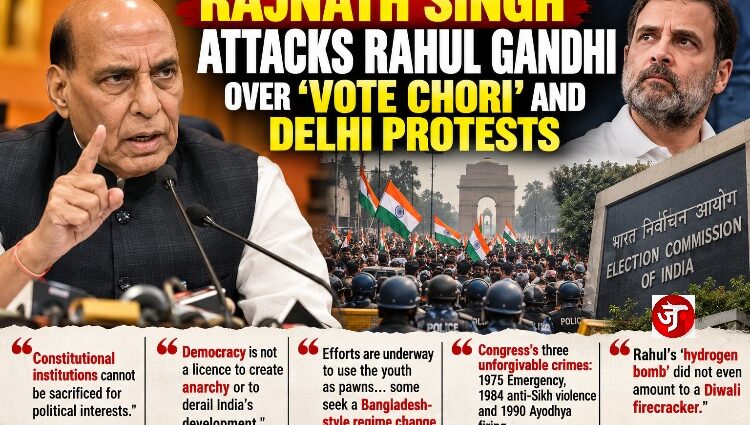
Rajnath Singh launched a sharp attack on Rahul Gandhi, the Congress and the INDIA bloc on Friday, accusing the opposition of politicising constitutional institutions and attempting to create unrest through protests over alleged electoral irregularities, the Special Intensive Revision (SIR) of electoral rolls and claims of “vote chori” (vote theft).
October 16, 2026: Rajnath Singh, Defence Minister, addressing a press conference in Lucknow, defended the Election Commission of India amid mounting political tensions over Chief Election Commissioner Gyanesh Kumar and the opposition’s allegations concerning electoral transparency. Rajnath Singh argued that constitutional institutions must not become casualties of political rivalry and warned that confrontation in the name of democracy could undermine governance and development.
The press conference marked another escalation in the BJP-Congress confrontation over the credibility of electoral institutions, the SIR exercise and the opposition’s protests in Delhi.
Rajnath Singh tells Rahul Gandhi to respect the public mandate
Rajnath Singh urged Rahul Gandhi to move away from what he described as the “politics of disruption” and instead respect the public mandate. He argued that India needed dialogue, constructive opposition and nation-building rather than confrontation.
“Democracy is not a licence for anarchy” was the central message of Rajnath Singh’s criticism of the Delhi protests. While acknowledging the right to protest, he maintained that democratic dissent must not be used to undermine constitutional institutions or obstruct the country’s development.
The BJP leader accused the Congress of attempting to discredit institutions for political advantage. The opposition, however, has maintained that questioning electoral processes and demanding accountability are legitimate democratic responsibilities.
Rajnath Singh invokes Bangladesh-style regime change
In one of his strongest allegations, Rajnath Singh claimed that sections of the opposition were attempting to use the country’s youth as pawns in a campaign of political instability.
Referring to Bangladesh’s recent political upheaval, Rajnath Singh alleged that calls for a Bangladesh-style regime change and the toppling of the government revealed intentions that went beyond electoral reforms or concerns about the SIR process.
He accused the opposition of trying to create an atmosphere of anarchy and derail India’s progress through extra-constitutional means.
These were serious political allegations made by Rajnath Singh. not treated as established facts about the intentions of the protesters. The opposition’s stated concerns centre on electoral transparency, alleged irregularities and the functioning of the Election Commission.
Rajnath Singh recalls Congress’s Emergency and 1984 anti-Sikh violence
Rajnath Singh turned the spotlight on the Congress’s political record, citing three episodes he described as “unforgivable crimes”.
The first was the Emergency imposed in 1975 under former Prime Minister Indira Gandhi, when civil liberties were curtailed and opposition leaders were imprisoned.
The second was the 1984 anti-Sikh violence, in which thousands of Sikhs were killed following Indira Gandhi’s assassination. Allegations of complicity and political protection involving Congress leaders have remained a deeply contentious chapter in India’s political history.
The third concerned the 1990 police firing on kar sevaks in Ayodhya under the Uttar Pradesh government led by Mulayam Singh Yadav, which the Congress supported politically.
Rajnath Singh also accused the Congress of questioning the Election Commission selectively, arguing that the party had exercised considerable influence over the institution when it was in power. He contrasted this with the BJP’s stated position that constitutional bodies and electoral outcomes should be respected.
The remarks added a historical dimension to the present dispute over the Election Commission, shifting the debate from the immediate allegations of vote theft to the political records of both parties.
Rajnath Singh dismisses Rahul Gandhi’s ‘hydrogen bomb’ claim
Rajnath Singh also ridiculed Rahul Gandhi’s much-publicised “hydrogen bomb” remark concerning alleged electoral irregularities, reportedly saying it did not even amount to a Diwali firecracker.
The Defence Minister questioned the evidence behind allegations involving purported duplicate voters and discrepancies in electoral records. He argued that the Congress had not substantiated its claims through formal complaints.
However, allegations concerning electoral rolls must ultimately be assessed against the underlying records, official responses and any complaints or investigations. Political dismissal alone cannot establish whether an allegation is true or false.
The exchange reflects the increasingly combative nature of the debate over vote chori, with the BJP challenging the opposition to produce evidence and the Congress pressing for scrutiny of the electoral process.
Rajnath Singh targets Rahul Gandhi over Rae Bareli
Turning to Uttar Pradesh politics, Rajnath Singh pointed to the Congress’s prolonged absence from power in the state, claiming that the party had been out of power in Uttar Pradesh for 37 years.
He also questioned whether Rahul Gandhi could win Rae Bareli without the support of the Samajwadi Party, highlighting the Congress’s dependence on opposition alliances in the state.
The remarks served as a reminder that the confrontation over SIR, vote chori and the Election Commission is also unfolding against the backdrop of electoral calculations and the future of INDIA bloc unity.
Vote chori row puts the Election Commission under the spotlight
The attack by Rajnath Singh comes amid continuing opposition protests over the Election Commission, Chief Election Commissioner Gyanesh Kumar and the SIR exercise.
For the BJP, the argument is that the opposition is attempting to undermine constitutional institutions and manufacture a political crisis without adequate evidence. For the Congress and its allies, the central issue is whether electoral rolls and the functioning of the Election Commission are receiving sufficient public scrutiny.
The dispute has become larger than the exchange between Rajnath Singh and Rahul Gandhi. It concerns the credibility of electoral processes, the accountability of constitutional institutions and the right of political parties to challenge decisions they consider questionable.
The decisive question is whether the competing claims over vote chori can be resolved through transparent procedures, verifiable evidence and impartial scrutiny. Defending institutions requires public confidence in their independence, while challenging them requires evidence. Neither political rhetoric nor counter-allegations can substitute for that test.
As Rajnath Singh escalates his attack on Rahul Gandhi and the Congress, the battle over SIR, vote chori and the Election Commission is set to remain a major flashpoint in Indian politics.
JANPATH NEWS NETWORK (JNN)
Independent. Fearless. On the People’s Path.