









Nineteen dead. Dozens injured. A festival of faith turned into a scene of horror. In a city accustomed to millions thronging its streets during Durga Puja, how did a crowded evening at Chorbagan become Kolkata’s first fatal stampede during the celebrations?
October 18, 2026: Kolkata knows crowds. It lives with them, moves through them, breathes through them, and celebrates among them. Its buses overflow, its markets spill onto pavements, its narrow lanes become rivers of people, and every autumn, millions take to the streets for Durga Puja, navigating packed pandals, serpentine queues and traffic-choked neighbourhoods in one of the world’s great public festivals.
Yet on Saturday evening, October 17, that familiar spectacle of collective celebration turned into a nightmare.
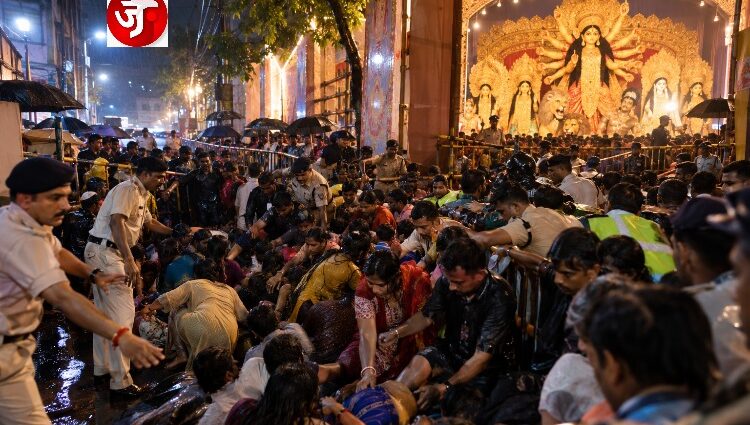
The tragedy unfolded at around 7.40 pm, amid heavy rain and a rush of devotees visiting the pandal. Eyewitness accounts suggest that people gathered near the entrance to escape the downpour, while others continued trying to enter. As pressure built in the confined space, the crowd began pushing forward. People reportedly lost their footing, fell over one another and became trapped in the crush.
According to The Times of India, one survivor described how visitors sheltering near the entrance kept pushing to get inside as the rain continued. Within minutes, the pressure became unbearable. Several people reportedly fell near a flight of stairs close to the exit and were trampled by those behind them. What began as congestion rapidly escalated into a life-threatening emergency.
At least 19 people were reported dead and around 25–35 injured in a stampede at the Chorbagan Sarbojanin Durga Puja pandal in north Kolkata during Maha Saptami.
For a city that has managed enormous festival crowds for generations, the tragedy raises a devastating question: How did a celebration that takes place every year, in a city that knows exactly how crowded its streets can become, end in such a catastrophic loss of life?
When a familiar crowd becomes a death trap
In a densely packed crowd, danger does not always begin with panic. It can begin with a few people slowing down, a queue suddenly stopping, or visitors moving in different directions within a confined space. Those behind may continue advancing without knowing that people at the front have fallen. Pressure builds, movement becomes impossible, and a crowd can turn deadly within minutes.
Rain may have triggered the surge. The narrow lane may have intensified it. But neither circumstance, by itself, answers the most important question: Were the arrangements capable of protecting the people who had come to celebrate?
Kolkata has seen the warning signs before
The tragedy is particularly disturbing because Kolkata has experienced serious crowd-control problems during previous Durga Puja celebrations.
In 2015, Deshapriya Park in south Kolkata attracted enormous crowds after organisers unveiled an 88-foot Durga idol promoted as the world’s tallest. The influx overwhelmed the surrounding streets, causing severe congestion and reports of panic, breathing difficulties and injuries. Authorities eventually restricted access to the site. No deaths were reported in that incident.
The circumstances were different, but the underlying challenge was familiar: a hugely popular attraction drawing people into a confined urban space.
That episode should have reinforced an essential lesson. Crowd safety cannot depend on good fortune, the patience of visitors or the assumption that people will always move in an orderly fashion. It requires planning for what happens when the expected flow breaks down.
The Chorbagan tragedy makes it necessary to ask whether those lessons were adequately applied. Were crowd-density limits enforced? Were emergency exits protected from obstruction? Were contingency plans in place for sudden rain? Could the flow of people have been redirected before the situation became dangerous?
These questions are not accusations. They are the questions a credible investigation must answer.
A city that knows crowds must know how to protect them
Durga Puja is not an ordinary public gathering. It is an extraordinary annual logistical challenge involving thousands of pandals, millions of visitors, changing traffic patterns and crowds that swell dramatically around popular attractions.
Kolkata’s streets, particularly in older neighbourhoods, were not designed to accommodate unlimited numbers of people moving through them simultaneously. That reality makes careful planning more important, not less.
The crucial issue is not whether a pandal was crowded. Crowds are inevitable during Durga Puja. The issue is whether the crowd was managed safely and whether warning signs were recognised in time.
A festival that attracts millions cannot rely on luck to keep them alive.
Compensation
West Bengal Chief Minister Suvendu Adhikari ordered an investigation, with a Special Investigation Team reportedly being constituted under the leadership of a sitting Calcutta High Court judge. Organisers and others have been detained for questioning, while other major pandals were temporarily closed as authorities responded to the tragedy.
TThe state government has announced compensation of ₹25 lakh and a government job for the family of each deceased person, along with ₹5 lakh for each injured person and coverage of medical expenses. Prime Minister Narendra Modi has also announced assistance of ₹2 lakh from the Prime Minister’s National Relief Fund for the next of kin of those killed.
Nineteen dead
There is a cruel irony in the fact that a festival celebrating the victory of good over evil should end with so many families confronting a tragedy that may have been preventable.
Kolkata’s Durga Puja is a celebration of art, devotion, community and the city’s extraordinary ability to bring people together. Its pandals are places of wonder. Its crowded streets are part of its identity.
Nineteen people went out to celebrate, their lives were lost. In a city that knows crowds better than most, the question is no longer simply how the stampede happened. It is why the safeguards failed to prevent it, and what will be done to ensure it never happens again. Kolkata is also a city that always gets back on its feet, while pulsating with life. Yet this time in a Durga Puja pandal, nineteen did not return home. Why?
JANPATH NEWS NETWORK (JNN)
Independent. Fearless. On the People’s Path.