










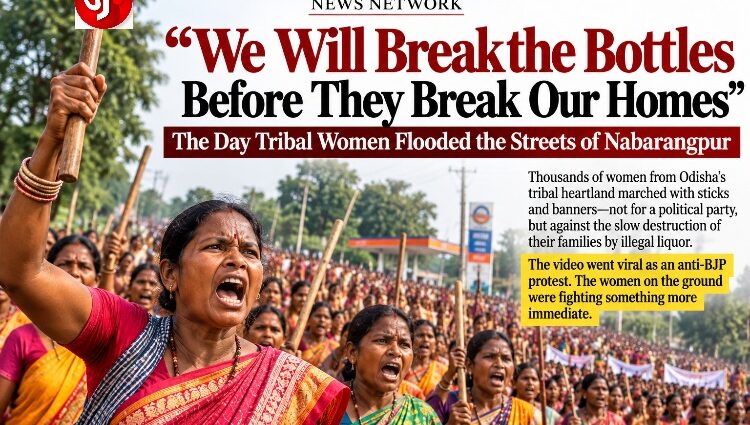
There is something big happening in India that no news channels are talking about: The scale is massive, the caption incomplete: On October 15, 2026, thousands of women from Odisha’s tribal heartland marched with sticks and banners, not for a political party, but against the slow destruction of their families by illegal liquor. The video went viral as an anti-BJP protest. The women on the ground were fighting something more immediate.
On the roads of Nabarangpur, the air filled with the sound of thousands of women. Most wore bright sarees, carried sticks, and moved in a dense, determined mass past trees, power lines, and a petrol station, banners raised, voices sharp. The video that captured this scene was posted by Samajwadi Party leader I.P. Singh with a simple claim: this was a massive protest by women in Odisha’s tribal areas against the BJP government.
What unfolded in Nabarangpur on 16 October 2026 was a district-wide mobilisation organised by the District Nari Mahasangha. Women from villages and panchayats across all ten blocks gathered at Chauria Guda Square and marched to the Collector’s office. Their demand was blunt and repeated: shut down unauthorised liquor outlets, act against the traders flooding the area with cheap country liquor and pouch liquor, and declare Nabarangpur an alcohol-free district. They submitted a ten-point charter and warned that if the administration did nothing within fifteen days, they would intensify the agitation by surrounding police stations.
Local reporting from The New Indian Express and other outlets described the same scene: thousands of women, many from tribal communities, alleging that open sale of liquor at roadside shops and eateries had deepened domestic violence, verbal abuse, economic ruin, and addiction among labourers and the young. Some pointed to sales continuing in Fifth Schedule areas without Gram Sabha consent. Leaders from the Biju Janata Dal and Congress joined them in support. The women were not waiting for any party’s permission to speak.
This was not an isolated flare-up. Throughout 2026, women in Nabarangpur, Kalahandi, Mayurbhanj, and Koraput have repeatedly taken to the streets, sometimes blocking highways, sometimes confronting liquor dens directly, sometimes destroying stocks. The pattern is familiar across parts of tribal Odisha: alcohol drains household income, fuels violence inside homes, and leaves women carrying both the financial and emotional burden. When enforcement remains weak, the women have turned to organised action of their own.
The viral post framed the march as a broad political uprising against the ruling BJP government in the state. That framing travelled quickly on social media. On the ground, the women were naming a concrete failure, the unchecked trade that reaches their villages, and demanding the administration stop it. Opposition parties amplified the protest; the women themselves have been running versions of this campaign for months. The difference matters. One version treats the march as evidence in a larger political argument. The other treats it as a direct response to a daily problem inside homes.
Nabarangpur is not an outlier. Similar mobilisations have appeared in other tribal districts under the same state government. The women carrying sticks are not an abstract symbol. They are responding to a trade that reaches their markets and their families with relative ease, while their earlier complaints produced limited results. When they gather in the thousands and march, they force the issue into public view in a way that scattered complaints have not.
The video shows the size of that gathering. The women in it are not waiting for the next election cycle or the next statement from any national party. They have already decided that the cost of remaining silent is higher than the cost of walking the road with sticks in their hands. The question now is whether the administration will treat the ten-point charter as a temporary headline or as a deadline that must be met. The women have already given their answer.
JANPATH NEWS NETWORK (JNN)
Independent. Fearless. On the People’s Path.