





CJP’s ‘Lehra Do Tiranga’ march turns Connaught Place into a tense confrontation as police detain activists amid a crackdown on a gathering, along with Neha Bora and Dipke’s detainment right at the onset
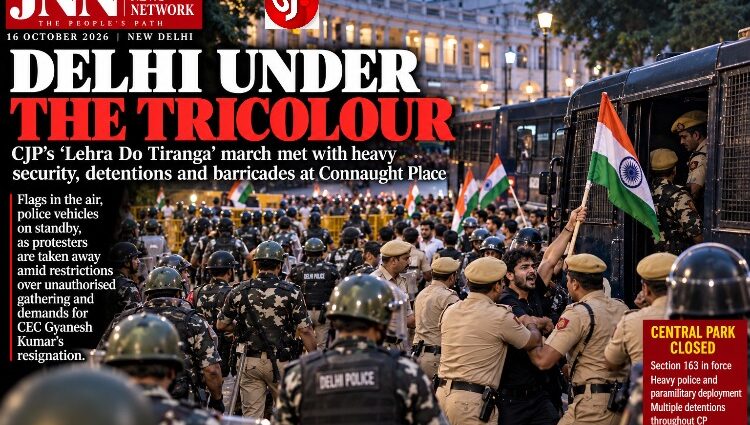
October 16, 2026: CJP’s tricolour march was meant to be the rallying point. Instead, the Lehra Do Tiranga march in Delhi has become another flashpoint in the escalating confrontation over electoral transparency, police restrictions and the right to peaceful protest.
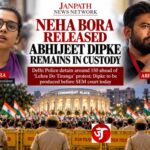
Before the march could begin at 5 pm, founder Abhijeet Dipke was preventively detained from the house where he was staying (near Karol Bagh/Jhandewalan area) as he tried to leave, and put into a police vehicle. AISA student leader Neha Bora was picked up at Mandi House. There were reports of jostling and people trying to block police vehicles.
The demonstration had been called for 5 pm at Central Park, where supporters were urged to assemble carrying the national flag and demanding accountability over alleged irregularities in electoral-roll revisions, and also to wave the Tiranga as an act of patriotism.
The activity was concentrated in and around Connaught Place (CP) in central Delhi , specifically near the closed Central Park, the inner circle, Palika Bazaar Gate areas, and approaches from Mandi House and toward Jantar Mantar. This is a busy commercial shopping district, not a designated protest site. Authorities had already closed Central Park for two days and imposed restrictions under Section 163 of the BNSS (prohibitory orders) across the area.
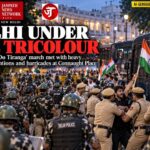
Crowds of a few hundred (reports of 200–300 and growing toward evening) gathered, many carrying Tricolours. Police moved in to disperse people, with some face-offs as protesters pushed forward while officers asked them to leave.
The air was tense and chaotic in the classic “heavy security vs. small-to-medium gatherings with flags” way with thousands of Delhi Police and paramilitary personnel, barricades all around that the area is described as a “fortress.”
Specific incidents included a student trying to escape a bus by jumping out a window (caught by police) and general commotion as groups converged near the park and inner circle.
It was a mixed atmosphere of flag-carrying protesters, students and opposition figures joining, and counter-groups of local shopkeepers chanting in support of police/Modi.
‘Waving the Tiranga is not a crime’
Dipke had called on citizens to gather with the national flag, arguing that CJP members Saurav Das and Ashutosh Ranka had been jailed for unfurling the Tricolour, which was not a crime.
The two activists were remanded to five days of judicial custody after police accused them of entering Jantar Mantar, which is no longer a designated protest site, and violating undertakings intended to maintain public peace. CJP supporters maintain that the action against them followed a peaceful display of the national flag.
Dipke’s message sought to turn the controversy into a test of patriotism and democratic freedoms. He declared his readiness to go to jail rather than abandon the protest.
For CJP, the flag march connects the immediate case of its detained activists to that wider political demand, and also a “fight for democracy”.
The movement began as political satire, drawing its name from controversial remarks comparing unemployed young people to cockroaches. It has since broadened its messaging around jobs, education and electoral issues, giving it a platform that extends beyond its original satirical identity.
The Delhi High Court had declined to restrain the proposed protest on October 15, while recording the police’s assurance that the gathering would be regulated in accordance with the law. That decision was not an unconditional grant of permission to hold the event at Central Park.
JANPATH NEWS NETWORK (JNN)
Independent. Fearless. On the People’s Path.