










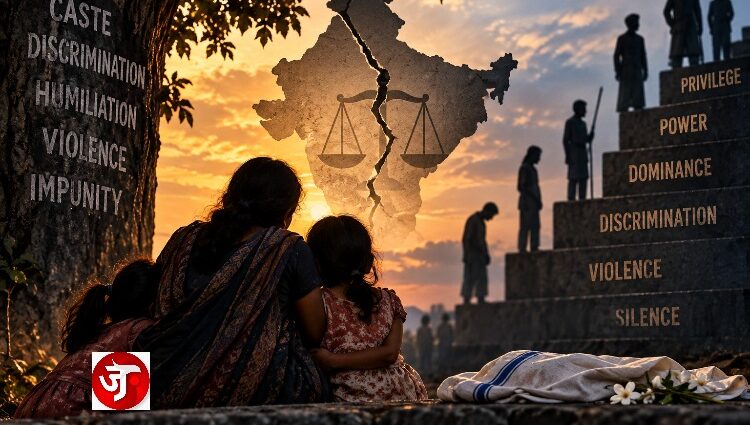
Uttar Pradesh: A 35-year-old Dalit man was allegedly surrounded and bludgeoned with sticks in Uttar Pradesh’s Sitapur district as his wife and young daughters pleaded for his life. His family alleges caste-based abuse; police cite an old rivalry as the investigation continues. Four arrested.
October 16, 2026: A roadside in Uttar Pradesh’s Sitapur district has become the scene of a horrifying tragedy. Manoj Gautam, a 35-year-old Dalit man, was allegedly beaten to death with sticks in front of his wife and young daughters, who pleaded with his attackers to stop. Their desperate appeals could not save him.
The assault took place around 6 pm on Thursday, October 15, near National Highway 30 in the Ludhaura village panchayat area, under Kamalapur police station. Manoj was reportedly returning from the local market with family members when a group surrounded him and launched the fatal attack.
According to reports, his wife and daughters tried to intervene, pleading with the assailants to spare him. Family accounts also allege that relatives who attempted to protect him were assaulted. Manoj was rushed to the Community Health Centre in Kasmanda but was declared dead on arrival.
A video showing his grieving wife and children beside his body circulated widely on social media, bringing the horror of the incident into public view. Behind the footage lies a family shattered by violence and children left to grapple with a loss no child should have to witness.
An old rivalry, a previous SC/ST Act case and allegations of caste abuse
Police have cited an old rivalry between the parties as the apparent backdrop to the killing. Reports further indicate that Manoj had previously filed a case under the Scheduled Castes and Scheduled Tribes (Prevention of Atrocities) Act against the accused. An altercation reportedly occurred between the two sides on Wednesday, a day before the fatal assault.
Manoj’s family has alleged that casteist slurs were used during the attack. These allegations raise serious questions about whether caste hostility played a role in the killing, although the precise motive and individual responsibility remain under investigation.
The distinction is important. An earlier dispute may help explain the sequence of events, but it does not excuse a fatal assault. Investigators must establish what happened, who participated, whether caste-based abuse occurred and whether the provisions of the SC/ST Act apply.
Four arrested as police hunt for remaining accused
An FIR was registered late Thursday night on the basis of the family’s complaint, naming six people. Those identified in reports include Shubham Singh, Dhirendra Singh, Narendra Singh, Kalpana and Sunita, along with another person whose identity was not fully established in early reporting.
By Friday, police had taken four of the six accused into custody, including Shubham Singh, Dhirendra Singh and Narendra Singh. Search operations were under way for the remaining suspects.
Sitapur Superintendent of Police Ankur Agrawal and personnel from multiple police stations visited the scene. Although tension was reported in the area, police said the situation was under control.
The arrests are an initial step, not the end of the matter. The investigation must establish the precise sequence of events, identify each accused person’s role and ensure that the family’s allegations are examined thoroughly. The remaining suspects must be traced and the case pursued through due process.
Chandra Shekhar Azad demands accountability
Bhim Army leader and Nagina MP Chandra Shekhar Azad condemned the killing, describing the incident as deeply shameful and alarming. Referring to the family’s account of casteist abuse and the assault on those who tried to intervene, he demanded the immediate arrest of all accused, a fair investigation and strict legal action.
Azad also questioned the pace of the police response and said local Bhim Army and Azad Samaj Party representatives were standing with the bereaved family.
Calls have also emerged for the effective application of the SC/ST Act, financial compensation and sustained support for Manoj’s wife and children. Any compensation must be assessed through the applicable legal and government procedures, while the family’s immediate needs deserve urgent attention.
Justice must extend beyond arrests
The killing of Manoj Gautam, a Dalit man, is not merely a crime recorded in a police register. It is the story of a man who died, brutally, a wife who witnessed a horrifying assault and children whose pleas could not stop the violence.
The allegations of caste-based abuse make a thorough, impartial investigation especially important. If caste discrimination or caste-based violence is established, the law must be applied accordingly. If other motives or circumstances emerge, those too must be established through evidence rather than assumption.
For now, four arrests have been reported, the investigation remains open and a family is left to mourn.
The measure of justice in Sitapur will not be the speed with which public outrage fades, but whether every allegation is investigated, every perpetrator is held accountable, and the family receives the protection and dignity it deserves. But this tragedy also forces India to confront a deeper, more uncomfortable truth: the cruelty of a caste system that continues to divide human beings by birth, deny dignity to some, and perpetuate generations of humiliation and violence. No person should have to fight for the right to live with dignity because of the caste into which they were born. A society that tolerates the humiliation of one human being diminishes the humanity of all.
Based on reports available as of October 16, 2026. The investigation is ongoing.
JANPATH NEWS NETWORK (JNN)
Independent. Fearless. On the People’s Path.