









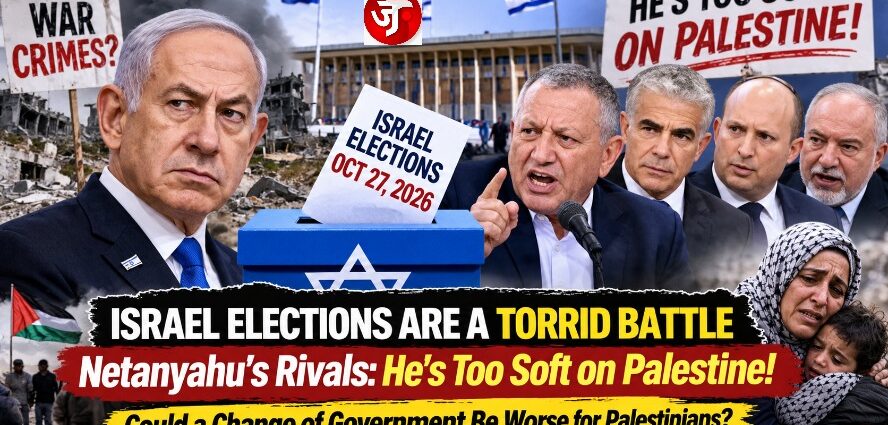
As Israel heads towards the October 27 election, one question hangs over Palestinians living through war, occupation and displacement: if Benjamin Netanyahu loses power, his successors could prove even more hardliners
October 17, 2026: Israel is approaching a pivotal election, its first since the Hamas-led attacks of October 7, 2023. The election campaign has descended into a bitter battle of contradictions. As Netanyahu faces international accusations of war crimes over Israel’s conduct in Gaza, his opposition rivals are accusing him of being too soft on Palestine. In a political landscape that has shifted sharply to the right since October 7, 2023, the question is chilling: if Netanyahu loses, could Palestinians face an even more hardline government?
Here are some quotes from Opposition leaders since August 2026:
“There is no Palestinian state, and in the government that we will form, a Palestinian state will not be established.”
Gadi Eisenkot (Yashar party, leading opposition figure)
“As long as Benjamin Netanyahu remains in power, Hamas will remain in power. The man who puts up signs saying ‘We will not surrender’ is the first to surrender: to draft dodgers, to his coalition partners and to Hamas.”
Gadi Eisenkot
(Speaking near the Gaza border, 15 October 2026)
“I pledge that within 18 months of entering the Prime Minister’s Office, Hamas will no longer rule the Gaza Strip. We will bring about the destruction of Hamas’ military wing.”
(Same Gaza-border appearance)
“Anyone who is thinking about a two-state solution after October 7 is just delusional.”
(August 2026 interview)
“There is no Palestinian state, and in the government that we will form, a Palestinian state will not be established.”
(August 2026)
“I have never advocated two states for two peoples. Netanyahu found a true friend in Arafat and spoke in favour of a Palestinian state on four occasions.”
(October 2026 radio interview)
“Netanyahu is Hamas’s fuel.”
Avigdor Liberman (Yisrael Beytenu)
“The only one who declared his willingness to establish a Palestinian state is Benjamin Netanyahu.”
(Referring to the 2009 Bar-Ilan speech; October 2026)
“Netanyahu is acting in a way that will bring about a Palestinian state, and he wants a Palestinian state to be established. Because when we do nothing, when we simply contain the situation without taking any initiative, we will have no one to blame.”
(October 2026)
“Exactly two years from this conference, the United States is going to recognize a Palestinian state in all of Yehuda and Shomron, the Jordan Valley, Gaza and eastern Jerusalem… And this is something that will be almost impossible to reverse.”
(October 2026; he has also called Netanyahu “the father of containment”)
“After 33 years since the signing of the Oslo Accords, it can be determined that the experiment failed, the agreements went bankrupt, and the Palestinian Authority must be dismantled.”
(September 2026)
A coalition of opposition movements has united around one immediate objective: ending Netanyahu’s long rule. But unity against a prime minister does not necessarily translate into unity for peace. The opposition spans different parts of Israel’s political spectrum, and its members share no clear consensus on Palestinian statehood, the future of Gaza or the extent of Israeli control over the occupied West Bank.
The uncomfortable question is whether Israel is preparing for a change of leadership without a change of direction.
When Netanyahu is accused of being too soft
Netanyahu has spent much of his political career opposing a fully sovereign Palestinian state, backing settlement expansion and insisting on overriding Israeli security control. His government has also relied on far-right coalition partners who favour even more uncompromising policies towards Palestinians.
Yet Netanyahu is being criticised by parts of the Israeli right for precisely the opposite reason: that he has not gone far enough.
Right-wing opposition leader Avigdor Liberman has attacked Netanyahu over his earlier, conditional acceptance of Palestinian statehood and what he considers insufficient action against Palestinian political institutions. Far-right critics have also condemned tactical restraint, including compromises involving hostages and responses to international pressure.
This is the paradox at the heart of Israel’s election campaign. Netanyahu, already associated with some of the hardest-line policies in Israeli politics, faces opponents who argue that he has been too restrained.
For Palestinians, that is hardly a reassuring prospect.
An opposition that does not promise a Palestinian state
Gadi Eisenkot, a former Israeli military chief and a leading opposition figure, has rejected the idea that a two-state solution is a realistic prospect in the aftermath of October 7. His approach prioritises Israeli security control, the demilitarisation of Gaza and the removal of Hamas from power.
Other opposition figures have their own differences with Netanyahu, including over governance, military preparedness, judicial reform and accountability for the October 7 security failures. But replacing Netanyahu does not automatically mean embracing Palestinian sovereignty.
This matters because an Israeli government may become more professionally managed, more receptive to Washington and less dependent on extremist coalition partners without fundamentally changing the conditions under which Palestinians live.
What do the election numbers suggest?
Recent polling cited in the campaign points towards a close contest, with neither the pro-Netanyahu bloc nor the opposition-aligned bloc consistently reaching the 61 seats required for a parliamentary majority.
The opposition brings together Yashar, the Democrats, Yisrael Beytenu and the Together alliance, associated with Naftali Bennett. Their cooperation is intended to improve their chances of forming a government.
But a narrow electoral lead is not the same as a governing majority. Coalition negotiations could prove difficult, and another political deadlock remains possible.
Arab parties may hold significant parliamentary leverage, although their ability to influence the formation of a government will depend on the election result and the willingness of other parties to cooperate with them.
For Palestinians, the arithmetic presents a troubling possibility: Israel could spend months negotiating who governs while the fundamental questions of occupation, settlement expansion and Gaza’s future remain unresolved.
Gaza: A different manager, but the same destination?
If Netanyahu returns to power, continuity is the likeliest outcome: a hardline security policy, resistance to international pressure for Palestinian statehood and continued dependence on right-wing partners.
An opposition-led government could adopt a different diplomatic tone, pursue a Gaza plan more closely aligned with US preferences, and establish an independent inquiry into the October 7 failures. It might also take a different approach to relations with Arab states and international partners.
These differences could matter. Restraint on settlement expansion, action against extremist settler violence, improved humanitarian access and a credible political process would have real consequences for Palestinian lives.
But there is a significant gap between changing how a conflict is managed and changing the political structures that sustain it.
If a new government still rejects meaningful Palestinian sovereignty, insists on indefinite Israeli security control and offers no credible route out of occupation, the change may be substantial for Israeli politics but painfully limited for Palestinians.
The West Bank: The danger beyond Gaza
Gaza dominates international attention, but the West Bank is equally central to the question of what comes next.
Settlement expansion, settler violence, restrictions on movement and the fragmentation of Palestinian territory remain major obstacles to a viable Palestinian state. A change of government could influence the pace and intensity of these policies, particularly if a new coalition is less dependent on far-right parties.
Yet the opposition’s positions do not suggest an assured reversal of the broader settlement project or a willingness to relinquish Israeli control.
For Palestinians in the West Bank, the crucial test will not be whether Netanyahu leaves office. It will be whether the next government changes policies on the ground.
The real question is not who replaces Netanyahu
Israel’s election will also be fought over domestic issues: responsibility for the October 7 failures, exemptions from military service for ultra-Orthodox men, judicial reform and Netanyahu’s ongoing corruption trial.
These are important questions for Israeli democracy. But they are not the same as a plan for Palestinian freedom.
The opposition may offer a more competent government, greater institutional accountability and a different relationship with the United States. It may also reduce the influence of some of Netanyahu’s most extreme coalition partners.
Whether that translates into a better future for Palestinians will depend on decisions that no election slogan can settle: whether occupation is brought to an end, whether settlements are restrained, whether Gaza’s reconstruction and governance include Palestinian political agency, and whether Palestinians are offered a credible path to self-determination.
Netanyahu’s defeat, if it happens, would be a political turning point. It would not, by itself, be a peace agreement.
For Palestinians, the fear is that Israel could replace the man who has presided over years of hardline policies with leaders who are more effective at pursuing many of the same objectives.
JANPATH NEWS NETWORK (JNN)
Independent. Fearless. On the People’s Path.