









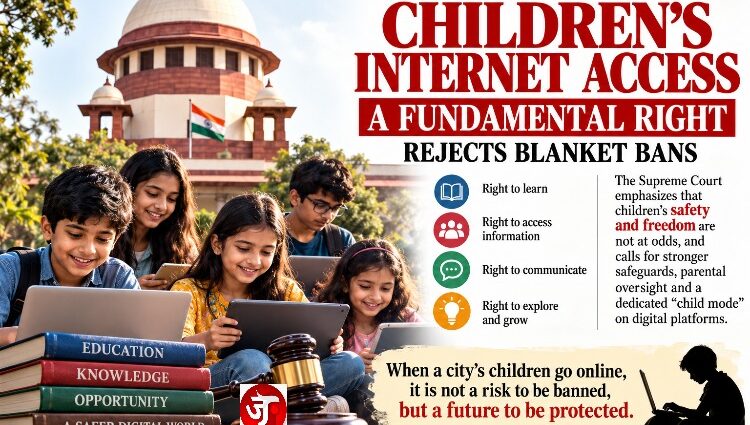
The Supreme Court has recognised children’s internet access as a fundamental right under the Constitution, rejecting blanket restrictions.
October 18, 2026
Children’s internet access has reached a landmark ruling with far-reaching implications for children, parents, technology companies and the government: The Supreme Court of India has held that children’s Internet comes under a fundamental right to access and use it. The court has cautioned that protecting children from online dangers cannot mean shutting them out of the digital world altogether. Its message is clear: protect children from predators, not from the right to learn, communicate and access information.
In its October 15 judgment in Just Rights for Children Alliance v. S. Harish, a bench comprising Justices J.B. Pardiwala and K. Vinod Chandran held that internet access is a fundamental right under Article 21, which protects life and personal liberty, read with Article 19(1)(a), which guarantees freedom of speech and expression. The ruling was reported widely on October 17.
The court’s message cuts through a debate that has grown increasingly urgent as governments and parents grapple with cyberbullying, online exploitation, harmful content and the dangers children face on social media.
Supreme Court on children’s internet access: Why blanket bans are not the answer
The Supreme Court maintains that children’s safety and their freedom are not opposing goals. The challenge is to guarantee both and rejected the idea that children should be denied internet access simply because the online world contains serious risks.
The internet is no longer merely a place for entertainment. It is a gateway to education, information, communication and participation in society. For children in remote areas, disadvantaged communities and households with limited educational resources, digital access can be particularly important.
A blanket ban may appear to offer a simple solution, but the court warned against addressing the dangers of online exploitation by restricting the rights of the very children who need protection. Such restrictions can also push young users towards less regulated spaces and make children who encounter online abuse reluctant to seek help for fear of punishment.
What safeguards did the Supreme Court suggest?
Recognising the serious risks children face online, the court called for stronger protection rather than indiscriminate restrictions.
Among the measures discussed were:
- Dedicated child mode: Social media platforms could provide child-specific accounts with age-appropriate safeguards.
- Parental consent and oversight: Greater emphasis on parental guidance and supervision, particularly for younger children.
- Safer default settings: Private accounts, restrictions on contact and messages from unknown adults, and appropriate moderation of advertising and content.
- Stronger detection of child sexual exploitation material: Better technological systems to identify, report and remove illegal material circulating online.
- Government guidelines and accountability: Clearer procedures and stronger obligations for platforms that fail to address child sexual exploitation and abuse material.
The judgment also addressed the need for more effective systems to identify and remove such material, including a comprehensive national database and stronger reporting and enforcement mechanisms. The court directed the Union government to take appropriate steps towards implementing the proposed safeguards.
These measures reflect an important distinction: children may need protection from specific harmful content and dangerous interactions, but that does not mean their access to the entire internet should be prohibited.
The real threat is online exploitation, not a child’s curiosity
Children need the internet to learn, explore ideas, develop skills and communicate. But the same platforms can expose them to grooming, manipulation, sexual exploitation and abusive content.
The responsibility for addressing these threats cannot rest solely on children or their parents. Technology platforms have a crucial role in identifying harmful material, responding quickly to reports, restricting dangerous interactions and preventing known abusive content from circulating repeatedly.
The court’s approach places the focus on the perpetrators who create, distribute or seek out child sexual exploitation material, as well as platforms that fail to meet their responsibilities.
Children should be taught how to recognise unsafe behaviour, protect their privacy, understand consent and approach trusted adults when something goes wrong. Parents need tools that help them guide children rather than simply block them from the digital world.
And technology companies must do more than issue safety policies that look reassuring on paper.
A fundamental right comes with a responsibility to protect
The Supreme Court’s ruling does not mean that every website, application or category of online content must be accessible to every child without restriction. The judgment recognises that proportionate, age-appropriate safeguards are necessary and that access to inherently harmful content can be restricted.
The challenge for policymakers is to draw that line carefully. Safeguards must protect children without unnecessarily infringing their privacy, freedom of expression or access to information.
The government has been directed to work on appropriate guidelines, standard operating procedures and changes to the relevant legal framework where necessary. The court has sought a progress report, with the matter listed for further consideration on December 10, 2026.
That makes implementation the next crucial test. A landmark judgment matters only when its principles translate into safer platforms, effective reporting mechanisms and meaningful protection for children.
Protect children. Do not shut them out.
The Supreme Court has placed a vital constitutional principle at the centre of India’s debate on children and technology: online safety must not become a pretext for denying children their fundamental rights.
The internet can expose children to danger, but it can also open doors to education, opportunity and knowledge. Treating access itself as the problem risks punishing children for the failures of adults, institutions and technology companies to make the digital world safer.
The answer is neither unrestricted exposure nor blanket prohibition. It is a system that preserves access, targets harmful content, holds platforms accountable and equips children to navigate the online world safely.
The court has made the constitutional principle clear. Now the government and technology companies must demonstrate that they can turn it into reality.
Children deserve both the freedom to explore the digital world and the protection to do so safely. They should not have to surrender one right to exercise the other. Curbing internet is not a solution to online dangers.
JANPATH NEWS NETWORK (JNN)
Independent. Fearless. On the People’s Path.