









From labelling ‘Left Parties’ rather than a People’s Movement: Is Media Missing the Bigger Picture on SIR?
October 23, 2026: The SIR Protests has sparked attention from the RSS stage in Nagpur to anti-SIR marches across India, a question about political language deserves closer scrutiny. When dissent is labelled ‘Left-wing’, does the public stop hearing what the protesters are actually saying?
On October 20, Israel’s Consul General in Mumbai, Yaniv Revach, attended the RSS’s annual Vijayadashami programme in Nagpur. Speaking about India-Israel ties, he warned against what he described as attempts by “extreme Left and Marxist forces” to destabilise their shared values. He had met RSS chief Mohan Bhagwat the previous day. The SIR protests have been grabbing attention across the world.
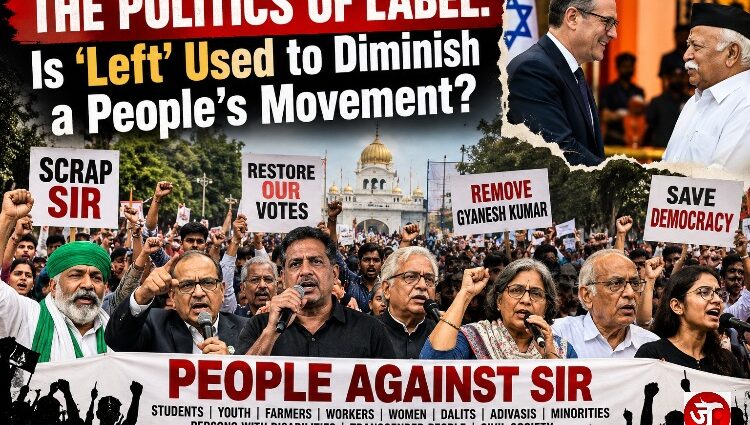
Three days later, on October 23, protests against the Special Intensive Revision (SIR) of electoral rolls were called across India under the banner of People Against SIR and by the Samyukt Kisan Morcha.
Members of student, youth, farmer, worker, and civil society groups participated in the nationwide SIR “People’s March” and anti-Special Intensive Revision (SIR) protests on October 23, 2026, demanding the removal and prosecution of Chief Election Commissioner Gyanesh Kumar.
Key Groups and Alliances involved were the common people involved in SIR protests: A joint civil society and coalition platform representing students, youth, farmers, workers, women, Dalits, Adivasis, minorities, persons with disabilities, and transgender people; Samyukt Kisan Morcha (SKM): Farmers’ organisations protesting and marching across districts, taluks, and block headquarters, led by figures like Ashok Dhawale (All India Kisan Sabha); INDIA Bloc: Opposition political parties urged by organizers to extend political and grassroots support to the demonstrations; Prominent Figures and Activists Associated with the March were Prakash Raj – Actor and activist; Prashant Bhushan – Senior Supreme Court lawyer; Rakesh Tikait – Farmers’ leader; Parakala Prabhakar – Author and social scientist; Anjali Bharadwaj – RTI activist; Ganesh Devy – Literary critic; Tushar Gandhi – Author and great-grandson of Mahatma Gandhi; Abhijeet Dipke – CJP (Citizens for Justice and Peace) founder; Neha Bora – AISA President; Aishe Ghosh – SFI leader, and Viraaj Devang – AISF President
Yet the media labelled the march against SIR a “Left” movement. The juxtaposition is worth examining, not because it proves a coordinated strategy, but because it raises a question about the language through which dissent is understood.
When a label becomes the story
A report describing SIR protests near Bangla Sahib Gurudwara in Delhi as a demonstration by “Left parties and student leaders” may accurately identify some of its participants. But if the report leaves readers with the impression that the larger anti-SIR mobilisation is merely a Left-wing initiative, it tells only part of the story.
People Against SIR describes itself as a broad platform bringing together organisations and networks representing farmers, workers, women, students, Adivasis, Dalits and minorities. Its public campaign has also involved lawyers, activists, writers and people from different political backgrounds.
Among those associated with the October 23 mobilisation against SIR were farmer leader Rakesh Tikait, senior advocate Prashant Bhushan, actor Prakash Raj, economist Parakala Prabhakar and Tushar Gandhi, alongside student organisations and Left-affiliated groups.
These are not interchangeable political identities. Nor should the presence of one group erase the participation of others. The distinction is particularly important when the immediate issue is the electoral process itself. A citizen concerned about the deletion of a name from the voter list need not subscribe to Marxism, belong to a Left party or agree with every demand made by the organisers. The right to question electoral procedures does not come with an ideological membership card.
From the Left to the alleged ‘extreme Left’
There is also a difference between identifying a political affiliation and describing an entire category of dissent as an extremist threat. The Left is a recognised political tradition encompassing a range of parties, unions and intellectual movements. Marxism is a particular political and economic philosophy. “Extreme Left” is a more charged characterisation, and its meaning depends on the context in which it is used.
Revach’s remarks at the RSS event were his stated assessment of what he considered a threat to shared values. They should be reported as such, not treated as proof that the anti-SIR movement is destabilising India.
The question is what happens when such language enters a wider political debate. Does it encourage scrutiny of particular claims and actions, or does it encourage audiences to dismiss dissenters before examining their arguments?
The same test should apply to every political camp. Calling protesters anarchists, anti-national or agents of destabilisation is not a substitute for evidence. Equally, calling the government authoritarian does not eliminate the need to substantiate the charge. Democracy depends on the ability to argue over facts without turning political disagreement into a test of national loyalty.
The real issue is the voter
The October 23 campaign called for the scrapping of SIR, restoration of eligible voters’ deleted names and action against Chief Election Commissioner Gyanesh Kumar. The organisers have alleged that the revision process risks disenfranchising citizens. Those allegations and their demands must be examined against the evidence and the Election Commission’s responses.
The stakes are substantial. Human Rights Watch reported on October 13 that more than 130 million names had been deleted in the SIR list during the nationwide revision process and raised concerns about arbitrary and opaque procedures. The Election Commission’s stated purpose for SIR is to clean electoral rolls by removing dead, duplicate and ineligible entries. The crucial question is whether the process reliably distinguishes ineligible entries from eligible citizens who must retain their voting rights.
Is the language shrinking the movement?
It would be premature to conclude, on the evidence of these reports alone of calling the anti-SIR march a leftist moment that the media has deliberately adopted a coordinated strategy to weaken the movement’s legitimacy. Establishing that would require a broader examination of headlines, coverage patterns, editorial choices and the language used by different outlets.
Journalists must identify Left organisations when they are involved. They must also identify the farmers, lawyers, women, workers, students and other citizens involved. Accuracy requires both. The narrowing the anti-SIR movement to a leftist branch is inaccurate.
If the movement is broader than one ideology, the media should report that breadth. If its allegations are disputed, investigate them. If the government has evidence supporting its position, publish it. If eligible voters have been wrongly excluded during the SIR execution, the people need answers.
Or it it that only voters with Left-leaning ideologies removed from the electoral rolls? Now, that would be truly startling!
JANPATH NEWS NETWORK (JNN)
Independent. Fearless. On the People’s Path.


Wow tht was unusual. I just wrote an incredibly long commet but atter
I clicked suvmit mmy comment didn’t show up. Grrrr…
well I’m noot writing alll that over again. Anyway, just wanted tto say great blog!
xnxx
Thank you for being here!