










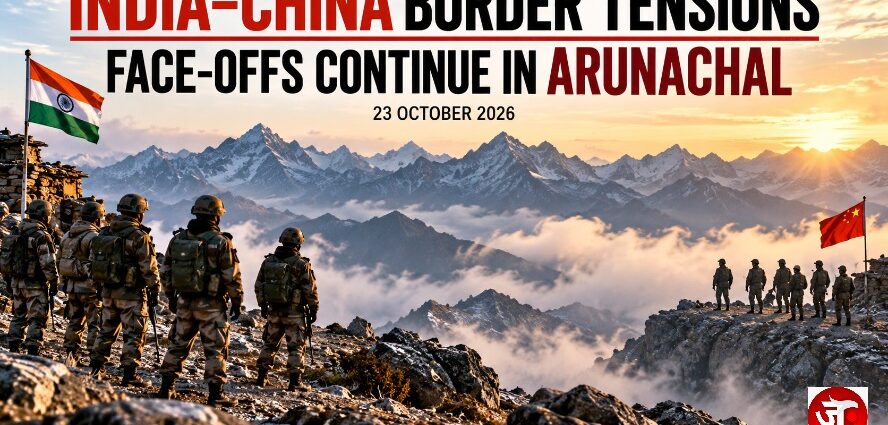
India-China border face-offs in Arunachal Pradesh (as of October 23, 2026) has drawn significant attention with ongoing confrontations.
The India-China border situation along the Line of Actual Control (LAC) in Arunachal Pradesh has drawn significant attention after official confirmation of ongoing confrontations. Indo-Tibetan Border Police (ITBP) Director General Shatrujeet Kapur (also referred to as Shatrujeet Singh Kapur) stated on Thursday, October 22, that face-offs with Chinese People’s Liberation Army (PLA) troops had occurred at multiple locations in Arunachal Pradesh in recent days and that the situation was continuing.
Speaking at an investiture/felicitation ceremony for ITBP personnel in Alwar, Rajasthan (ahead of the force’s Raising Day), Kapur said: “In the past few days, a situation arose where face-off happened at several locations in Arunachal and it still continues.” He praised the ITBP’s newly raised Shaurya Commando teams for their role in handling the confrontations, describing their performance as exemplary. He also noted the ITBP’s origins as a mountain guerrilla force and its assignment of border-guarding duties along the China frontier in 2004, while highlighting the need for specialised high-altitude capabilities, including drones and counter-drone systems, given modern border warfare dynamics.
Reports and government sources indicate the tensions have persisted since late July, particularly around Asaphila near Taksing in the Upper Subansiri district. Chinese PLA forces are said to have pitched tents at an elevated position roughly 6–7 km within India’s perception of the LAC, near the Maja company operating base in the Taksing circle.
Indian troops remain deployed in strength in the area to prevent escalation. The ITBP and the Indian Army jointly manage the border, with long-range patrols typically conducted between June and October due to weather conditions. Kapur’s remarks marked the first clear official confirmation of the scale of these ongoing face-offs on the north-eastern sector since mid-year reports of friction.
On Friday, October 23, the Ministry of External Affairs (MEA) responded to questions about the ITBP chief’s comments. Spokesperson Randhir Jaiswal stated that “the situation in the India-China border areas gets disturbed from time to time when Chinese forces diverge from established patrolling patterns.” He reiterated that both sides continue to use existing diplomatic and military mechanisms (such as the Working Mechanism for Consultation and Coordination and Corps Commander-level talks) to address issues and prevent misunderstandings.
The MEA emphasised that “the maintenance of peace and tranquillity in the border areas is essential for the overall development of bilateral relations” and referred queries on the specific details of the face-offs to the Ministry of Defence. This position aligns with India’s long-standing public stance on LAC management, where differing perceptions of the boundary frequently lead to localised stand-offs.
Opposition parties have criticised the government. Congress president Mallikarjun Kharge described the ITBP DG’s confirmation as “deeply alarming” and urged Prime Minister Narendra Modi to “come clean,” raising questions about the handling of the border situation. Other Congress leaders, including Pawan Khera, have highlighted the continuing face-offs alongside concerns over the trade deficit and called for greater accountability on territorial security and India’s response capabilities against China’s military modernisation. The developments occur against the backdrop of earlier high-level engagements, including talks and the BRICS Summit, yet local military friction has persisted.
In summary, while both sides publicly stress the importance of dialogue and stability, the ITBP chief’s on-record acknowledgement of multi-location, ongoing face-offs in Arunachal, combined with the MEA’s measured response attributing disturbances to Chinese deviations from patrolling patterns, has kept the eastern sector of the LAC in the spotlight. The situation remains managed through established channels, with no reports of major escalation, but it underscores the persistent challenges of an undemarcated boundary and competing perceptions.
JANPATH NEWS NETWORK (JNN)
Independent. Fearless. On the People’s Path.