









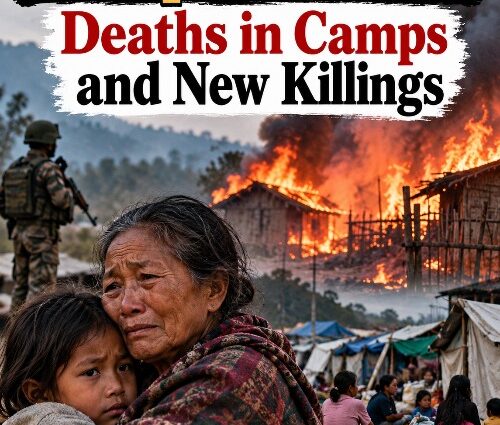
As violence spills to the hills and valley, displaced families are not safe. The Supreme Court sought answers over unnatural deaths in camps
October 24, 2026
Manipur is once again gripped by fear, fresh killings, arson and angry protests. More than three years after ethnic violence first erupted in May 2023, civilians continue to face insecurity, displacement and the devastating loss of their homes and loved ones. Now, reports of deaths inside relief camps have raised another deeply troubling question: are even those who fled violence to find safety receiving adequate protection?
The crisis has taken a dangerous turn in October, with armed attacks reported across several districts, homes set ablaze and civilians forced to flee. The latest developments reveal a state where the search for safety remains a daily struggle for thousands of internally displaced people.
Deaths in relief camps: Supreme Court demands answers
The plight of displaced families has come under renewed judicial scrutiny. In September, the Supreme Court sought an explanation from the Manipur government regarding 25 reported unnatural deaths among people living in relief camps established following the ethnic violence.
The court directed the Chief Secretary to provide details of the deaths, including post-mortem reports, the causes of death, investigations initiated and measures taken to protect displaced people. The proceedings followed findings submitted by a committee headed by former Jammu and Kashmir High Court Chief Justice Gita Mittal.
According to reports on the committee’s findings, 34 cases of unnatural death had been brought to its attention. Post-mortem examinations had reportedly been conducted in only 20 cases, raising serious questions about the investigation and accountability process.
The distinction matters: the 25 deaths cited before the court were part of a wider set of 34 reported cases requiring scrutiny. The circumstances of these deaths must be established through proper investigations rather than assumptions.
For families who have already lost homes, livelihoods and relatives, the prospect of losing loved ones while living in designated places of refuge compounds an already devastating ordeal. Relief camps must provide more than temporary shelter. They require adequate healthcare, food, sanitation, security and systems for identifying and investigating deaths.
Three Meitei villagers killed in ambush
On October 19, three Meitei men collecting firewood near the Imphal East–Kangpokpi border were killed in an ambush by unidentified armed assailants. Three others were injured.
The victims were identified in reports as Lairenlakpam Inaobi, Arubam Ronin and Kshetrimayum Susil. Their deaths triggered protests in Imphal, where residents brought the bodies of victims to the vicinity of Chief Minister Yumnam Khemchand Singh’s residence and demanded action. Police used tear gas to disperse demonstrators.
Three suspects were subsequently arrested in connection with the attack, according to media reports. The investigation must establish individual responsibility and bring those responsible to justice.
The killings have renewed fears of further escalation between communities already traumatised by years of ethnic conflict.
Houses burned, civilians flee
The violence has not been confined to the Imphal valley. In the hill districts, reports of arson and armed attacks have intensified concerns over the safety of Kuki-Zo and Naga civilians.
In Chassad village in Kamjong district, at least 15 houses belonging to Kuki families were reported torched in an attack around October 17. Residents fled towards forested areas and a nearby security camp. A Kuki civilian was also killed in the violence.
Further reports described homes being burned in other locations, including Khoikai, while allegations of attacks involving armed groups circulated among affected communities. Such allegations must be independently investigated, particularly where the identity of the attackers remains disputed.
A separate incident on October 20 saw a Kuki-Zo man, Paolen Khongsai, shot dead while gathering bamboo shoots near P Molding village in Kangpokpi district, according to media reports.
These incidents underscore the vulnerability of civilians whose access to their homes, farmland and forest resources has become increasingly dangerous. When people cannot safely collect firewood, gather food or return to their villages, displacement becomes more than a temporary consequence of conflict. It becomes a prolonged struggle for survival.
Protests spread as anger mounts
The latest killings and reports of arson have fuelled protests, shutdowns and demonstrations across Manipur. On October 23, protest activity in the Imphal valley included a large noise protest, with participants beating drums, banging utensils and honking to draw attention to their demands.
Demonstrators called for an end to the violence, stronger protection for civilians, action against armed groups and measures concerning the National Register of Citizens (NRC) and Suspension of Operations (SoO) agreements. Security forces deployed in sensitive areas, and tear gas was used during some demonstrations.
The protests reflect mounting frustration over the continuing insecurity and the perception among affected residents that existing arrangements have failed to guarantee lasting peace.
The state government has called for peace and unity, while security forces have reported arrests, weapons recoveries and operations against suspected militants. But security operations alone cannot resolve the deeper crisis if communities remain displaced, allegations of attacks go unresolved and trust continues to erode.
A crisis that demands accountability
Manipur’s tragedy cannot be reduced to a sequence of clashes, casualty figures and official statements. Behind every number is a family grieving, a home abandoned, a child growing up in displacement or a person whose future has been put on hold.
The deaths reported in relief camps in Manipur demand transparent investigations and public accountability. The latest killings require impartial probes and prosecution of those responsible. Burned homes require more than compensation announcements: displaced families need safe conditions in which to return, rebuild and live without fear.
The state must also ensure that humanitarian assistance reaches people across communities without discrimination. Protection cannot depend on ethnic identity, political affiliation or the location of a village.
The central question remains: if people who fled violence are dying in relief camps, while others are being killed and driven from their homes in fresh attacks, what concrete measures will guarantee their safety?
Manipur needs more than appeals for calm. It needs credible investigations, secure relief facilities, protection for vulnerable villages, sustained dialogue and a rehabilitation process that restores dignity and trust.
Until civilians can sleep safely, return home without fear and trust that their deaths will be investigated, the promise of peace will remain painfully distant.
The people of Manipur cannot be left to choose between the danger of returning home and the insecurity of remaining displaced.
JANPATH NEWS NETWORK (JNN)
Independent. Fearless. On the People’s Path.