








In an extraordinary political escalation, the INDIA bloc held a public, parliamentary-style impeachment proceeding against CEC Gyanesh Kumar
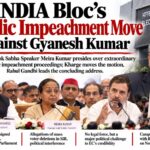
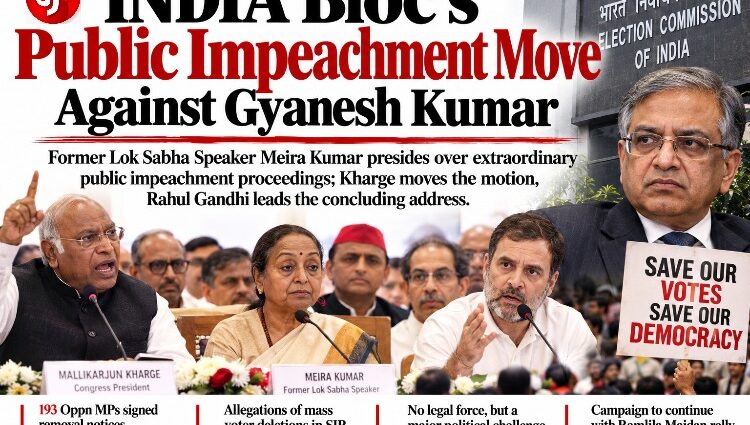
October 31, 2026: Former Lok Sabha Speaker Meira Kumar presides over parliamentary proceedings; Kharge moves removal motion, Rahul Gandhi leads Opposition’s concluding challenge as INDIA bloc takes its fight over alleged vote theft and SIR irregularities to the people.
In an extraordinary political escalation, the INDIA bloc on Saturday, October 31, staged a public impeachment-style proceeding against Chief Election Commissioner Gyanesh Kumar, recreating the atmosphere of a parliamentary removal motion outside Parliament. The unprecedented political initiative, held at Congress president Mallikarjun Kharge’s residence at 10 Rajaji Marg in New Delhi, brought together Opposition leaders, representatives of civil society and citizens who say they have been affected by the Special Intensive Revision (SIR) of electoral rolls.
The proceedings were presided over by former Lok Sabha Speaker Meira Kumar, while Kharge moved the motion against the CEC. Rahul Gandhi, Leader of the Opposition in the Lok Sabha, was scheduled to deliver the concluding address before the symbolic motion was put to a vote.
This was not an ordinary Opposition press conference or another street protest. The INDIA bloc deliberately adopted a parliamentary-style format to put its allegations against the country’s highest election official before the public, following the rejection of its earlier formal notices seeking the removal of Gyanesh Kumar.
The event, originally scheduled for October 30, was postponed because of heavy rain and held on Saturday. The alliance is positioning the exercise as a public demand for accountability and the restoration of confidence in the Election Commission.
A crucial distinction: This was a symbolic public impeachment of Gyanesh Kumar, not a constitutionally recognised parliamentary proceeding. Its motion has no legal force and cannot remove the CEC. Its political significance lies in the scale and nature of the challenge being mounted against the head of a constitutional institution.
Why the Opposition took the impeachment battle outside Parliament
The background to Saturday’s proceedings is particularly significant.
In March 2026, Opposition MPs submitted notices in both Houses of Parliament seeking the removal of Gyanesh Kumar. The notices reportedly carried 193 signatures, with 130 in the Lok Sabha and 63 in the Rajya Sabha. Both notices were subsequently rejected by the respective presiding officers.
The Opposition maintains that serious allegations against the CEC Gyanesh Kumar were denied the opportunity for examination through the formal parliamentary process. It has consequently taken its campaign to a public forum, recreating the broad structure of a parliamentary proceeding.
Congress MP Shashi Tharoor said the Opposition had been left with little option but to organise a mock Parliament after its notices were not admitted. He also urged the Union Home Minister to intervene to ensure that the notices could be taken up in Parliament.
The move has brought a constitutional accountability question to the forefront: what avenues remain available to elected representatives when they seek parliamentary scrutiny of allegations against the head of an independent constitutional institution?
Kharge’s opening charge: ‘We hold no personal grudge against the CEC Gyanesh Kumar’
Moving the motion, Mallikarjun Kharge delivered a sharp indictment of the Election Commission’s functioning and its handling of electoral-roll revisions.
He invoked Article 326 of the Constitution and the universal adult franchise, arguing that the right to vote, secured through India’s freedom struggle and constitutional democracy, was now under threat.
Kharge recalled the contributions of Mahatma Gandhi, Jawaharlal Nehru, B.R. Ambedkar, Sardar Vallabhbhai Patel and Maulana Abul Kalam Azad in building an independent democratic republic.
He invoked Ambedkar’s emphasis on the power of the vote, describing it as the ordinary citizen’s instrument to make and remove governments.
On Gyanesh Kumar, Kharge alleged that CEC Gyanesh Kumar was running the Commission under the direct instructions of Prime Minister Narendra Modi and Home Minister Amit Shah.
He recalled the 193 signatures on the earlier parliamentary removal notices and said their rejection had prompted the Opposition to bring its case directly before the public.
Kharge stressed that the motion was not motivated by personal hostility.
“Our intention is for the Election Commission to function impartially, in line with the spirit of the Constitution, so that the common man’s trust in it remains intact,” he said, according to ANI’s reporting of his speech.
He also raised the concern that the voting rights of vulnerable communities, women and young people must not be quietly taken away through computer-based deletions of electoral-roll entries.
Kharge’s wider political indictment: From electoral bonds to alleged vote theft
Kharge extended his accusations beyond the SIR exercise, alleging that the government had used multiple institutions and political mechanisms to retain power since 2014.
He accused the BJP of engineering defections, breaking political parties, toppling elected governments and using investigative agencies such as the Enforcement Directorate and CBI against political opponents.
He then turned to the 2023 Chief Election Commissioner and Other Election Commissioners (Appointment, Conditions of Service and Term of Office) Act.
Kharge criticised the legislation, arguing that it had altered the safeguards surrounding the appointment and protection of Election Commissioners. He also referred to the suspension of 145 Opposition MPs during the parliamentary session in which the legislation was passed.
His argument was that the changes had weakened institutional accountability and helped create conditions in which the Election Commission could face questions about its independence.
The Maharashtra and Karnataka examples cited by the Opposition
Kharge also cited specific electoral controversies to support the Opposition’s allegations.
Maharashtra: He referred to the addition of approximately 40 lakh names to electoral rolls ahead of the 2024 Assembly elections, contrasting this with subsequent deletions during the SIR exercise. The Opposition has questioned the timing and scale of these changes and alleged that electoral-roll management is being manipulated. These figures and the alleged connection to election outcomes require examination against official constituency-level records.
Karnataka: The Opposition cited the Aland constituency controversy, where allegations of fraudulent attempts to delete voters’ names have been raised. Kharge referred to the Karnataka CID’s attempts to obtain information from the Election Commission, alleging that repeated requests had not received adequate responses.
The Opposition argues that these examples point to a larger problem of transparency and accountability in the management of electoral rolls.
The six-charge framework and the SIR controversy
The public proceedings were structured around allegations concerning the CEC’s conduct and the functioning of the Election Commission.
The charges raised by the Opposition included:
- Alleged mass exclusion and deletion of eligible voters during electoral-roll revisions.
- Alleged irregularities in the handling of Form 6 and voter-registration procedures.
- Alleged unilateral decision-making without adequate collegial consultation among Election Commissioners.
- Alleged failure to ensure transparency in the SIR process.
- Alleged partisan functioning and political interference in the Commission.
- Alleged failure to safeguard the constitutional right to vote and the independence of the Election Commission.
These are charges advanced by the Opposition and must be distinguished from findings established by a court or a competent constitutional inquiry.
The 13.39-crore voter controversy: What does the figure actually mean?
One of the most significant points in the SIR controversy is the figure of 13.39 crore electors placed in the categories of absent, shifted, dead and duplicate (ASDD) in the Election Commission’s exercise.
The Opposition has raised concerns about the scale of the exercise and the possibility of genuine voters being excluded.
However, it is important to clarify that 13.39 crore is not an established figure of voters permanently deleted or proven to have lost their voting rights. It refers to entries placed in the ASDD categories for verification and further action.
The central question is how many eligible voters have actually been excluded, whether they received adequate notice and whether effective procedures exist to restore their names.
Election Commission’s defence and the Supreme Court battle
The Election Commission has rejected allegations of unilateral functioning and defended the legality of the SIR exercise.
In a 248-page affidavit submitted to the Supreme Court, the Commission maintained that the relevant decisions were taken unanimously by all three members of the Election Commission. It also disputed allegations that statutory Form 6 had been amended without proper authority, arguing that changes were made to an accompanying declaration rather than the prescribed form itself.
The Commission has maintained that the revision exercise is legally authorised and intended to identify ineligible and duplicate entries.
On October 27, the Supreme Court granted petitioners 10 days to respond to the Commission’s affidavit. It also issued notice on a separate plea by Rajya Sabha MP Dola Sen concerning alleged changes to Form 6 during Bihar’s SIR.
The legal dispute is therefore still alive. The Supreme Court has not delivered a final finding on the allegations against the CEC or the legality of the contested decisions.
What does the Constitution actually say about removing a CEC?
The constitutional safeguards surrounding the office of the Chief Election Commissioner make the confrontation particularly consequential.
Under Article 324(5), the CEC can be removed only in the same manner and on the same grounds as a Supreme Court judge.
Article 124(4) requires proved misbehaviour or incapacity. Removal requires a special majority in each House of Parliament: a majority of the total membership of the House and at least two-thirds of members present and voting, followed by an order of the President.
This is deliberately a demanding process. It is designed to protect the independence of the Election Commission from arbitrary removal by the government of the day.
The Opposition’s public impeachment, however, does not satisfy this constitutional process and cannot itself trigger the CEC’s removal.
November 1: The battle moves to Ramlila Maidan
Saturday’s public impeachment is part of a wider mobilisation by the INDIA bloc.
Rahul Gandhi and other Opposition leaders have called for a Chalo Dilli march and a major rally at Ramlila Maidan on November 1 under the slogan ‘Vote Bachao, Desh Bachao’.
The alliance has invited political parties, civil society organisations, journalists, students and citizens to participate.
The objective is to transform the SIR controversy into a broader public campaign around electoral transparency, voting rights and institutional independence.
A constitutional institution facing a test of public confidence
The confrontation over Gyanesh Kumar has moved beyond the question of whether one political alliance approves of one Election Commissioner.
At its heart is a larger democratic question: how can citizens be assured that the institution responsible for conducting elections is independent, impartial and accountable?
The Opposition must substantiate its allegations with documentary and constituency-level evidence. The Election Commission, in turn, must answer legitimate questions about deletions, verification procedures, internal decision-making and safeguards for eligible voters.
The extraordinary public impeachment proceedings of Gyanesh Kumar have now placed the dispute firmly in the public domain. Whether they lead to renewed parliamentary action, further judicial scrutiny or a wider political confrontation remains to be seen.
JANPATH NEWS NETWORK (JNN)
Independent. Fearless. On the People’s Path.