










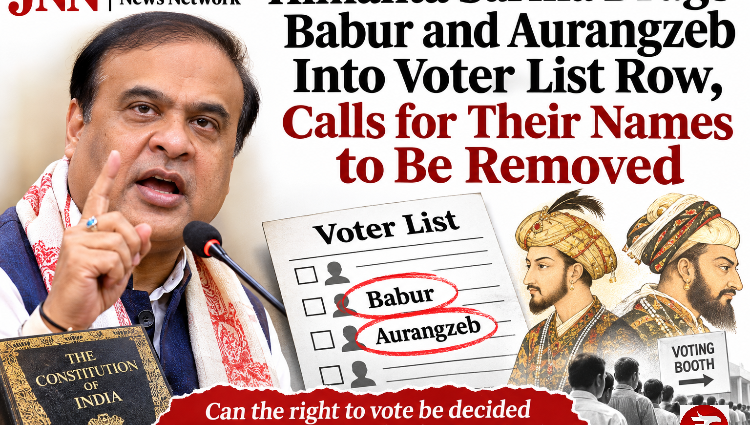
Assam Chief Minister Himanta Sarma’s remarks at a BJP rally in Bihar raise troubling questions about electoral rights, religious polarisation.
Assam Chief Minister Himanta Biswa Sarma has triggered a fresh political controversy after invoking Mughal rulers Babur and Aurangzeb while attacking the Opposition over the revision of electoral rolls.
Speaking at the BJP’s Loktantra Bachao, Arajakta Hatao rally in Purnea, Bihar, on November 4, Himanta Sarma questioned whether removing names associated with Babur and Aurangzeb from voter lists could be described as ‘vote theft’.
“If the names of Babar and Aurangzeb are deleted from the voters list, is it vote theft or heart theft?” he asked the gathering.
He also challenged the Opposition’s objections to the Special Intensive Revision (SIR) of electoral rolls and called for the removal of such names. His remarks were reported by The New Indian Express and The Economic Times.
But the statement raises a question far more serious than the political exchange itself: Can a person’s right to vote become a matter of historical or religious identity rather than constitutional eligibility?
The Constitution does not recognise a historical-name test
India’s electoral framework is quite clear. Article 325 of the Constitution states that no citizen can be made ineligible for inclusion in an electoral roll on grounds only of religion, race, caste or sex. Article 326 provides for adult suffrage, subject to citizenship and legally prescribed qualifications.
Further, Section 22 of the Representation of the People Act, 1950, lays down the grounds for correcting or deleting entries. These include death, change of ordinary residence and other legal ineligibility. It requires proper verification and, in relevant cases, an opportunity for the person concerned to be heard.
There is no provision allowing a voter to be deleted merely because their name resembles that of a historical ruler.
A person’s name is not evidence of their citizenship. Electoral rolls must be cleaned through lawful verification, not political symbolism.
Why this controversy matters particularly in Assam
The remarks are especially significant because Himanta Sarma is not merely a BJP campaigner. He is the Chief Minister of Assam, a state where questions of citizenship, migration, identity and electoral inclusion have been politically contentious for decades.
His demand for fresh electoral revision also comes amid an already heated national debate over the Special Intensive Revision.
The scale of that debate is considerable. Reuters reported in September that approximately 130 million voters had been excluded from initial draft rolls across the nationwide exercise, with the Election Commission maintaining that deletions concerned categories such as deceased, duplicate, relocated or untraceable voters.
Against this backdrop, political leaders must exercise particular care when speaking about who belongs on India’s electoral rolls.
The question the Election Commission must answer
The Election Commission is an independent constitutional authority, not an instrument for settling historical grievances or advancing political narratives.
If an individual is not legally entitled to vote, the law provides a process to establish that. If an individual is an eligible Indian citizen, their right to vote must be protected.
The Election Commission should make clear whether it has received any formal communication from Sarma, whether it intends to act on his public demand, and what legal grounds could possibly justify the proposed deletions.
The right to vote cannot depend on whether a political leader approves of a person’s name, ancestry or historical associations.
The larger political question
India’s democracy is built on the principle that citizenship and voting rights are determined by the Constitution and the law. Babur and Aurangzeb belong to history. India’s present-day voters belong to a constitutional democracy.
Turning electoral roll revision into a symbolic battle against historical figures risks shifting attention away from the real responsibility of the Election Commission: ensuring that every eligible citizen is registered and that no eligible voter is arbitrarily excluded.
The Election Commission must protect the voter’s right, not become an arbiter of historical identity.
JANPATH NEWS NETWORK (JNN)
Independent. Fearless. On the People’s Path.