










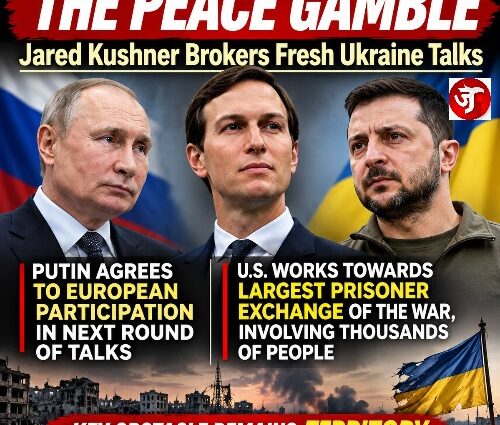
As Trump Pushes Putin And Zelenskyy Towards Negotiations; Us Works Towards The Biggest Prisoner Exchange Of The War, Involving Thousands
November 13, 2026: In a significant diplomatic development that could reshape the course of the Russia-Ukraine war, US President Donald Trump’s special envoy Jared Kushner (son-in-law) has announced progress in efforts to bring Moscow and Kyiv closer to a negotiated settlement.
After an intense three-day diplomatic push involving Abu Dhabi, Moscow and Dublin, Washington says Russia and Ukraine have agreed to include European representatives in the next round of peace negotiations.
Kushner, one of the key figures in the American negotiating team, has also revealed that the United States is working towards what could become the largest prisoner exchange since Russia launched its full-scale invasion of Ukraine in February 2022.
The developments have raised hopes of renewed diplomatic momentum after months of stalled negotiations. However, the fundamental disagreements between the two countries remain unresolved.
From Abu Dhabi to Moscow: Kushner’s diplomatic mission
The latest diplomatic initiative began on November 10 in Abu Dhabi, where Russian, Ukrainian and American delegations held their first direct US-mediated trilateral negotiations in nine months.
Kushner and fellow US envoy Steve Witkoff were central to the discussions. Following the Abu Dhabi meetings, the American envoys travelled to Moscow on November 12 to meet Russian President Vladimir Putin at the Kremlin.
The discussions focused on the outcome of the Abu Dhabi negotiations, possible security arrangements and the prospects of bringing European governments into the next stage of the peace process.
The envoys subsequently travelled to Dublin, Ireland, where they met Ukrainian President Volodymyr Zelenskyy. Kushner described the discussions as meaningful progress, saying the negotiations had helped identify areas of common ground and possible solutions.
Putin agrees to European participation
One of the most important developments is Moscow’s reported agreement to allow European representatives to participate in the next round of negotiations.
This is significant because European governments have repeatedly expressed concern that Washington and Moscow could negotiate Ukraine’s future without adequately involving the countries most directly affected by European security arrangements.
Zelenskyy welcomed the prospect of European participation, maintaining that Europe’s role is essential to any lasting settlement.
The expanded negotiations are expected to address not only the territorial dispute between Russia and Ukraine but also the wider security architecture of post-war Europe.
Thousands of prisoners could return home
In another major development, Kushner announced that Washington was working towards what he described as potentially the largest prisoner exchange of the war.
The proposed arrangement could reunite thousands of people with their families.
While the precise numbers and timeline have not been announced, the humanitarian implications could be enormous.
The Abu Dhabi negotiations had already produced progress towards a substantial prisoner-of-war exchange, expected to take place in the coming weeks.
For families separated by years of conflict, this could represent one of the most meaningful outcomes of the diplomatic initiative.
The biggest obstacle remains territory
Despite the renewed optimism, the most difficult question remains unanswered: what happens to the occupied territories? Russia continues to demand control over the remaining Ukrainian-held parts of the Donbas region.
Ukraine has consistently rejected surrendering territory defended by its armed forces. Kyiv is also demanding credible international security guarantees to prevent another Russian invasion if a ceasefire is reached.
Moscow, meanwhile, opposes Ukraine’s NATO membership and has rejected the prospect of European troops being deployed in Ukraine after a ceasefire.
These differences remain formidable obstacles to a comprehensive peace agreement.
Can Trump finally deliver the peace he promised?
Donald Trump returned to the White House promising to end the Russia-Ukraine war. Yet repeated diplomatic initiatives have failed to produce a lasting settlement.
Kushner’s growing involvement, alongside Witkoff, signals that Washington is intensifying its efforts to bring both sides to the negotiating table.
The inclusion of Europe could also make the process more politically credible, although the details of its participation remain unclear.
For now, there is diplomatic movement, renewed engagement and the possibility of a major humanitarian breakthrough.
But a ceasefire has not been secured, territorial disagreements remain deep, and neither side has announced a comprehensive peace agreement.
The world is watching to see whether Kushner’s latest diplomatic mission can achieve what years of negotiations have failed to deliver: an end to Europe’s bloodiest war in generations.
JANPATH NEWS NETWORK (JNN)
Independent. Fearless. On the People’s Path.