






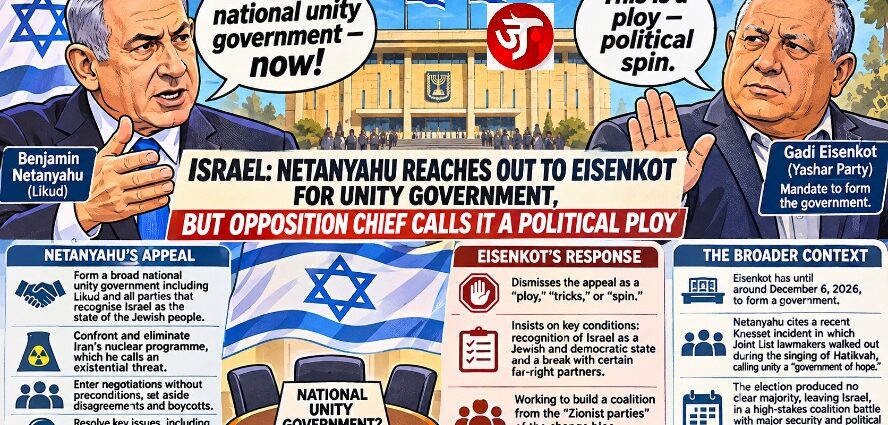
Israel: Netanyahu Reaches Out To Eisenkot For Unity Government, But Opposition Chief Calls It A Political Ploy
Sunday, November 15, 2026:
In a dramatic post-election political move, Israeli Prime Minister Benjamin Netanyahu has publicly appealed to Gadi Eisenkot, chairman of the Yashar party and the politician currently holding the mandate to form Israel’s next government, to abandon political divisions and establish a broad national unity government.
But the appeal has been met with scepticism. Eisenkot has dismissed Netanyahu’s overture as political manoeuvring, raising fresh questions about whether Israel’s deeply divided political leadership can come together at a time of mounting security challenges.
In a video statement released on November 14, following a security briefing lasting more than two hours with Eisenkot, Netanyahu argued that Israel needed a government broad enough to confront what he described as existential threats to the country.
Netanyahu invokes Iran and national security
Netanyahu placed Iran’s nuclear programme at the centre of his appeal, describing it as an existential danger that Israel must eliminate once and for all.
He argued that a narrow coalition, particularly one dependent on parties he accused of supporting terrorism, would be incapable of taking the difficult security decisions facing the country.
Instead, he called for a government bringing together all political parties that recognise Israel’s existence as the state of the Jewish people. Addressing Eisenkot directly, Netanyahu urged him to abandon attempts to construct what he called a “shaky and dangerous” government.
His message was unmistakable: enter negotiations without preconditions, put political disagreements and boycotts aside, and reach an agreement on Israel’s security and future.
Eisenkot: “This is political spin”
Eisenkot was quick to reject the public appeal, accusing Netanyahu of attempting to create an impression of unity while continuing to fuel political divisions.
He pointed out that negotiations between the Likud and Yashar negotiating teams had already been scheduled for November 15, making Netanyahu’s public invitation appear, in his view, like a political performance.
Eisenkot also made clear that any emergency government under his leadership would require Netanyahu to accept his stated principles and part ways with far-right political partners.
His position is significant. Eisenkot has previously ruled out serving in a government led by Netanyahu, although he has left room for negotiations involving Likud without Netanyahu at its helm.
The Hatikvah controversy adds another dimension
Netanyahu also invoked a controversial incident during the swearing-in ceremony of Israel’s 26th Knesset on November 10. Several Joint List lawmakers walked out during the singing of Hatikvah, Israel’s national anthem. Members of the Ra’am faction, led by Mansour Abbas, remained standing.
Netanyahu described a national unity government as the appropriate response, calling it a “government of hope”. The incident has added another layer to Israel’s already polarised political debate, particularly over national identity, the role of Arab political parties and the boundaries of coalition-building.
A difficult coalition arithmetic
The political challenge is considerable. The October 27 election failed to produce a clear parliamentary majority. President Isaac Herzog subsequently gave Eisenkot the first opportunity to form a government after 67 lawmakers recommended him for the mandate.
Eisenkot has 28 days to assemble a coalition, with the possibility of a further 14-day extension. The negotiations are complicated by disagreements over ultra-Orthodox military conscription, the participation of Arab-led parties and the role of far-right factions.
Meanwhile, Netanyahu’s Likud remains the largest individual party, and he is working to prevent potential coalition partners from joining Eisenkot’s camp. AP News+2
There are already signs that Netanyahu’s appeal has support within parts of his political camp. Finance Minister Bezalel Smotrich has publicly urged Eisenkot to accept the unity proposal. The Jerusalem Post+1
What happens next?
Israel now faces a crucial political test: can two leaders with sharply different political positions find common ground, or will coalition negotiations deepen the country’s divisions?
Netanyahu is presenting unity as a matter of national survival, with Iran’s nuclear programme at the centre of his argument.
Eisenkot, however, appears unwilling to accept unity on Netanyahu’s terms.
The bigger question is whether this is a genuine attempt to put national security above political rivalry, or a strategic effort by Netanyahu to retain influence over Israel’s next government.
For now, the negotiations continue, and Israel’s political future remains uncertain.
JANPATH NEWS NETWORK (JNN)
Independent. Fearless. On the People’s Path.