










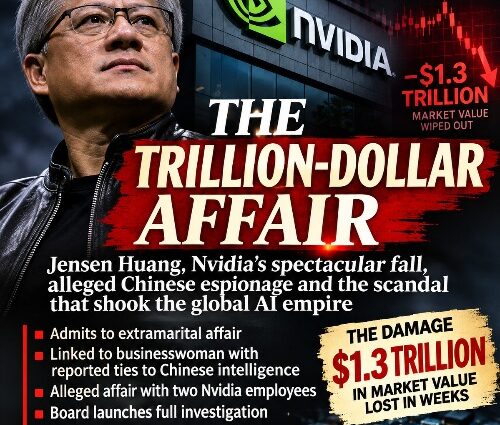
Jensen Huang, Nvidia’s spectacular fall, alleged Chinese espionage and the scandal that shook the global AI empire
TUESDAY, NOVEMBER 17, 2026: One of the world’s most powerful technology executives. Alleged extramarital relationships. A suspected Chinese intelligence connection. A corporate investigation. And more than $1 trillion in market value wiped away.
The world has seen corporate empires collapse over fraud, corruption, financial misconduct and political intrigue. But few could have anticipated that Nvidia, the company at the very heart of the artificial intelligence revolution, would find itself engulfed in a scandal combining all four elements of corporate vulnerability, personal conduct, geopolitics and national security.
At the centre of this extraordinary controversy is Jensen Huang, the Taiwanese-American billionaire who transformed Nvidia from a graphics-chip manufacturer into the world’s most influential AI hardware company.
For more than three decades, Huang was Nvidia’s driving force, its public face and, to many investors, its indispensable visionary. Then came the revelations, and the consequences were staggering.
A relationship that became a national security controversy
The controversy intensified on October 29, 2026, when reports emerged that US intelligence officials were concerned about Huang’s relationship with Alice Huang, a Singapore-based businesswoman and former executive associated with Megaspeed International, a company involved in data-centre operations and Nvidia-powered computing infrastructure.
The allegations were explosive. American intelligence officials reportedly suspected that Alice Huang had links to China’s Ministry of State Security and may have been involved in efforts to facilitate access to advanced American semiconductor technology.
The two Huangs are not related. Jensen Huang acknowledged on November 8 that he had been unfaithful to his wife, Lori, taking responsibility for his conduct and apologising to his family and Nvidia employees.
He did not publicly identify the woman in his admission. China has rejected the espionage allegations. US authorities have not publicly established that Alice Huang acted on behalf of Chinese intelligence, and Reuters has not independently verified that allegation.
But the questions were already spreading through Washington and Silicon Valley. Was this simply a private relationship that had become a public scandal? Or had a personal connection created a vulnerability around one of America’s most strategically important technology companies?
The scandal deepens: More alleged relationships
As the controversy widened, another revelation emerged. The New York Times reported that Huang had an extramarital relationship with Kimberly Powell, Nvidia’s vice-president of healthcare, who reportedly worked under him.
Reuters subsequently reported a further intimate relationship with another Nvidia employee, citing two people familiar with the matter. These reports intensified scrutiny of the company’s leadership, particularly because of the potential conflicts of interest surrounding relationships between a chief executive and employees.
Nvidia’s board commissioned an independent investigation, retaining the prominent law firm Wachtell, Lipton, Rosen & Katz.
The question was no longer confined to Huang’s personal conduct. It concerned corporate governance, executive accountability and whether the company’s leadership had adequately addressed potential risks.
Washington enters the picture
The controversy had consequences far beyond Nvidia’s headquarters in California. Nvidia sits at the centre of America’s technological rivalry with China. Its advanced processors are essential to the development and training of sophisticated artificial intelligence systems.
Washington has spent years restricting China’s access to advanced American semiconductor technology. Huang, meanwhile, had consistently argued for maintaining access to the Chinese market, warning that excessive restrictions could benefit Chinese competitors.
His relationship with Alice Huang therefore attracted particular attention because of her reported connections to a company involved in supplying Nvidia-powered computing infrastructure.
Lawmakers demanded answers. US intelligence concerns became part of a wider political debate about semiconductor exports, corporate security and America’s technological advantage.
Reports also alleged that shipments worth billions of dollars were connected to the wider controversy. Those allegations require independent scrutiny and should not be mistaken for established findings. The affair had become a geopolitical problem.
The price of the scandal: More than $1 trillion
Then came Wall Street’s reaction. Nvidia had reached extraordinary market valuations during the AI boom. Its processors powered the ambitions of technology companies, governments and AI developers around the world.
But uncertainty surrounding its leadership and the espionage allegations rattled investors. According to WIRED, Nvidia lost more than $1 trillion in market value in less than a month as the scandal unfolded.
Reuters separately reported that the company’s shares had fallen more than 30% from their early-October peak by November 13, erasing more than $1.8 trillion in market capitalisation.
The distinction matters: these figures cover different periods, and the losses cannot all be attributed to the affair alone. Broader market conditions, AI investment concerns and leadership uncertainty also played a part.
Nevertheless, the scale of the damage was extraordinary. A company synonymous with the future of artificial intelligence was suddenly confronting questions about the judgement and stability of the man who had built it.
November 12: The fall of Jensen Huang
On November 12, 2026, the crisis reached its defining moment. Jensen Huang resigned as Nvidia’s president, chief executive and board member, effective immediately. Chief Financial Officer Colette Kress was appointed interim CEO.
The departure marked an extraordinary reversal for a man who had become one of the most influential figures in global technology. The founder who had steered Nvidia through decades of technological change was suddenly gone.
The company now faced the difficult task of reassuring investors, protecting its technological position and establishing that its future did not depend on one individual.
The bigger question: Who controls the future of AI?
The Jensen Huang controversy raises questions that reach far beyond one billionaire’s private life. Nvidia is not an ordinary technology company. Its processors are central to the infrastructure powering the global AI revolution.
Its customers include some of the world’s largest technology companies. Its influence extends into national security, scientific research, defence, data centres and the future of computing.
When a company of this importance faces a leadership crisis involving alleged foreign intelligence connections, the consequences are not confined to shareholders.
They reach governments, competitors, investors and ordinary people whose economic futures are increasingly tied to artificial intelligence.
The affair may have begun as a personal scandal. It became a test of corporate governance, national security and the concentration of technological power.
And the most uncomfortable question remains: If one man’s private decisions can place an entire technological empire under such extraordinary pressure, how secure is the empire itself? The trillion-dollar affair triggered a situation when personal choices collided with corporate power and national security.
JANPATH NEWS NETWORK (JNN)
Independent. Fearless. On the People’s Path.