










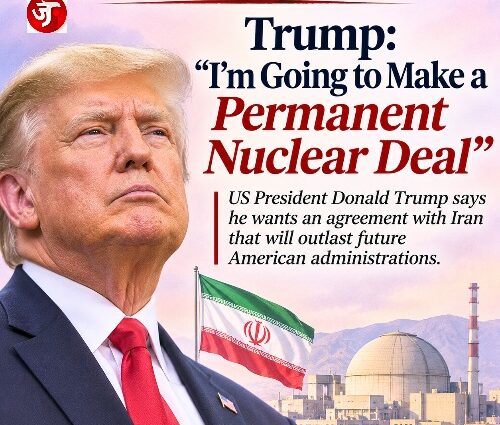
US President Donald Trump says he wants an agreement with Iran that will outlast future American administrations
Sunday, November 22, 2026
US President Donald Trump says he wants an agreement with Iran that will outlast future American administrations. Tehran, however, has consistently maintained that its nuclear programme is intended for peaceful development, insisting that the production and use of nuclear weapons are forbidden under its religious doctrine.
US President Donald Trump has declared his intention to secure a permanent nuclear agreement with Iran, saying he wants an arrangement that will remain binding regardless of who occupies the White House in the years ahead.
Trump made the statement on Saturday, November 21, 2026, during a telephone interview with Fox News, reiterating that he would not allow Iran to acquire nuclear weapons.
Trump said.
“I’m going to make it so that if we have an incompetent president in four years or 15 years or 20 years, I’m going to make a deal that is going to be permanent,”
He added that he would not allow a future American administration to reverse the agreement and permit Tehran to obtain a nuclear weapon.
The remarks reflect Trump’s insistence that any future agreement must go beyond the temporary arrangements and political commitments that have characterised previous attempts to resolve the nuclear dispute.
Iran’s position: Nuclear energy, not nuclear weapons
Iran has consistently rejected accusations that it is seeking to develop nuclear weapons. Tehran maintains that its nuclear programme is intended for peaceful purposes, including scientific research, electricity generation, medical applications and technological development.
Iran’s position is also rooted in a religious declaration issued by its former Supreme Leader, Ayatollah Ali Khamenei, prohibiting the development and use of nuclear weapons.
Under this religious doctrine, the production, stockpiling and use of nuclear weapons are considered forbidden, or haram. Iranian officials have repeatedly invoked this position, arguing that weapons capable of indiscriminately killing innocent civilians have no place in their religious or national defence doctrine.
In a September 29, 2026 statement at the United Nations, Iran reiterated that its nuclear programme was peaceful and conducted under its obligations under the Nuclear Non-Proliferation Treaty and International Atomic Energy Agency safeguards.
Iran’s Atomic Energy Organization has also cited the country’s stated principle: nuclear energy for all, nuclear weapons for no one.
However, Tehran’s declarations have not resolved international concerns about uranium enrichment, verification and the possibility of military applications. The United States and other countries continue to demand assurances that Iran cannot develop a nuclear weapon. Iran, in turn, insists that its right to peaceful nuclear technology must be respected.
The diplomatic contradiction
The fundamental disagreement remains: Washington wants guarantees that Iran will never acquire nuclear weapons, while Tehran wants recognition of its right to pursue peaceful nuclear development without what it considers discriminatory restrictions.
Trump’s demand for a permanent agreement raises another difficult question. Can an American president realistically negotiate an arrangement that binds administrations elected decades into the future?
The diplomatic challenge is not simply to prevent nuclear proliferation. It is to establish an agreement that both sides consider legitimate, verifiable and durable.
For now, Trump has made his position clear. Whether Tehran will accept his terms remains uncertain.
JANPATH NEWS NETWORK (JNN)
Independent. Fearless. On the People’s Path.