


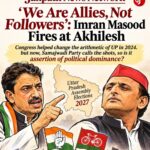




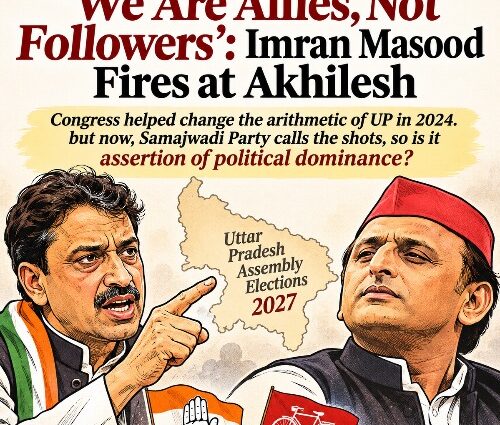
Congress helped change the arithmetic of UP in 2024. but now, Samajwadi Party calls the shots, so is it assertion of political dominance?
Wednesday, November 25, 2026
The numbers tell an uncomfortable story.
In the 2024 Lok Sabha elections, the Samajwadi Party won 37 seats in Uttar Pradesh. Congress won six, taking its tally from just one seat in 2019 to six. More importantly, Congress secured approximately 9.46 per cent of the state’s votes, translating into more than 83 lakh votes. Together, the INDIA bloc won 43 of Uttar Pradesh’s 80 parliamentary seats, against the NDA’s 36.
Congress was not merely an appendage to the SP’s electoral campaign. It brought its own support base, organisational resources, national leadership and a share of the anti-BJP vote. Its recovery contributed to the alliance’s wider electoral performance.
Yet the negotiations for 2027 are presenting a very different picture. Congress initially sought a substantially larger share of the 403 Assembly constituencies. Its negotiating list reportedly contained around 130 seats. The Samajwadi Party, however, has put forward an offer of just 26.
Twenty-six seats. That is the figure around which the present confrontation has crystallised. But the dispute has acquired a sharper edge because Akhilesh Yadav’s party has announced five candidates even while negotiations remain underway. Two of those constituencies, Behat and Saharanpur, were reportedly among Congress’s preferred seats.
For Congress MP and Uttar Pradesh working committee chief Imran Masood, the announcement was particularly provocative. His response was unmistakable: “We are not beggars.”
What else did Imran Masood say?
On SP announcing candidates while negotiations continued:
“SP is free to announce candidates for all 403 seats. What’s the point of holding talks if you are going to release candidates?”
On Akhilesh Yadav’s contradictory conduct:
“Akhilesh Yadav writes something on X and then behaves in the opposite manner.”
NDTV
On Congress’s position in the alliance:
“We can be fellow travellers and allies, but we cannot be SP’s followers. It’s very clear.”
NDTV
On Rahul Gandhi’s contribution:
“Rahul Gandhi gave you more seats in 2024. He showed a big heart. It won’t be possible to defeat the BJP without Rahul Gandhi.”
NDTV
“““““““““““““““““““““““““““““““““““““““““““““““““On whether the SP wants to fight Congress or the BJP:
“I do not understand whether you want to fight me, the Congress or the BJP. It needs to be decided whether we want to fight the BJP or fight among ourselves.”
On Congress’s next move:
“I will fight for my party; I will fight for the existence of my party.”
Another particularly interesting remark
Masood also questioned why the SP had offered Congress 26 seats when it had given the RLD 35 seats in the 2022 Assembly election.
He asked:
“So what message are you sending, you know best yourself.”
There is a larger question here. What exactly does the INDIA alliance mean if its partners cannot agree on the basic principle of mutual respect?
The SP has its argument. It points to its stronger Assembly-level performance in 2022 and insists that seat allocation must be determined by winnability, local equations and electoral arithmetic. That is a legitimate consideration in any coalition negotiation.
But winnability cannot become a convenient instrument for reducing an alliance partner to a subordinate position. Nor can the 2022 results alone settle the question of political strength in 2027. The 2024 Lok Sabha election demonstrated that the political landscape had changed.
Congress, too, has to answer difficult questions. Does it possess the organisation, candidates and grassroots machinery to justify a claim exceeding 100 seats? Its national profile and parliamentary recovery do not automatically translate into Assembly-level strength across Uttar Pradesh.
Akhilesh Yadav may believe that the SP’s electoral dominance in the state gives it the right to lead the negotiations. Congress, meanwhile, may be asking whether its contribution to the alliance is being acknowledged at all.
And what of Rahul Gandhi? Can Congress continue to invest politically in an alliance where its partner appears comfortable making unilateral decisions over constituencies that Congress itself is seeking?
The BJP will hardly complain if the opposition spends its time negotiating with itself rather than preparing for the election.
The real test is not how many seats Congress gets. It is whether the INDIA bloc can function as a partnership rather than a hierarchy.
An alliance cannot demand loyalty from one partner while denying it a meaningful voice. If 2024 was about combining political strengths, 2027 cannot become a contest over who gets to command whom.
The question Congress must now confront is simple: how much longer can it remain in an arrangement where partnership increasingly looks like subordination?
JANPATH NEWS NETWORK (JNN)
Independent. Fearless. On the People’s Path.