



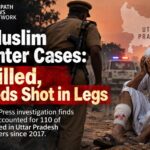

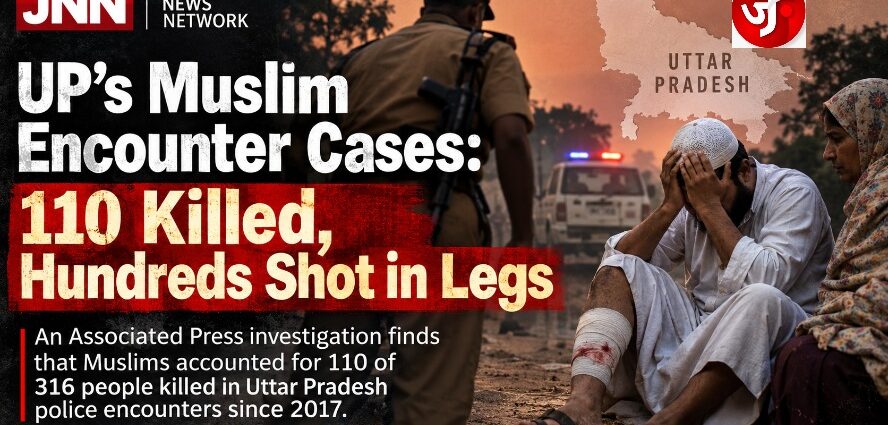
An Associated Press investigation finds that Muslims accounted for 110 of 316 people killed in Uttar Pradesh police encounters since 2017.
Wednesday, November 25, 2026
Uttar Pradesh’s encounter policy, long promoted by Chief Minister Yogi Adityanath’s government as a decisive response to organised crime, is facing renewed scrutiny after an investigation by the Associated Press exposed a striking religious imbalance in police shootings across the state.
An Associated Press investigation finds that Muslims accounted for 110 of 316 people killed in Uttar Pradesh police encounters since 2017. A separate investigation into nearly 650 shootings of alleged cow smugglers found that almost 93% of identified victims were Muslim. The recurring pattern has raised serious questions about police accountability, religious discrimination and the right to a fair trial.
The figures are difficult to dismiss.
Between March 2017, when Adityanath assumed office, and October 13, 2026, police killed 316 suspects in encounter shootings. Of these, 110 were Muslim, representing approximately 35% of those killed, although Muslims constitute around 19% of Uttar Pradesh’s population.
The figures come from state police data obtained by the Associated Press. They do not establish that every shooting was unlawful or religiously motivated. But they raise an important question: why are Muslims disproportionately represented among those killed?
The ‘half-encounter’ phenomenon
The concern extends beyond fatal encounters. An Associated Press investigation published in October examined nearly 650 cases since 2020 in which Uttar Pradesh police shot and injured people accused of cow smuggling. Of the 627 victims whose religious identity could be established, nearly 93% were Muslim.
The shootings have acquired a local name: ‘Operation Langda’, or ‘Operation Lame’. In many cases, suspects are reportedly shot in the legs, often below the knee, before being formally arrested. Police accounts commonly describe a familiar sequence: officers receive a tip-off, stop a vehicle, suspects allegedly open fire or attempt to escape, and police return fire.
The Washington-based Center for the Study of Organized Hate compiled the case records. AP independently reviewed more than 200 incidents. A forensic medicine professor, Dr Mohd Kaleem Khan, questioned whether the repeated pattern of injuries was consistent with police accounts of suspects being shot while fleeing. He said wounds passing horizontally through the calf without striking bone could suggest deliberate shooting at close range.
The AP investigation found that the pattern was widespread, but the underlying database consisted of incidents publicised by police. The actual number may therefore be higher.
The latest figures: 105 Muslim men shot in three months
The South Asia Justice Campaign’s India Persecution Tracker documented at least 105 Muslim men shot and injured in Uttar Pradesh between August 1 and October 31, 2026. Of these, 32 were reported in August, 39 in September and 34 in October.
Sixty-nine were accused of cow slaughter, cattle smuggling or cattle theft. The remaining cases involved allegations ranging from robbery and theft to drug trafficking, arms offences, murder and rape.
The shootings were reported across 31 of Uttar Pradesh’s 75 districts. Muzaffarnagar recorded 15 victims, Meerut 14 and Saharanpur nine. These are tracker figures compiled from published reports, not a complete official religious breakdown of all police shootings.
Several cases illustrate why independent investigation matters.
Mohammed Furqan, Shamli, August 5, 2026: Police said Furqan and an associate opened fire when officers approached them following a tip-off. A head constable was reportedly wounded, and Furqan died after being shot. Police described him as a wanted gangster facing cases including murder, robbery and extortion. His son told reporters that Furqan had been released on bail about six months earlier and was running a dairy business.
Asim Ali alias Vicky, July 7, 2026: The Special Task Force shot Ali in Ambedkar Nagar district. Police described him as a gang member wanted in several cases and said an STF constable was injured in the exchange. A magisterial inquiry was reported to have begun in September.
Zeeshan and Gulfam, Ghaziabad, March 2026: The two Muslim brothers, aged 22 and 35, were shot dead in separate police encounters within 48 hours. Both were suspects in the stabbing of a local YouTuber. Police said they had opened fire at officers. The killings followed a public demand for strict action by the Chief Minister.
The allegations against these men and the police accounts must be examined separately. Being accused of a crime does not remove a person’s right to due process.
The Allahabad High Court intervenes
One of the most significant developments came on August 13, when the Allahabad High Court ordered a Central Bureau of Investigation inquiry into the shooting of Chotkau alias Allauddin, 36, in Shravasti district in May 2025.
Police had shot him in both legs. The court questioned the police account and said, prima facie, that the officer involved had not given a truthful account in the FIR. It also questioned a confession allegedly attributed to Allauddin while he was injured.
The court noted that 23 police officers involved in the operation had received rewards for their work. It raised concerns about how officers repeatedly emerged unharmed while suspects were shot in the legs.
The case is particularly important because it moves the debate beyond allegations by activists and families: a constitutional court itself identified serious questions requiring an independent federal investigation.
What does the law require?
The Supreme Court’s 2014 judgment in People’s Union for Civil Liberties v. State of Maharashtra laid down safeguards for investigating police encounter deaths. These include registration of an FIR, an independent investigation by the CID or another police team, a magisterial inquiry, proper medical examination and preservation of evidence.
The guidelines are intended to ensure that police accounts are not accepted automatically simply because the deceased was accused of a crime. The UP government and police have consistently defended the encounters as necessary responses to armed suspects. Senior police official Amitabh Yash told AP that officers are instructed to fire only in self-defence, denied any order to shoot suspects in the legs and rejected allegations of religious bias. He argued that the high proportion of Muslims in cattle-related cases reflected their presence in the trade. That explanation, too, deserves examination against the evidence.
The question Uttar Pradesh cannot avoid
A government has a responsibility to protect citizens from violent crime. Police officers must also be protected when they face armed attackers. But the rule of law cannot operate on the assumption that an accused person is already guilty. Nor can an encounter report replace an independent investigation.
The central issue is not whether criminals should be pursued. They should. It is whether the police can be allowed to become investigator, accuser and executioner in the same operation. With Uttar Pradesh approaching another Assembly election, the encounter policy is likely to become a major political issue. But beyond the political contest lies a more fundamental question:
Does the right to life and a fair trial apply equally to every citizen, regardless of religion or the accusation against them? That is a question the government, the police and the courts must answer with evidence, not slogan
JANPATH NEWS NETWORK (JNN)
Independent. Fearless. On the People’s Path.