









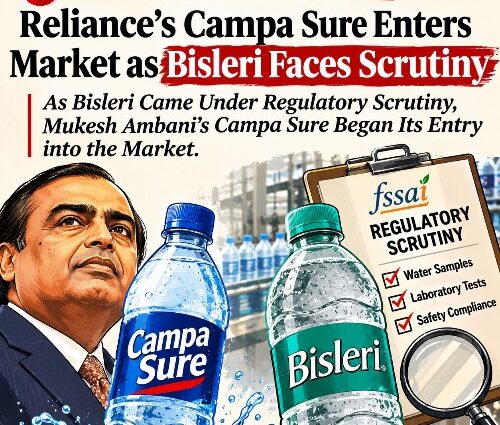
As Bisleri Came Under Regulatory Scrutiny, Mukesh Ambani’s Campa Sure Began Its Entry into the Market.
Wednesday, November 25, 2026
A September 2025 timeline, an aggressive new competitor, six water samples and a regulatory controversy that has resurfaced 14 months later. Is this simply fierce corporate competition, or are there bigger questions about India’s business and regulatory environment?
India’s packaged drinking-water market is witnessing an extraordinary corporate contest. At its centre are two familiar names: Bisleri, the country’s established market leader, and Reliance Consumer Products, the FMCG arm of Mukesh Ambani’s conglomerate.
What makes this story particularly interesting is the sequence of events. In September 2025, the government announced a major GST restructuring. The tax on packaged drinking water was reduced from 18% to 5%, effective September 22, 2025. The change applied across the industry, not just to Reliance or Bisleri.
On September 23, Reliance Consumer Products announced the launch of Campa Sure, its aggressively priced packaged-water brand. The strategy was unmistakable: enter a market dominated by established players with a lower-priced product and Reliance’s formidable distribution network.
According to an October 2 report in The Economic Times, Campa Sure was priced at ₹5 for 250 ml, ₹8 for 500 ml, ₹15 for one litre and ₹25 for two litres. The one-litre bottle was priced below the ₹20 charged by major competitors, including Bisleri. Reliance was also planning partnerships with regional bottlers to expand its reach.
This was a serious competitive challenge to the existing market. Then came September 30: Six samples from Bisleri’s Goa facility. Just seven days after the GST reduction took effect, the Food Safety and Standards Authority of India (FSSAI) collected six water samples from Bisleri’s manufacturing facility in Goa. The date was September 30, 2025.
According to Bisleri’s account, five samples passed the applicable standards. The sixth recorded bromate levels of 12 micrograms per litre against the prescribed limit of 10 micrograms per litre. That was a 20% exceedance.
The company subsequently appealed against the finding on November 22, 2025. The sample was referred to a referral laboratory. This time, the laboratory reportedly found bromate within the prescribed limit but separately detected polynuclear aromatic hydrocarbons (PAHs).
These compounds include substances associated with serious toxicological and cancer risks. Their specific identities and concentrations matter when assessing the health implications. The referral laboratory nevertheless declared the sample unsafe.
This is where the controversy begins.
The laboratory dispute: What exactly was found?
Bisleri subsequently arranged an independent test at an FSSAI-approved laboratory. The company said this test also found bromate levels within the permitted limit.
On February 2, 2026, Bisleri submitted the independent results to FSSAI’s Western Regional Office. The company says it received no further communication and understood the matter to have been closed.
However, there is a crucial omission in the company’s public explanation: its statement does not establish that the independent laboratory also tested for PAHs and found them absent.
A test clearing one chemical does not automatically clear a sample of a different contaminant. This point is central to understanding the controversy.
On November 22, 2026, FSSAI announced that it had sanctioned prosecution against Bisleri International under the Food Safety and Standards Act, 2006.The regulator maintained that the referral laboratory had declared the sample unsafe following the detection of PAHs.
Bisleri, meanwhile, said its products remained safe for consumption, disputed aspects of the findings and stated that it had not received a formal prosecution notice. On November 24, the company clarified that the regulatory action concerned only one batch, GO 270, manufactured at its Goa facility on September 27, 2025.
It said no stock from that batch remained in the market and that the FSSAI had not suspended operations at the Goa plant. FSSAI, for its part, clarified that the referral laboratory’s report is final in an appeal under the applicable legal procedure. It also said the sale prohibition applied to the specific batch and that Bisleri had been asked to conduct a root-cause analysis.
Meanwhile, Goa’s Food and Drugs Administration has ordered wider surveillance of packaged drinking-water brands manufactured and sold in the state. The investigation has therefore expanded beyond one company.
Was the timing coincidental?
Reliance’s entry into the packaged-water market and the sampling at Bisleri’s Goa facility occurred within days of each other. Is there any documentary evidence connecting the two events? So far, none has emerged.
Reuters reported that a government source said the linked batches had been recalled. Bisleri subsequently said no stock from the identified batch remained in the market. The exact recall timeline and quantities need to be established.
Will the same level of scrutiny apply to every major brand?
FSSAI has indicated that it intends to widen testing across the packaged-water industry. This is important. Consumer safety cannot become a selective exercise.
Reliance has the financial resources, retail reach and distribution infrastructure to compete aggressively in India’s consumer-goods market. Its entry into packaged drinking water is part of a wider expansion of its FMCG portfolio.
Bisleri, meanwhile, has spent decades building its brand and distribution network. Competition at lower prices can benefit consumers. But when a regulatory action involving a market leader emerges during the entry of a powerful new competitor, transparency becomes especially important.
There is currently no publicly established evidence that Reliance influenced the FSSAI investigation, initiated the sampling or engineered action against Bisleri. Nor should the regulatory findings be dismissed simply because a powerful competitor has entered the market.
When India’s biggest business houses compete for control of an everyday necessity, the public deserves to know that the rules are being applied equally to everyone.
JANPATH NEWS NETWORK (JNN)
Independent. Fearless. On the People’s Path.