










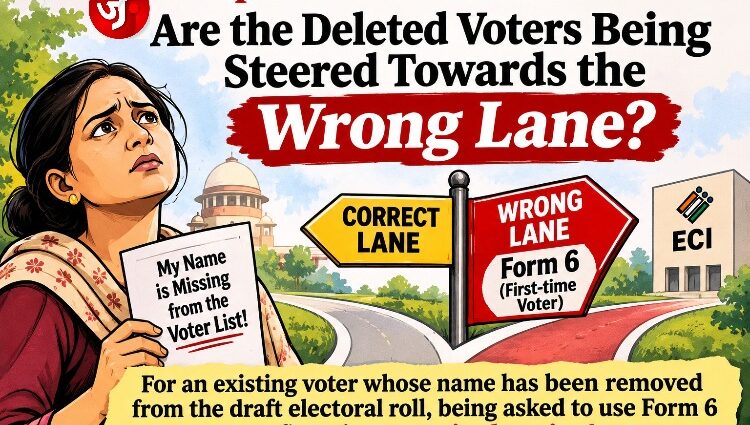
For an existing voter whose name has been removed from the draft electoral roll, being asked to use Form 6 as a first-time voter is alarming!
Tuesday, November 24, 2026
Imagine having voted in previous elections, only to discover that your name has disappeared from the electoral rolls. You approach election officials to get it restored, but are asked to fill out a form meant for someone registering as a first-time voter.
After the Supreme Court questioned the use of Form 6 to reinstate existing voters, the Election Commission issued fresh instructions on November 6 for Delhi, Maharashtra, Telangana, Andhra Pradesh, Haryana, Jharkhand and Nagaland. and Delhi. However, deleted voters may still be directed towards the wrong procedure according to Activist Anjali Bhardwaj who has warned affected voters against filling Form 6 as first-time applicants. She has urged them to demand their enumeration forms and restoration of their original voter ID numbers.
The controversy centres on Form 6, which is ordinarily used by people seeking registration as new voters. For an existing voter whose name has been removed from the draft electoral roll, being asked to use this route as a first-time voter raises an obvious question: why should someone who was already registered have to apply as though they never existed on the electoral list?
The Supreme Court raised precisely this concern on October 28, 2026, during the hearing of a Delhi SIR matter. Justice Joymalya Bagchi described the use of Form 6 in such circumstances as an “error”.
Under the revised arrangement, affected voters marked as Absent, Shifted, Dead or Duplicate (ASDD) can seek restoration by submitting their enumeration forms through their Booth Level Officers (BLOs) or downloading them from the ECI portal. If accepted, their original EPIC numbers are to be restored.
In simple terms, they are being given a route to reclaim their previous registration rather than start afresh. But the problem may not have ended with the new instructions. Reports have also indicated that implementation of the revised procedure has been uneven, with some state authorities continuing to rely on Form 6 while awaiting the necessary enumeration forms.
This creates a potentially serious administrative confusion. The Election Commission may have issued a correction at the top, but if local officials are still directing voters towards the earlier procedure, the people most affected may never benefit from it. The question is not merely which form a voter should fill. It is whether an eligible citizen can recover an existing electoral identity without being pushed into an inappropriate registration process.
But has the correction reached the ground?
Activist Anjali Bhardwaj has now urged affected voters not to fill Form 6 as first-time applicants:
The concern is particularly serious given reports of uneven implementation across the seven states such as Delhi to seven states, voters classified as Absent, Shifted, Dead or Duplicate (ASDD) face uncertainty over the restoration of their names. The ECI announced a fresh mechanism after the Supreme Court questioned its use of Form 6. Yet reports of delayed implementation, missing enumeration forms and continuing confusion raise questions about electoral accountability. Meanwhile, 38 lakh appeals in West Bengal expose the scale of the SIR backlog.
Following the intervention, the Election Commission issued fresh instructions on November 6 covering Delhi, Maharashtra, Telangana, Andhra Pradesh, Haryana, Jharkhand and Nagaland. and Delhi, with some election authorities reportedly continuing to rely on Form 6 while awaiting the new enumeration forms.
The Supreme Court has intervened while the ECI has issued fresh instructions. But the question remains whether local election officials are following them.
A voter whose name has been deleted should not have to declare a false electoral history to reclaim an existing right. The Election Commission must ensure that its corrective orders reach every affected voter.
JANPATH NEWS NETWORK (JNN)
Independent. Fearless. On the People’s Path.