









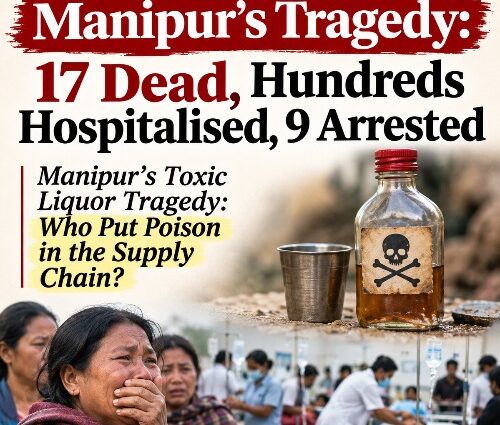
Manipur’s Toxic Liquor Tragedy: 17 Dead, Hundreds Hospitalised, Nine Arrested. Who Put Poison in the Supply Chain?
Tuesday, November 24, 2026
Seventeen people are dead. Hundreds have been treated in hospitals. Nine people have been arrested. Approximately 5,000 litres of suspected illicit liquor have been seized in Manipur.
Yet one of the most disturbing questions surrounding Manipur’s suspected toxic liquor tragedy remains unanswered: Who was responsible for putting a potentially lethal product into circulation, and did they know what it contained?
The tragedy, which began emerging from Chakpikarong subdivision and adjoining areas of Chandel district around November 18, has developed into a major public-health and criminal investigation. Sixteen of the reported deaths are from Chandel district and one from Kakching district.
The initial hospitalisation figures were staggering. Reports on November 21 and 22 put the number of people hospitalised at approximately 600, with one regional report documenting a hospital-wise count reaching 641. At Shija Hospital alone, more than 300 patients were reportedly admitted with suspected poisoning.
The latest Health Department figures, however, present a different picture: 81 patients remained hospitalised as of November 23, including 11 in intensive care. Another 813 patients had been discharged, while 1,236 people had undergone screening. The department cautioned that repeated screenings and multiple hospital discharges could affect these totals.
The reduction in current admissions must not obscure the scale of the original outbreak.
The investigation has reportedly traced suspected supply links to Andro village in Imphal East and Sugnu in Kakching district.
According to preliminary accounts given by the authorities, the liquor consumed in the affected areas was not manufactured in Chandel district. It had reportedly been procured from elsewhere, with investigators examining how it travelled through the supply network.
Police have identified six people arrested in the initial phase of the investigation:
- Khaidem Jadumani Singh (57) – Sugnu.
- Kangabam Surjit Singh (40) – Sugnu.
- Sagolsem Das Singh (40) – Andro.
- Kangabam Ratan Singh – Sugnu.
- Khaidem Naoba Meitei (32) – Owner of Eikhoi Hotel, Sugnu.
- Ningthoujam Joykumar Singh (45) – Andro.
Three further arrests were subsequently reported:
- L. Shanti Priya alias Leima – Andro.
- Thoudam Kouba alias Bhaijpai – Sugnu.
- Yumnam Sharat – Andro Awang Leikai.
These are the names publicly reported in connection with the arrests. Their individual roles and the extent of their involvement remain matters for investigators and the courts to establish.
Was the liquor deliberately poisoned is perhaps the most disturbing question, but the available evidence does not yet establish deliberate poisoning.
Methanol contamination is among the suspected explanations being investigated. Methanol is an industrial chemical that can cause severe poisoning, blindness, organ damage and death when consumed.
Doctors have treated patients with suspected methanol poisoning, with some requiring haemodialysis. However, symptoms and clinical treatment alone cannot establish the precise chemical composition or how contamination occurred. Authorities have sent samples for laboratory examination, including to the National Food Laboratory in Kolkata, the Forensic Science Laboratory and the State Public Health Laboratory in Imphal.
Until the results are available, it would be premature to conclude that methanol was deliberately introduced into the liquor.
There are several possibilities investigators must examine: deliberate adulteration, negligent or unsafe production, accidental contamination, or the circulation of an illicit product whose manufacturers and distributors failed to ensure its safety.
The distinction matters enormously. Deliberate poisoning, reckless adulteration and negligent distribution carry different questions of criminal responsibility.
The seizure of approximately 5,000 litres of suspected illicit liquor raises another uncomfortable question. How long had this supply network been operating? Where was the liquor manufactured? Who transported it? Were there licensed or unlicensed outlets involved? Had authorities received previous complaints?
A crackdown after deaths have occurred is necessary, but it cannot replace an examination of the failures that allowed dangerous liquor to reach consumers in the first place.
The government has constituted a high-level inquiry committee, tasked with examining the origin and chemical composition of the liquor, medical and forensic findings, and possible regulatory or enforcement lapses. The committee has been given one month to submit its report.
In the affected areas, the consequences have extended far beyond hospital wards.
A family that loses its primary breadwinner faces an immediate economic crisis. Families whose members require intensive treatment, dialysis and prolonged medical care face expenses that can become overwhelming.
The Anal Naga Tangpi Association has raised concerns about the availability of specialist doctors, nursing staff, medicines and equipment in the affected areas. Its president, Pashel Monihring, has demanded that the government bear the full cost of treatment, including hospital admission, ICU care, medicines, dialysis and ambulance services.
Nine arrests are not the end of the investigation and it must establish where exactly was the liquor manufactured, its chemical composition, a string of other things besides were there failures in excise enforcement and local policing?
Most importantly, the authorities must establish whether the deaths resulted from deliberate criminal conduct, reckless commercial practices or a failure of regulatory oversight.
Seventeen lives have been lost. Hundreds of families have been affected. The public deserves to know what was in that liquor, who put it into circulation, and whether this tragedy could have been prevented.
The question is no longer simply who sold the liquor. It is who was responsible for the poison, and who allowed it to reach the people.
JANPATH NEWS NETWORK (JNN)
Independent. Fearless. On the People’s Path.