










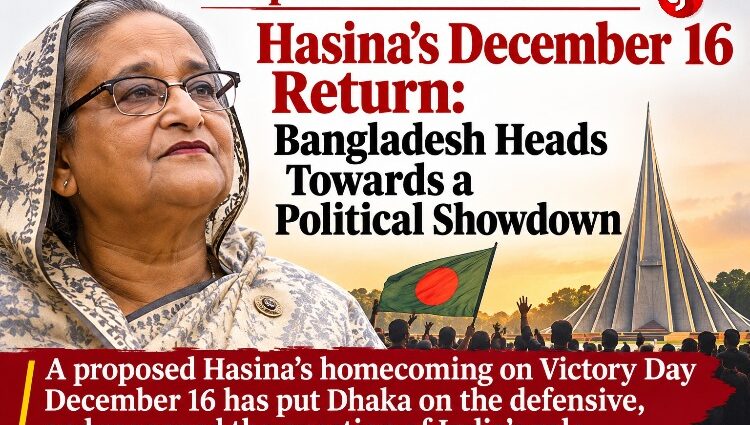
A proposed Hasina’s homecoming on Victory Day December 16 has put Dhaka on the defensive, and reopened the question of India’s role
Wednesday, November 25, 2026
Sheikh Hasina has chosen a date heavy with history and political symbolism for her proposed return to Bangladesh: December 16, the country’s Victory Day, commemorating its liberation from Pakistan in 1971.
But the former prime minister, who has been living in India since fleeing Dhaka in August 2024, is unlikely to receive the homecoming she appears to envisage.
Hasina wants the Bangladesh government to arrange her journey from Delhi aboard Biman Bangladesh Airlines, the country’s national carrier. Her spokesperson, Syed Mozammel Ali, argues that since she was flown to India aboard a Bangladeshi aircraft on August 5, 2024, the government now has a responsibility to facilitate her return.
Dhaka’s response has been uncompromising. The government has rejected the idea of arranging a special flight and insists that Hasina can return only through formal extradition proceedings. State Minister for Foreign Affairs Humaiun Kobir said she would have to return in handcuffs or under strict surveillance.
The message was unmistakable: Hasina is not being treated as a former head of government seeking to come home, but as a convicted person whose return would be governed by the law.
The stakes are extraordinary. In November 2025, Bangladesh’s International Crimes Tribunal sentenced Hasina to death in absentia for crimes against humanity over the deadly crackdown on the student-led uprising that brought down her 15-year government. Hasina has rejected the charges and the verdict.
The United Nations estimated that up to 1,400 people were killed during the violence that preceded her departure.
Hasina’s announcement presents Prime Minister Tarique Rahman’s government with a difficult political problem. Her Awami League remains banned from political activities and was excluded from the February 2026 general election. Yet the party has not disappeared. Its leaders and supporters continue to mobilise, demand the lifting of the ban and campaign for Hasina’s return.
Recent demonstrations have turned violent, particularly in Gopalganj, Hasina’s home district. At least four people have been killed in the wider wave of unrest, according to reports, while police installations and other properties have been attacked.
The government has accused Hasina’s supporters of fomenting instability. The Awami League, meanwhile, portrays the restrictions on its activities and the legal proceedings against its leadership as politically motivated.
Hasina’s proposed return therefore carries implications beyond her personal fate. It could become a test of whether the government can contain the political movement associated with her without provoking another cycle of confrontation.
There is also a question of timing. December 16 is not an ordinary date on the Bangladeshi political calendar. It commemorates the surrender of Pakistani forces in 1971 and the birth of an independent Bangladesh.
By choosing Victory Day, Hasina is attaching her proposed homecoming to one of the most emotionally significant dates in the country’s national history.
Whether she can actually return is another matter. Her passport and identity documents have been cancelled, Dhaka has rejected her request for fresh travel documents, and India has not announced any decision on Bangladesh’s extradition request.
Even as Dhaka and New Delhi face the diplomatic complications of Hasina’s proposed return, an extraordinary statement from West Bengal has added another dimension to the crisis.
West Bengal Transport Minister Arjun Singh has declared that Bangladesh would be taken over by December 16, invoking reports of attacks and killings of Hindus in the neighbouring country.
Speaking to reporters in Bhatpara, Singh said:
“We will take over Bangladesh by December 16. Enough is enough. The way Hindus have been killed in Bangladesh, we will definitely avenge that.”
The statement is particularly provocative because December 16 is also the date Hasina has chosen for her proposed return. The remarks raise serious questions about the political consequences of rhetoric involving territorial takeover and revenge. They should not be mistaken for an announced policy of the Indian government. No official Indian decision to take over Bangladesh has been announced.
Nevertheless, a statement of this nature from a serving minister in an Indian state government risks aggravating an already strained relationship between the two neighbours.
The treatment and safety of religious minorities in Bangladesh are legitimate matters of concern. But threats of territorial intervention are an entirely different proposition, carrying implications for sovereignty, regional stability and diplomatic relations.
India is now central to the unfolding situation. Bangladesh has repeatedly sought Hasina’s extradition under the bilateral treaty. New Delhi has acknowledged the request and said it is being examined through the appropriate legal process.
Dhaka’s position is that Hasina should be returned to face the consequences of the tribunal’s verdict. Hasina, on the other hand, has maintained that the proceedings against her were politically motivated and has expressed a willingness to return despite the risks.
The question is no longer simply whether Hasina wants to come home. It is whether India will facilitate her return, under what legal circumstances, and what consequences that decision could have for bilateral relations.
For New Delhi, the dilemma is considerable. Hasina governed Bangladesh for 15 years and maintained close relations with India. Her departure fundamentally altered the political landscape and left New Delhi dealing with a government whose relationship with India has been considerably more complicated.
A decision on extradition could affect diplomatic ties, security cooperation and India’s wider interests in the neighbourhood.
December 16: A date loaded with consequences
Hasina’s proposed return, the government’s insistence on extradition, the Awami League’s attempts to regain political space and the inflammatory rhetoric emerging from West Bengal are converging around a single date.
There is no confirmation that Hasina will be able to board a Biman Bangladesh aircraft on December 16. Dhaka has made clear that it will not facilitate such an arrangement, and India’s position remains unresolved.
For Hasina, Victory Day offers an opportunity to frame her return as an assertion of political legitimacy and national belonging. For the Tarique Rahman government, allowing her to return without addressing the tribunal’s verdict would carry enormous political and legal consequences.
For India, the situation presents a delicate balancing act between its legal obligations, diplomatic interests and regional security concerns.
And for Bangladesh, the danger is that a dispute over one former prime minister could reopen the deeper divisions that have unsettled the country since August 2024.
December 16 may yet pass without Hasina setting foot in Dhaka. But the confrontation surrounding her proposed return has already begun.
JANPATH NEWS NETWORK (JNN)
Independent. Fearless. On the People’s Path.