









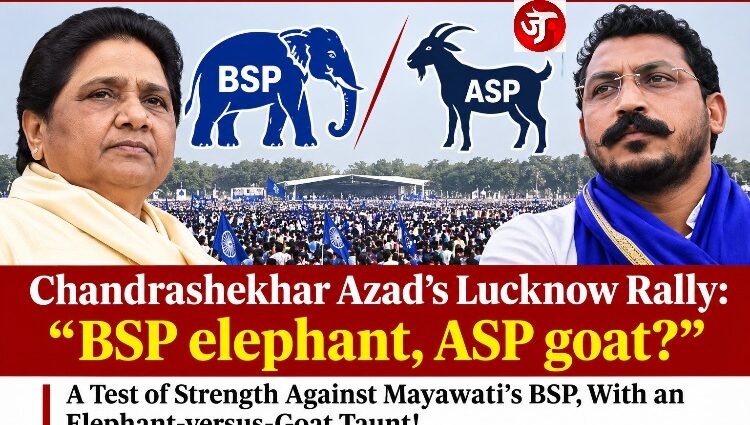
Chandrashekhar Azad’s Lucknow Rally: A Test of Strength Against Mayawati’s BSP, With an Elephant-versus-Goat Taunt!
Thursday, November 26, 20260.
With organisers promising a massive turnout of five lakh supporters, the November 26 gathering at Ramabai Ambedkar Ground puts Azad’s claim to a larger Bahujan political space under public scrutiny.
The political contest for the Bahujan vote in Uttar Pradesh has acquired a new dimension, with Chandrashekhar Azad and Asaduddin Owaisi bringing their newly formed Samajik Parivartan Morcha to Lucknow for a major rally on Constitution Day.
The gathering at Ramabai Ambedkar Ground is being watched not merely as a show of strength by two political parties, but as an attempt to challenge the political space historically dominated by Mayawati and her Bahujan Samaj Party (BSP).
Ahead of the rally, organisers had projected an attendance of more than five lakh people. Some reports put their mobilisation target even higher. The expectations were therefore substantial.
However, social-media commentary surrounding the gathering has questioned whether the turnout would match the scale of those claims. One widely circulated post mocked the contrast between the BSP’s elephant symbol and Chandrashekhar Azad’s political ambitions, comparing the two organisations to an elephant and a goat.
The comparison was intended as a political taunt, but it points towards a larger question: how much of the traditional BSP support base can Azad actually attract?
The ground that carries Mayawati’s political legacy
The choice of venue is significant. Spread across approximately 51 acres, Ramabai Ambedkar Ground was developed during Mayawati’s tenure as Chief Minister and has long been associated with the BSP’s large political gatherings.
Azad’s decision to organise his Constitution Day rally at the same venue places his mobilisation effort against a powerful political backdrop.
Mayawati, meanwhile, is preparing for her own December 6 gathering at the Ambedkar Memorial in Lucknow, marking the death anniversary of Dr B.R. Ambedkar.
The two events, separated by barely ten days, offer an opportunity to observe the competing mobilisation strategies of the BSP and Azad’s party.
The Owaisi factor
The rally also marks an important public test for the Samajik Parivartan Morcha, announced by the Azad Samaj Party (Kanshi Ram) and the AIMIM on November 12. The alliance intends to contest all 403 Assembly seats in Uttar Pradesh in 2027, with Chandrashekhar Azad projected as its chief ministerial face.
Its political calculation rests partly on bringing Dalit and Muslim voters onto a common platform, while appealing to other marginalised communities.
AIMIM chief Asaduddin Owaisi’s presence gives the alliance a wider political dimension, although translating a shared political platform into sustained electoral support remains a separate challenge.
The organisers’ crowd projections have generated considerable attention, but the actual turnout needs to be assessed through independent reporting rather than social-media photographs or partisan claims.
Early reports on Thursday indicated that supporters had begun arriving at the venue ahead of the scheduled speeches. A reliable final attendance estimate was not yet available at the time of writing.
For Azad, the rally is an opportunity to demonstrate organisational reach beyond his Nagina parliamentary constituency. For the BSP, the gathering offers another indication of the political competition emerging around its traditional support base.
The larger question is whether Uttar Pradesh’s Bahujan politics is entering a phase of genuine political realignment, or whether new alliances will struggle to convert public mobilisation into lasting electoral organisation.
The December 6 BSP gathering will provide another important point of comparison.
JANPATH NEWS NETWORK (JNN)
Independent. Fearless. On the People’s Path.
With organisers promising a massive turnout of five lakh supporters, the November 26 gathering at Ramabai Ambedkar Ground puts Azad’s claim to a larger Bahujan political space under public scrutiny.
The political contest for the Bahujan vote in Uttar Pradesh has acquired a new dimension, with Chandrashekhar Azad and Asaduddin Owaisi bringing their newly formed Samajik Parivartan Morcha to Lucknow for a major rally on Constitution Day.
The gathering at Ramabai Ambedkar Ground is being watched not merely as a show of strength by two political parties, but as an attempt to challenge the political space historically dominated by Mayawati and her Bahujan Samaj Party (BSP).
Ahead of the rally, organisers had projected an attendance of more than five lakh people. Some reports put their mobilisation target even higher. The expectations were therefore substantial.
However, social-media commentary surrounding the gathering has questioned whether the turnout would match the scale of those claims. One widely circulated post mocked the contrast between the BSP’s elephant symbol and Chandrashekhar Azad’s political ambitions, comparing the two organisations to an elephant and a goat.
The comparison was intended as a political taunt, but it points towards a larger question: how much of the traditional BSP support base can Azad actually attract?
The ground that carries Mayawati’s political legacy
The choice of venue is significant.
Spread across approximately 51 acres, Ramabai Ambedkar Ground was developed during Mayawati’s tenure as Chief Minister and has long been associated with the BSP’s large political gatherings.
Azad’s decision to organise his Constitution Day rally at the same venue places his mobilisation effort against a powerful political backdrop.
Mayawati, meanwhile, is preparing for her own December 6 gathering at the Ambedkar Memorial in Lucknow, marking the death anniversary of Dr B.R. Ambedkar.
The two events, separated by barely ten days, offer an opportunity to observe the competing mobilisation strategies of the BSP and Azad’s party.
The Owaisi factor
The rally also marks an important public test for the Samajik Parivartan Morcha, announced by the Azad Samaj Party (Kanshi Ram) and the AIMIM on November 12.
The alliance intends to contest all 403 Assembly seats in Uttar Pradesh in 2027, with Chandrashekhar Azad projected as its chief ministerial face.
Its political calculation rests partly on bringing Dalit and Muslim voters onto a common platform, while appealing to other marginalised communities.
AIMIM chief Asaduddin Owaisi’s presence gives the alliance a wider political dimension, although translating a shared political platform into sustained electoral support remains a separate challenge.
The numbers that matter
The organisers’ crowd projections have generated considerable attention, but the actual turnout needs to be assessed through independent reporting rather than social-media photographs or partisan claims.
Early reports on Thursday indicated that supporters had begun arriving at the venue ahead of the scheduled speeches. A reliable final attendance estimate was not yet available at the time of writing.
For Azad, the rally is an opportunity to demonstrate organisational reach beyond his Nagina parliamentary constituency. For the BSP, the gathering offers another indication of the political competition emerging around its traditional support base.
The larger question is whether Uttar Pradesh’s Bahujan politics is entering a phase of genuine political realignment, or whether new alliances will struggle to convert public mobilisation into lasting electoral organisation.
The December 6 BSP gathering will provide another important point of comparison.
Janpath News Network