






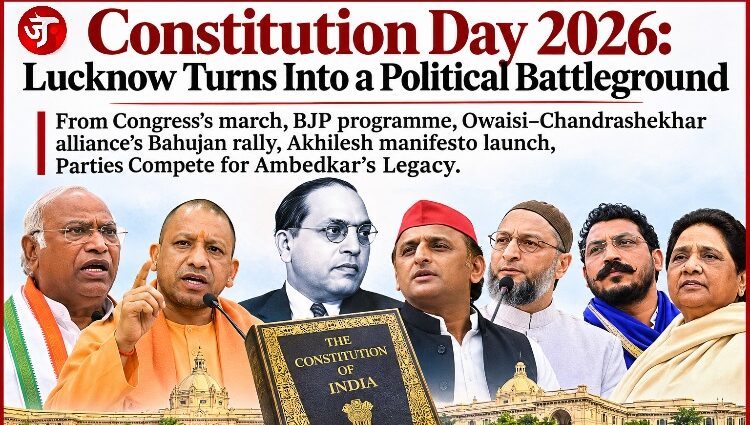
From Congress’s march, BJP, Owaisi–Chandrashekhar alliance’s Bahujan rally, Akhilesh manifesto launch, Parties Compete for Ambedkar’s Legacy
Thursday, November 26, 2026
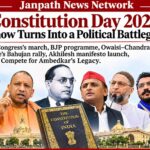
On a day meant to commemorate the adoption of India’s Constitution, Lucknow has become the stage for an unusually concentrated display of political activity. Congress, BJP, Samajwadi Party and the newly formed alliance between Asaduddin Owaisi’s AIMIM and Chandrashekhar Azad’s Azad Samaj Party have all chosen November 26 to advance their respective political narratives.
The common reference is Dr B.R. Ambedkar and the Constitution. The political messages, however, are markedly different.
With Uttar Pradesh heading towards Assembly elections in 2027, the competing programmes reveal how central constitutional rights, social justice, representation and the political legacy of Ambedkar have become to the state’s electoral conversation.
The day’s events are also significant because they bring together parties attempting to consolidate different social constituencies, particularly Dalits, OBCs, Muslims and other marginalised communities.
Congress President Mallikarjun Kharge’s visit to Lucknow was the centrepiece of the party’s Samvidhan Raksha programme. The party had planned a march from Gandhi Bhavan to the statue of Dr Ambedkar at Hazratganj, following a Samvidhan Raksha Sammelan at its state headquarters.
However, the proposed march encountered an administrative hurdle. Police denied permission, citing the sensitive nature of the area. Congress leaders said they had agreed to the conditions imposed by the administration and accused the authorities of applying different standards to different political parties.
Uttar Pradesh Congress president Aradhana Misra-Mona questioned why other political programmes had been permitted while the Congress march was being restricted.
Senior leader P.L. Punia also criticised the decision, pointing to the BJP’s earlier Loktantra Bachao programme in Lucknow.
Congress maintained that its programme would proceed despite the denial of permission. Kharge was scheduled to pay homage at the Ambedkar Mahasabha before addressing party workers. The march was intended to culminate at Ambedkar Crossing in Hazratganj.
The party’s argument centres on voting rights. It has linked its Constitution campaign to allegations of electoral-roll manipulation, particularly the Special Intensive Revision (SIR), and its demand for accountability from Chief Election Commissioner Gyanesh Kumar.
Congress has also announced a nationwide Vote Rakshak campaign, under which party workers will identify voters whose names have allegedly been deleted from electoral rolls and assist them in seeking restoration.
For Congress, therefore, Constitution Day is being used to frame the 2027 political contest around the right to vote, institutional accountability and the protection of democratic rights.
The BJP has chosen a different approach, marking the occasion as Samvidhan Gaurav Diwas.
In Lucknow, Chief Minister Yogi Adityanath participated in a Constitution Day programme at Lok Bhavan, where he read the Preamble alongside members of his Council of Ministers and reaffirmed the constitutional commitment to democratic values. He also launched development and beautification works under the Dr B.R. Ambedkar Murti Vikas Yojana.
The BJP’s wider programme in the state capital includes a public dialogue at Bhagidari Bhawan, scheduled for 3 pm, with Union Minister Jyotiraditya Scindia as chief guest and Minister Asim Arun also expected to attend. Around 500 professionals, including doctors, chartered accountants, teachers and businesspersons, have been invited.
The programme includes an exhibition on the Constitution and Ambedkar, cultural presentations and the distribution of literature. The party has also planned seminars at educational institutions across parliamentary constituencies between November 26 and 29.
The BJP’s approach seeks to present Constitution Day as an occasion for institutional commemoration, public engagement and recognition of Ambedkar’s contribution.
The contrast with Congress is evident. While the Opposition is foregrounding questions of electoral rights and institutional accountability, the BJP is emphasising constitutional commemoration and its own outreach programmes.
Owaisi and Chandrashekhar Azad: A new Dalit-Muslim political experiment
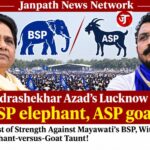
Perhaps the most closely watched political gathering of the day is the Bahujan Swaraj Sankalp Maharally at Ramabai Ambedkar Ground. AIMIM president Asaduddin Owaisi and Azad Samaj Party (Kanshi Ram) chief Chandrashekhar Azad have shared the platform under the banner of the Samajik Parivartan Morcha.
The alliance was announced on November 12 and is positioning itself as a political alternative built around Dalit and Muslim representation. The two parties have announced their intention to contest all 403 Assembly constituencies in Uttar Pradesh in 2027, with Chandrashekhar Azad projected as the chief ministerial face.
Before the rally, organisers claimed that at least five lakh people would attend. The gathering at Ramabai Ambedkar Ground is intended to demonstrate the alliance’s organisational reach and its ability to mobilise supporters beyond the individual constituencies associated with its leaders. Videos from the venue show supporters arriving, followed by the reception of Owaisi and Azad on the stage.
The political significance of the alliance extends beyond the rally itself. It challenges the established political calculations of both the Samajwadi Party and the BSP, while potentially creating another centre of Dalit-Muslim political mobilisation.
For Azad, the challenge is to demonstrate that his political influence can extend beyond his parliamentary constituency. For Owaisi, the alliance offers an opportunity to expand AIMIM’s presence in Uttar Pradesh.
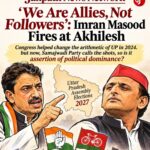
The Samajwadi Party has chosen November 26 to unveil the first instalment of its political promises for the 2027 Assembly elections. Party president Akhilesh Yadav is scheduled to release the document in Lucknow under the titles Jan-Man Ghoshna Patra and Sattais Ka Sankalp: PDA Ka Pran Patra.
The PDA formulation, referring to Pichhda, Dalit and Alpsankhyak communities, has been central to the SP’s political messaging. The manifesto is expected to address employment, education, farmers’ welfare, women’s welfare and other development issues. Proposals relating to free electricity and the restoration of the old pension scheme have also figured in advance reporting.
The expected presence of senior leader Azam Khan adds another dimension to the programme, particularly given the party’s efforts to consolidate Muslim support.
For Akhilesh Yadav, the manifesto launch is an attempt to give the PDA slogan a more concrete policy framework. The timing is significant. On the same day that Owaisi and Chandrashekhar Azad are attempting to create an alternative Dalit-Muslim platform, the SP is seeking to reinforce its own claim to represent backward, Dalit and minority communities.
And Mayawati’s BSP?
One conspicuous absence from the day’s major Lucknow programmes is a separately confirmed, large-scale public rally led by Mayawati. That does not mean the BSP has surrendered its claim to Ambedkar’s political legacy. The party remains an established force in Uttar Pradesh’s Dalit politics, and Mayawati’s December 6 Ambedkar commemoration is an important upcoming event.
The BSP’s elephant symbol and its political history remain central to the competition over the Bahujan constituency. The emergence of Chandrashekhar Azad as a new claimant to that political space has made the comparison particularly visible. The social-media taunt contrasting the BSP’s elephant with the ASP’s goat has become part of the commentary surrounding the Lucknow rally.
But the more important question is whether the newer political formation can build a durable support base and challenge the BSP’s established organisation.
Mayawati’s response, political strategy and December 6 mobilisation will therefore be worth watching.
One Constitution, several political interpretations
The Constitution was adopted by the Constituent Assembly on November 26, 1949, and came into effect on January 26, 1950. Constitution Day, observed annually on November 26, commemorates that adoption.
This year’s political activity in Lucknow illustrates how the document has become a central reference point in Uttar Pradesh’s approaching electoral contest.
While Congress is raising the alarm over voting rights and institutional accountability, the BJP is showcasing its constitutional credentials and Ambedkar outreach. The Samajwadi Party is pushing its PDA coalition, while Owaisi and Chandrashekhar Azad are attempting to build a Dalit-Muslim political alternative. For Mayawati’s BSP, the challenge is to defend its traditional Bahujan base against these emerging claimants.
The competing programmes raise a question that goes beyond the symbolism of Constitution Day: how will these parties translate their competing claims about equality, representation and social justice into political organisation, policy and electoral commitments?
The Constitution belongs to the people, not to any one political party. Yet in Uttar Pradesh, each party appears determined to demonstrate that it is the more credible custodian of its promises.
JANPATH NEWS NETWORK (JNN)
Independent. Fearless. On the People’s Path.