









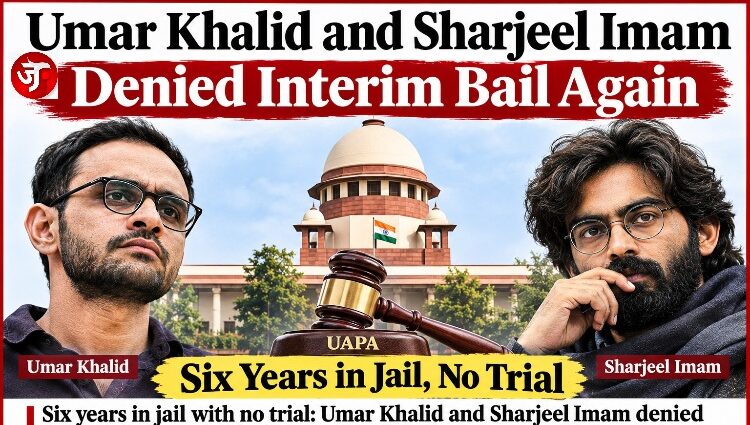
Six years in jail with no trial: Umar khalid and Sharjeel Imam denied interim bail again, the case raises difficult questions again.
Thursday, November 26, 2026
The Supreme Court has deferred interim relief for the two accused in the 2020 Delhi riots conspiracy case. With more than 900 prosecution witnesses yet to be examined, the case raises difficult questions about personal liberty, the UAPA and the constitutional promise of a speedy trial.
Six years and nine months after the violence that shook northeast Delhi in February 2020, Umar Khalid and Sharjeel Imam remain behind bars, yet not been convicted. Their trial has yet to reach the stage of examining prosecution witnesses. And their latest attempt to secure bail has once again failed to bring immediate relief.
On November 25, the Supreme Court declined to grant interim bail to the two activists, while issuing notice to Delhi Police on their fresh petitions. The three-judge bench comprising Chief Justice of India Surya Kant and Justices Joymalya Bagchi and V. Mohana directed that the matter be placed before the Chief Justice for the constitution of another three-judge bench, in light of conflicting judicial interpretations of the law governing prolonged incarceration under the Unlawful Activities (Prevention) Act (UAPA).
The next hearing is scheduled for December 14. The proceedings have acquired particular significance because Chief Justice Surya Kant referred to his own 2021 judgment in Union of India v. K.A. Najeeb, which recognised that prolonged detention and an unduly delayed trial could justify bail even under stringent provisions of the UAPA.
The Chief Justice reportedly acknowledged the conflicting interpretations of that judgment, observing that he felt somewhat embarrassed because different benches had interpreted his ruling differently.
It is an unusual judicial moment. The constitutional principle that prolonged incarceration cannot be allowed to defeat the right to liberty is now at the centre of a case in which two accused have spent more than six years in prison without their guilt being established at trial.
What exactly are they accused of?
Khalid and Imam are accused in FIR 59/2020, registered by the Delhi Police Crime Branch in connection with the alleged larger conspiracy behind the February 2020 northeast Delhi riots.
The violence erupted amid protests against the Citizenship Amendment Act (CAA) and the proposed National Register of Citizens (NRC). Fifty-three people were killed and hundreds injured.
The police allege that the violence was not spontaneous but the culmination of a carefully organised conspiracy involving protest mobilisation, meetings, road blockades and coordinated disruption of essential services. The prosecution has attributed a central role to both men.
Umar Khalid is accused of participating in the planning and strategic direction of the alleged conspiracy. Investigators have relied on witness statements, WhatsApp communications, meetings and his speeches, including one delivered in Amravati, Maharashtra.
Sharjeel Imam is accused of mobilising people, organising protests and advocating chakka jams to disrupt road connectivity. Police allege that he helped coordinate the protest network and prepare the ground for the subsequent violence.
The charges include criminal conspiracy and several offences under the Indian Penal Code, alongside Sections 13, 16, 17 and 18 of the UAPA, relating to unlawful activities, terrorist acts, raising funds for terrorist acts and conspiracy.
These are serious allegations. But they remain allegations. Neither man has been convicted in this case.
What do Khalid and Imam say?
Their defence is that the prosecution has conflated political dissent and protest mobilisation with a criminal conspiracy to engineer communal violence.
Khalid has argued that he was not even in Delhi when the February 2020 violence occurred. His lawyers have maintained that the principal public evidence against him includes a speech delivered in Amravati, Maharashtra, which they say contained no incitement to violence or communal hatred.
During earlier Supreme Court proceedings, senior advocate Kapil Sibal argued that Khalid was being prosecuted for his speeches and political activities rather than any demonstrated participation in the actual violence.
The defence has also questioned the interpretation of WhatsApp conversations and witness statements relied upon by the prosecution. Imam, too, has disputed the allegation that his speeches incited violence.
In submissions before a Delhi court in January 2026, his lawyers argued that speeches delivered by him in Bihar and West Bengal had not resulted in public disorder. They also disputed the alleged connection between him and Khalid.
Imam’s defence has maintained that advocating a chakka jam as a form of political protest cannot automatically be equated with a terrorist act.
The prosecution, however, argues that the speeches and protest mobilisation formed part of a larger, coordinated plan to disrupt public life and trigger violence.
The Supreme Court, in its January 5, 2026 judgment, accepted the prosecution material as sufficient to establish a prima facie case against Khalid and Imam at the bail stage, describing their alleged roles as central to the conspiracy. This was not a finding of guilt after trial.
The contradiction at the heart of the case
The legal controversy goes beyond the individual bail applications.
In Union of India v. K.A. Najeeb (2021), a three-judge Supreme Court bench recognised that constitutional courts could grant bail despite the stringent restrictions imposed by Section 43D(5) of the UAPA when prolonged incarceration and the absence of a realistic prospect of an early trial threatened the fundamental right to life and personal liberty under Article 21.
The principle was significant: the statutory restrictions on bail cannot be allowed to extinguish constitutional guarantees. Yet, on January 5, 2026, a different Supreme Court bench denied bail to Khalid and Imam, holding that the prosecution material disclosed a prima facie case of their central involvement in the alleged conspiracy.
The court distinguished their alleged roles from those of five co-accused who were granted bail. On May 18, 2026, another Supreme Court bench, comprising Justices B.V. Nagarathna and Ujjal Bhuyan, expressed serious reservations about the January ruling while granting bail to another UAPA accused. It emphasised that the constitutional protection recognised in K.A. Najeeb could not be reduced to an exceptional or narrowly applicable principle.
The matter was subsequently referred to a larger bench.
It is this unresolved legal tension that has now returned to the Supreme Court, with Chief Justice Surya Kant acknowledging the difficulty of reconciling the different interpretations of the judgment he authored.
More than 900 witnesses, and still waiting
Perhaps the most troubling dimension of the case is the pace of the proceedings. According to the latest submissions reported in court, the prosecution has cited more than 900 witnesses, including 47 protected witnesses. The charge sheet was filed in September 2020. Yet, after more than six years of incarceration, the examination of prosecution witnesses has not begun.
The defence argues that the scale of the prosecution’s evidence makes an early conclusion of the trial highly unlikely. The Supreme Court’s January 2026 order had allowed Khalid and Imam to seek bail again after the examination of protected witnesses or after one year, whichever came earlier. Their subsequent attempts to obtain relief have encountered further procedural and legal obstacles.
A person awaiting trial is not a convicted prisoner. When detention continues for years without the prosecution having tested its evidence before a trial court, the constitutional question becomes increasingly difficult to avoid.
Justice must protect society from violence. It must also protect the individual from indefinite punishment before guilt has been established.
JANPATH NEWS NETWORK (JNN)
Independent. Fearless. On the People’s Path.